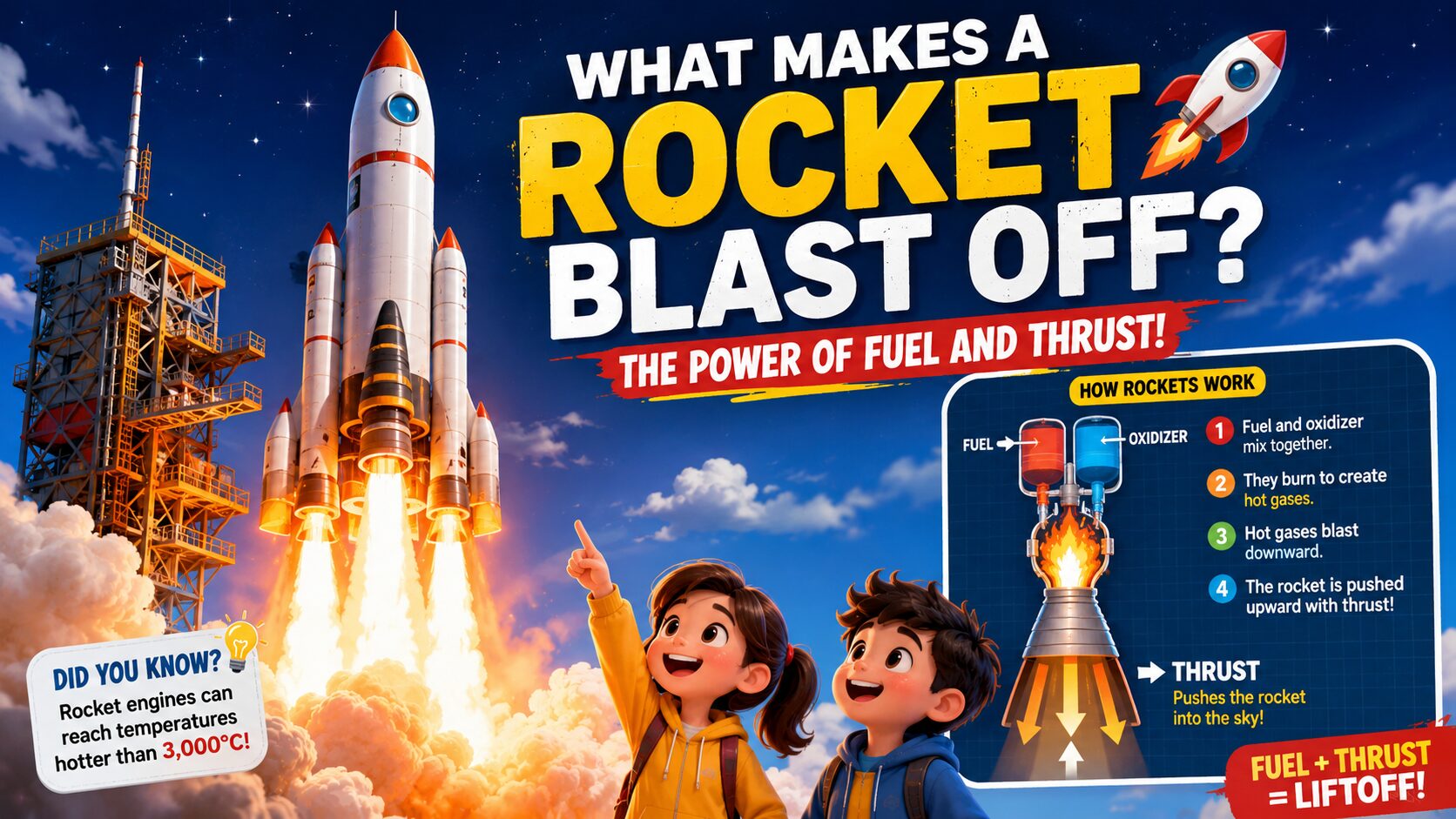
The Amazing Power of Fuel and Thrust!
Discover how rockets blast off! Learn how fuel, thrust, gravity, and rocket engines work in this fun, easy-to-understand science article for kids.
🌟 Have You Ever Wondered?
3… 2… 1… Liftoff! 🚀
The countdown reaches zero. A giant rocket begins to rumble. Bright orange flames burst from its engines, thick clouds of smoke fill the launch pad, and the ground shakes beneath it.
Then, something incredible happens…
A machine weighing millions of pounds slowly rises into the sky and speeds toward space!
But wait…
How can something so heavy actually fly?
After all, rocks fall to the ground. Cars stay on roads. Buildings don’t float into the air.
So what makes a rocket different?
The answer lies in two amazing science ideas: fuel and thrust. Together, they create enough power to overcome Earth’s gravity and send astronauts, satellites, and even robots to other worlds.
Let’s blast off and discover how!
🚀 Key Highlights
- 🚀 Rockets need enormous amounts of energy to lift off.
- 🔥 Rocket fuel burns to create hot, expanding gases.
- 💨 The engines push these gases downward at high speed.
- ⬆️ This creates thrust, the force that pushes the rocket upward.
- 🌍 Rockets must overcome Earth’s gravity before reaching space.
- 🌌 Rockets even work in the airless vacuum of space!
🚀 Meet the Rocket
A rocket is much more than a giant metal tube.
It’s a carefully designed space vehicle built to carry astronauts, satellites, telescopes, scientific instruments, or supplies beyond Earth’s atmosphere.
Most rockets have four important parts:
🛰️ Payload – The astronauts or cargo.
⛽ Fuel Tanks – Store the fuel needed for launch.
🔥 Rocket Engines – Burn fuel to produce powerful thrust.
🧭 Guidance System – Computers and sensors that keep the rocket on the correct path.
Every part is important, but the engines are the real superheroes during launch!
🌍 Gravity: Earth’s Invisible Pull
Before a rocket can reach space, it has to fight against one powerful force…
Gravity.
Gravity is the invisible force that pulls everything toward Earth.
It’s why:
🍎 Apples fall from trees.
⚽ A soccer ball lands back on the ground.
🏃 You don’t float away while walking.
The larger an object is, the harder gravity pulls on it.
Since rockets are extremely heavy, gravity pulls on them with tremendous force.
To lift off, a rocket must produce an even stronger upward force.
That force is called…
💥 Thrust!
💨 What Is Thrust?
Imagine you’re sitting on a skateboard.
Now imagine a friend gives you a gentle push.
You begin rolling forward.
The push that makes you move is called a force.
A rocket creates its own pushing force.
Instead of someone pushing it, the rocket pushes hot gases downward.
As those gases blast out of the engine at incredible speed, the rocket is pushed in the opposite direction—upward!
That upward force is called thrust.
Without thrust, a rocket would never leave the launch pad.
🔥 Where Does Thrust Come From?
Rocket engines produce thrust by burning special fuels.
Rocket fuel is far more powerful than the gasoline used in cars.
Inside the engine, something amazing happens:
- Fuel mixes with an oxidizer (a chemical that provides oxygen for burning).
- The mixture ignites.
- Temperatures rise to thousands of degrees.
- Huge amounts of hot gas are created.
- These gases expand rapidly.
- They shoot out through the engine nozzle at incredible speed.
The faster the gases leave the rocket…
🚀 …the greater the thrust!
It’s like squeezing toothpaste out of a tube—but instead of toothpaste, the rocket shoots out superheated gases moving faster than the speed of sound.
🎈 Try This at Home!
Here’s a fun way to see thrust in action.
Blow up a balloon.
Don’t tie it.
Now let it go!
🎈 Whoosh!
The escaping air rushes backward.
The balloon zooms forward.
The balloon isn’t being pulled.
It’s being pushed because the escaping air moves in the opposite direction.
A rocket works using exactly the same idea—just with much hotter gases and much, much more power.
⚖️ Newton’s Third Law
More than 300 years ago, the famous scientist Sir Isaac Newton discovered an important rule about motion.
It says:
For every action, there is an equal and opposite reaction.
Here’s how it works for rockets:
➡️ The rocket pushes hot gases downward.
⬅️ The gases push the rocket upward.
Both happen at exactly the same time.
This is called Newton’s Third Law of Motion, and it’s the secret behind every rocket launch—from tiny model rockets to giant spacecraft headed for the Moon.
🌌 Can Rockets Work in Space?
Many people think rockets need air to push against.
Surprisingly…
They don’t!
Unlike airplane engines, rockets carry everything they need.
They carry:
⛽ Fuel
💨 An oxidizer (which supplies oxygen for burning)
Because rockets carry both, they can keep producing thrust even where there is no air at all.
That’s why spacecraft can travel:
🌙 To the Moon
🔴 To Mars
🛰️ Around Earth
☀️ Far beyond our Solar System
🚀 Why Are Rocket Flames So Bright?
When rocket fuel burns, it releases an enormous amount of energy.
The engines become incredibly hot.
Rocket exhaust can reach temperatures of over 3,000°C (5,400°F)!
The glowing flames and roaring sound you see during launch are signs of the huge amount of energy being released in just a few minutes.
🌟 Do You Know?
🚀 The powerful engines on modern rockets produce millions of pounds of thrust during liftoff.
🌍 A rocket reaches space in only a few minutes, even though space begins about 100 kilometers (62 miles) above Earth.
🔥 Some rocket engines burn hundreds of gallons of fuel every second during launch!
🛰️ Without rockets, we wouldn’t have weather satellites, GPS navigation, satellite TV, or many space missions that help scientists learn about our universe.
🤯 Fun Science Facts
✨ The first rockets were invented in ancient China over 800 years ago.
✨ The Saturn V rocket that carried astronauts to the Moon stood about 111 meters (363 feet) tall—roughly the height of a 36-story building.
✨ Rockets are so loud that the sound waves can shake buildings several kilometers away.
✨ Some reusable rockets can land safely back on Earth after launching into space!
📚 Science Words Explained
🚀 Rocket
A vehicle that uses engines and fuel to travel into space.
⛽ Fuel
A substance that stores energy and burns to produce power.
💥 Thrust
The pushing force that moves a rocket upward.
🌍 Gravity
The invisible force that pulls objects toward Earth.
🔥 Engine
A machine that converts fuel into powerful motion.
🌌 Space
The vast area beyond Earth’s atmosphere where planets, stars, and galaxies are found.
🎯 Imagine It Like This
Picture yourself standing on a skateboard while holding a pile of heavy balls.
If you throw the balls backward one after another, you’ll roll forward.
Why?
Because pushing something backward pushes you forward.
A rocket does the same thing—but instead of throwing balls, it throws out billions of tiny, superheated gas particles every second. That powerful backward blast creates the forward force needed to climb into space.
🌟 Encouragement to Explore
Every rocket launch is a perfect example of science in action. Engineers, scientists, and astronauts use the principles of fuel, thrust, gravity, and motion to explore places humans have never been before.
The next time you watch a rocket soar into the sky, remember—you now know the amazing science that makes it happen.
Who knows? One day, you might design the rocket that carries astronauts to Mars or beyond! 🚀🌍
🎯 Big Takeaway
Rockets blast off because burning fuel creates hot gases that rush out of powerful engines. As the gases are pushed downward, an equal force called thrust pushes the rocket upward. When thrust becomes stronger than Earth’s gravity, the rocket lifts off and begins its incredible journey into space.

The Kids Science Magazine Editorial Team brings together nearly a decade of hands-on experience in electronics engineering, IoT systems, and embedded technology — combined with a deep passion for making complex science genuinely exciting for young minds. Our writers have worked across core electronics testing and real-world technology development, giving every science mystery article a foundation in actual engineering thinking rather than surface-level storytelling. We believe every child deserves access to mind-blowing science — explained clearly, honestly, and in a way that makes them lean forward and ask “but wait, WHY?” Every mystery published on this site is thoroughly researched, fact-checked against credible scientific sources, and written to spark curiosity in kids aged 8–14 across the USA, UK, Canada, Australia & Others across the Globe. New mystery every Friday — because science never runs out of surprises.