
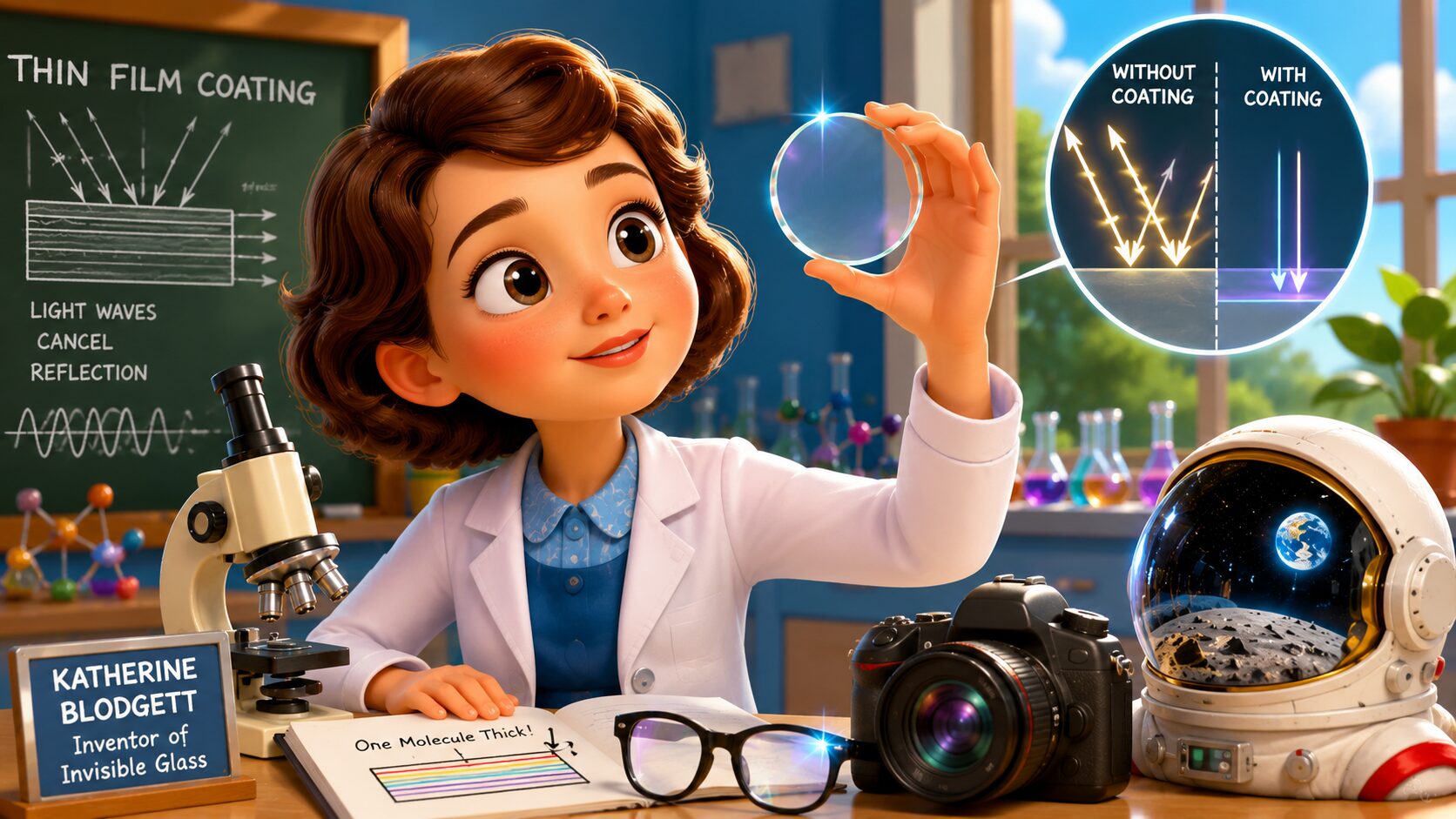
Discover how Katharine Blodgett invented invisible glass using ultra-thin coatings. Learn how her discovery improved cameras, eyeglasses, microscopes, telescopes, and even astronauts’ helmets in this inspiring science story for kids.
Introduction: The Girl Who Wanted to Make Glass Disappear!
Imagine looking through a window so clear that it almost seems to disappear.
No annoying reflections.
No bright glare.
Just a perfectly clear view.
Sounds like magic, doesn’t it?
Over 90 years ago, one brilliant scientist asked a question that nobody else had thought to ask:
“What if glass didn’t reflect light at all?”
Most people thought it was impossible.
But Katharine Burr Blodgett wasn’t interested in “impossible.”
She loved solving puzzles, experimenting with tiny invisible layers, and discovering new ways to improve everyday life.
Her amazing invention eventually helped create clearer camera lenses, microscopes, telescopes, eyeglasses, movie projectors, smartphone cameras, and even the visors worn by astronauts.
Today, millions of people use her discovery every single day—often without realizing it.
🌱 A Curious Child Who Loved Asking “Why?”
Katharine was born in 1898 in New York, USA.
From an early age she enjoyed looking closely at nature.
She wondered:
- Why do rainbows appear?
- Why does light bounce off mirrors?
- Why do windows sometimes shine like mirrors?
- Why can’t we always see clearly through glass?
Unlike many children, she didn’t stop asking questions.
She wanted answers.
Her family encouraged her curiosity, and she became fascinated with mathematics and science.
Teachers quickly noticed that she solved difficult problems faster than most students.
🎓 Breaking Barriers for Women in Science
At the beginning of the 1900s, very few women became scientists.
Many universities accepted only a small number of female students.
Many laboratories hired only men.
Katharine refused to give up.
She studied physics and chemistry with determination and eventually became one of the first female scientists hired by General Electric, one of the world’s largest technology companies.
She also became the first woman scientist to earn a Ph.D. in physics from the famous University of Cambridge> (through its associated research work and historical context), a remarkable achievement for her time.
🔬 The Mystery of Shiny Glass
Glass looks smooth.
But every piece of glass has one annoying problem.
Whenever light hits it…
Some light goes through.
Some light bounces back.
That bouncing light creates reflections.
Imagine trying to take a photograph through a window.
Instead of seeing only the view…
You also see yourself!
This same problem affected:
📷 Cameras
🔭 Telescopes
🔬 Microscopes
🚗 Windshields
👓 Eyeglasses
Scientists had accepted this problem for centuries.
Katharine wondered…
“Can we stop light from bouncing away?”
🧪 A Discovery Only Molecules Thick
Katharine began experimenting with extremely thin coatings.
Not paper-thin.
Not hair-thin.
Much thinner.
Each layer was only one molecule thick.
That’s millions of times thinner than a sheet of paper.
Using careful chemistry, she stacked these invisible layers one by one onto glass.
Then something incredible happened.
The reflections almost disappeared.
The glass suddenly became amazingly clear.
Scientists called it non-reflective (anti-reflective) glass.
It looked almost…
Invisible.
🌈 How Can Glass Become “Invisible”?
Imagine throwing two pebbles into a calm pond.
The ripples spread out.
Sometimes they crash together and disappear.
Light waves can behave in a similar way.
Katharine’s special coating caused reflected light waves to cancel each other out.
Instead of bouncing into your eyes…
Most of the light passed straight through the glass.
The result?
Brighter.
Sharper.
Clearer images.
🚀 From Tiny Experiment to Space Exploration
Katharine probably never imagined how many inventions would use her discovery.
Today, anti-reflective coatings help improve:
📱 Smartphone cameras
📷 Professional cameras
🔭 Giant telescopes
🔬 Scientific microscopes
👓 Eyeglasses
🚘 Car displays
🛰️ Satellites
🚀 Astronaut helmet visors
🌌 Space telescopes
Even many solar panels use special coatings inspired by the same scientific principles to capture more sunlight.
🌍 Why Her Discovery Changed the World
Before Katharine’s invention:
❌ Pictures contained more glare.
❌ Scientists saw dimmer microscope images.
❌ Telescope observations lost valuable light.
❌ Glass reflections caused problems.
After her invention:
✅ Sharper photographs
✅ Better scientific discoveries
✅ Safer protective goggles
✅ Clearer eyeglasses
✅ Improved space exploration
Sometimes the greatest inventions are the ones people hardly notice.
🤯 Amazing Facts Most Kids Don’t Know
⭐ She earned 8 patents during her career.
⭐ She became the first woman scientist hired by General Electric’s research laboratory.
⭐ Her coatings were only one molecule thick.
⭐ Her invention was nicknamed Invisible Glass because reflections almost disappeared.
⭐ Millions of camera lenses today use technology based on her discovery.
⭐ Astronauts benefit from anti-reflective coatings.
⭐ She loved solving puzzles involving light.
⭐ She inspired many women to study physics.
⭐ Her discovery helped both science and photography.
⭐ Her work is still used nearly a century later.
🔍 Science Around You
Look around your home.
Can you find something with glass?
Maybe:
📱 Phone screen
👓 Glasses
🪟 Window
📷 Camera
Ask yourself:
Why doesn’t every piece of glass reflect light the same way?
Congratulations!
You’re already thinking like Katharine Blodgett.
🎮 Think Like a Scientist
Imagine you could invent a special type of glass.
Would it:
🌈 Change colors?
🌞 Make houses cooler?
🚀 Protect astronauts?
🦖 Create a dinosaur museum window?
Every great invention begins with imagination.
🌟 What Kids Can Learn from Katharine
Katharine teaches us that…
🔬 Small discoveries can change the world.
👩 Girls can become brilliant scientists.
💡 Asking unusual questions leads to amazing inventions.
✨ Sometimes the best inventions are almost invisible.
🌈 Conclusion: The Woman Who Helped Us See More Clearly
Katharine Blodgett didn’t invent rockets or giant machines.
Instead, she improved something people use every day.
Her invisible coating made it easier for scientists to explore tiny cells, photographers to capture beautiful pictures, astronomers to study distant galaxies, and astronauts to see the universe more clearly.
So the next time you look through a camera, telescope, microscope, or even a pair of glasses, remember the brilliant scientist who asked one simple question:
“Can glass become invisible?”
Because of Katharine Blodgett…
The world became just a little clearer. ✨🔬
🧠🌍 Top 75 Famous Scientists in the World for Kids | Great Scientists Who Changed the World 🌍

Akanksha Srivastava is a science educator with a deep commitment to making learning feel like discovery rather than duty. With a background in classroom teaching and science education, she has spent years watching the exact moment when a complicated idea finally clicks for a young student — and has dedicated her writing to recreating that moment for every child who reads her work. At Kids Science Magazine, Akanksha covers the stories of history’s greatest scientists, bringing their human struggles, unlikely breakthroughs, and extraordinary curiosity to life in a way that makes young readers see science not as a subject but as an adventure anyone can join. She also curates the magazine’s evergreen science news — selecting discoveries and developments that matter most to young learners and explaining them with the clarity and warmth of a teacher who genuinely loves her subject. Published every Tuesday, Wednesday and Thursday.