🌌 Kids Curiosity
Right now, Earth is falling.
Not crashing-into-the-ground falling — but constantly, endlessly falling around the Sun, at about 107,000 km/h, and it has been doing this for 4.5 billion years without ever slowing down or drifting away. No engine. No fuel. No brakes.
So what’s holding the whole solar system together — and why doesn’t everything just fly off into space? The answer is one invisible force doing all the heavy lifting: gravity.
⭐ Key Highlights
- Planets don’t need fuel to orbit — gravity keeps pulling them, and their sideways speed keeps them from falling in
- An orbit is really a perfect balance between “falling toward” and “moving past”
- The Sun’s gravity controls the whole solar system because it holds 99.8% of all the mass
- Astronauts float in the ISS not because there’s “no gravity” — but because they’re falling with the station
- Every planet moves at a different speed depending on how far it is from the Sun
📖 Easy Storytelling Explanation
Imagine you’re standing on a mountain so tall it pokes above the atmosphere, and you throw a ball as hard as you can. Gravity pulls it down, so it curves and lands somewhere far away.
Now imagine you throw it even harder. It travels farther before it lands.
Keep throwing it harder and harder, and eventually something strange happens: the ball falls toward the ground — but the ground curves away underneath it at the same rate it’s falling. The ball never lands. It just keeps falling, forever, around the planet.
That’s not a trick. That’s exactly what an orbit is.
This thought experiment actually belongs to Isaac Newton, who realized in the 1600s that the same force pulling an apple to the ground was also what kept the Moon circling Earth. One force. Two situations. He called it universal gravitation — the idea that every object with mass pulls on every other object with mass, no exceptions.
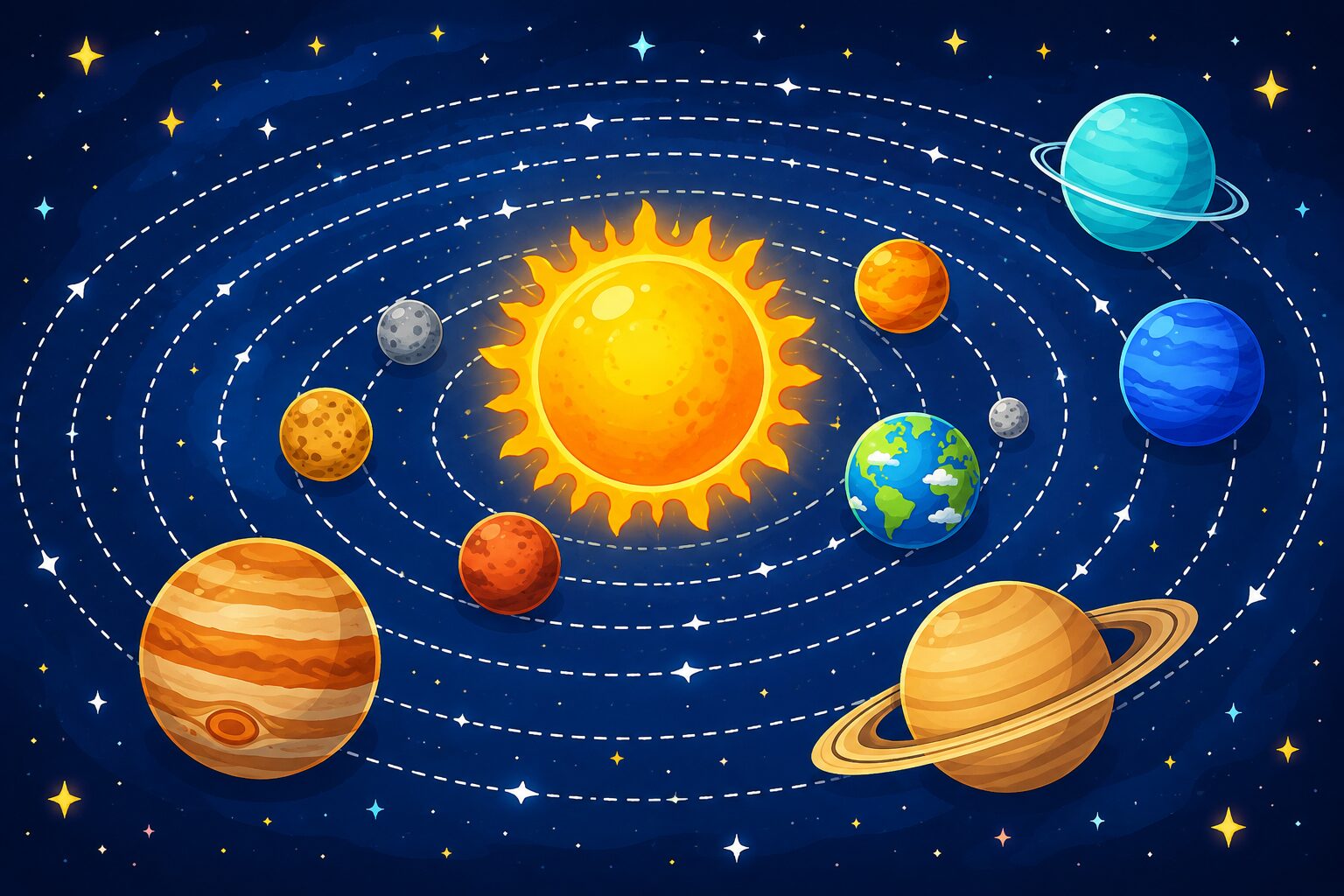
Planets orbiting the Sun work exactly the same way. Each planet is moving forward incredibly fast — sideways, not toward the Sun. At the same time, the Sun’s gravity is constantly pulling it inward. Neither force wins. The planet keeps “falling” toward the Sun and “missing” it, over and over, tracing out a huge loop that repeats forever. That loop is the orbit.
🔤 Science Words Explained
Gravity — A force of attraction between any two objects that have mass. The more mass something has, the stronger its pull.
Orbit — The curved path an object takes around another object because of gravity.
Mass — The amount of “stuff” (matter) an object is made of. Not the same as weight!
Orbital velocity — The exact sideways speed an object needs to keep falling around something instead of crashing into it or flying away.
Centripetal force — A fancy term for any force (like gravity) that constantly pulls a moving object toward a center point, keeping it on a curved path.
Escape velocity — The speed something needs to break free of a planet’s gravity completely, instead of orbiting it.
🌍 Real-Life Analogies
The swinging bucket. Tie a bucket of water to a rope and swing it in a fast circle above your head. Your hand (like the Sun) constantly pulls the bucket inward through the rope (like gravity), while the bucket’s own speed keeps it swinging outward. Balance those two, and the bucket loops around instead of flying off or crashing into your hand.
The playground merry-go-round. If you’re spinning fast and let go of the bar, you fly off in a straight line — because nothing is pulling you toward the center anymore. Planets never “let go,” because gravity never stops pulling.
A ball rolling on a stretched sheet. Picture a heavy bowling ball sitting on a trampoline, curving the fabric downward. Roll a marble past it, and the marble’s path bends around the dip instead of going straight — sort of like how the Sun curves the space around it, and planets follow that curve. (This is actually close to how Einstein later described gravity too!)
🤔 Do You Know?
Did you know the International Space Station isn’t actually gravity-free? Astronauts float because the ISS and everything inside it are all falling around Earth together at the same rate — it’s called freefall, not “zero gravity.”
Did you know Neptune takes about 165 Earth years to complete just one orbit around the Sun? It has only orbited the Sun once since it was discovered in 1846.
Did you know that without the Sun’s gravity, Earth wouldn’t curve around it at all — it would fly off in a straight line into deep space at over 100,000 km/h?
🔭 Fun Science Facts
- Mercury, the closest planet to the Sun, zips around it in just 88 days because the Sun’s gravity is strongest there
- Gravity gets weaker with distance — that’s why outer planets like Neptune move much more slowly in their orbits than Mercury
- The Moon’s gravity is about 1/6th of Earth’s, which is why astronauts could bounce around so easily on its surface
- Black holes have gravity so strong that not even light can escape their pull
- Our entire solar system also orbits something huge: the center of the Milky Way galaxy — one loop takes about 230 million years
❓ Myth vs. Science
Myth: There’s no gravity in space, which is why astronauts float. Science: Gravity exists almost everywhere in space, including at the ISS’s altitude — it’s just barely weaker than on Earth’s surface. Astronauts float because they’re in continuous freefall, not because gravity switched off.
Myth: Planets orbit in perfect circles. Science: Most orbits are actually slightly oval-shaped (ellipses), a discovery made by astronomer Johannes Kepler. Earth’s orbit is nearly circular, but others, like Mercury’s, are more stretched out.
💡 Big Takeaway
Orbits aren’t magic, and they don’t need engines or invisible strings — they’re the result of a beautiful tug-of-war between gravity pulling inward and speed carrying an object forward. Every planet, moon, and satellite in the sky is doing exactly what Earth is doing right now: falling forever, and always missing.
🧠 Mini Quiz: Test Your Orbit IQ!
- What force keeps planets orbiting the Sun? A) Magnetism B) Gravity C) Wind D) Electricity
- Who first connected the falling apple to the Moon’s orbit? A) Albert Einstein B) Galileo Galilei C) Isaac Newton D) Johannes Kepler
- Why don’t astronauts on the ISS float away into space? A) There’s no gravity in space B) They are strapped in tightly C) They and the station are falling together D) The ISS has magnets
- What is an orbit? A) A straight path through space B) A curved path caused by gravity C) A type of rocket D) A planet’s core
- Which planet takes the longest to orbit the Sun? A) Mercury B) Earth C) Mars D) Neptune
- What happens to gravity’s pull as distance increases? A) It gets stronger B) It stays the same C) It gets weaker D) It disappears completely
- What shape are most planetary orbits, according to Kepler? A) Perfect circles B) Squares C) Ellipses (ovals) D) Triangles
- What is “escape velocity”? A) The speed needed to orbit a planet forever B) The speed needed to break free of a planet’s gravity C) The speed of light D) The spinning speed of a planet
- Why does Mercury orbit the Sun faster than Neptune? A) It’s smaller B) It’s closer, so the Sun’s gravity pulls harder on it C) It has more moons D) It spins faster on its axis
- What keeps a planet from either flying off into space or crashing into the Sun? A) Its own engines B) A balance between gravity pulling in and its speed carrying it forward C) The planet’s magnetic field D) Other planets pushing it back
✅ Answers & Explanations
- B) Gravity — Gravity is the pulling force between any two masses, and it’s what keeps every planet looping around the Sun.
- C) Isaac Newton — Newton realized in the 1600s that the force pulling objects down on Earth is the same force keeping the Moon (and planets) in orbit.
- C) They and the station are falling together — This constant falling is called freefall, and it’s why everything inside the ISS appears weightless.
- B) A curved path caused by gravity — An orbit forms when an object’s forward motion and a pulling force stay perfectly balanced.
- D) Neptune — Being farthest from the Sun, Neptune has the longest path to travel and moves the slowest, taking about 165 Earth years.
- C) It gets weaker — Gravity’s strength drops off the farther apart two objects are, which is why outer planets orbit more slowly.
- C) Ellipses (ovals) — Johannes Kepler discovered that planetary orbits are slightly stretched ovals, not perfect circles.
- B) The speed needed to break free of a planet’s gravity — Rockets need to reach escape velocity to leave a planet’s gravitational pull entirely.
- B) It’s closer, so the Sun’s gravity pulls harder on it — Gravity is stronger at shorter distances, so Mercury has to move fast to keep from spiraling into the Sun.
- B) A balance between gravity pulling in and its speed carrying it forward — This balance is the entire secret behind every stable orbit in the universe.

The Kids Science Magazine Editorial Team brings together nearly a decade of hands-on experience in electronics engineering, IoT systems, and embedded technology — combined with a deep passion for making complex science genuinely exciting for young minds. Our writers have worked across core electronics testing and real-world technology development, giving every science mystery article a foundation in actual engineering thinking rather than surface-level storytelling. We believe every child deserves access to mind-blowing science — explained clearly, honestly, and in a way that makes them lean forward and ask “but wait, WHY?” Every mystery published on this site is thoroughly researched, fact-checked against credible scientific sources, and written to spark curiosity in kids aged 8–14 across the USA, UK, Canada, Australia & Others across the Globe. New mystery every Friday — because science never runs out of surprises.