
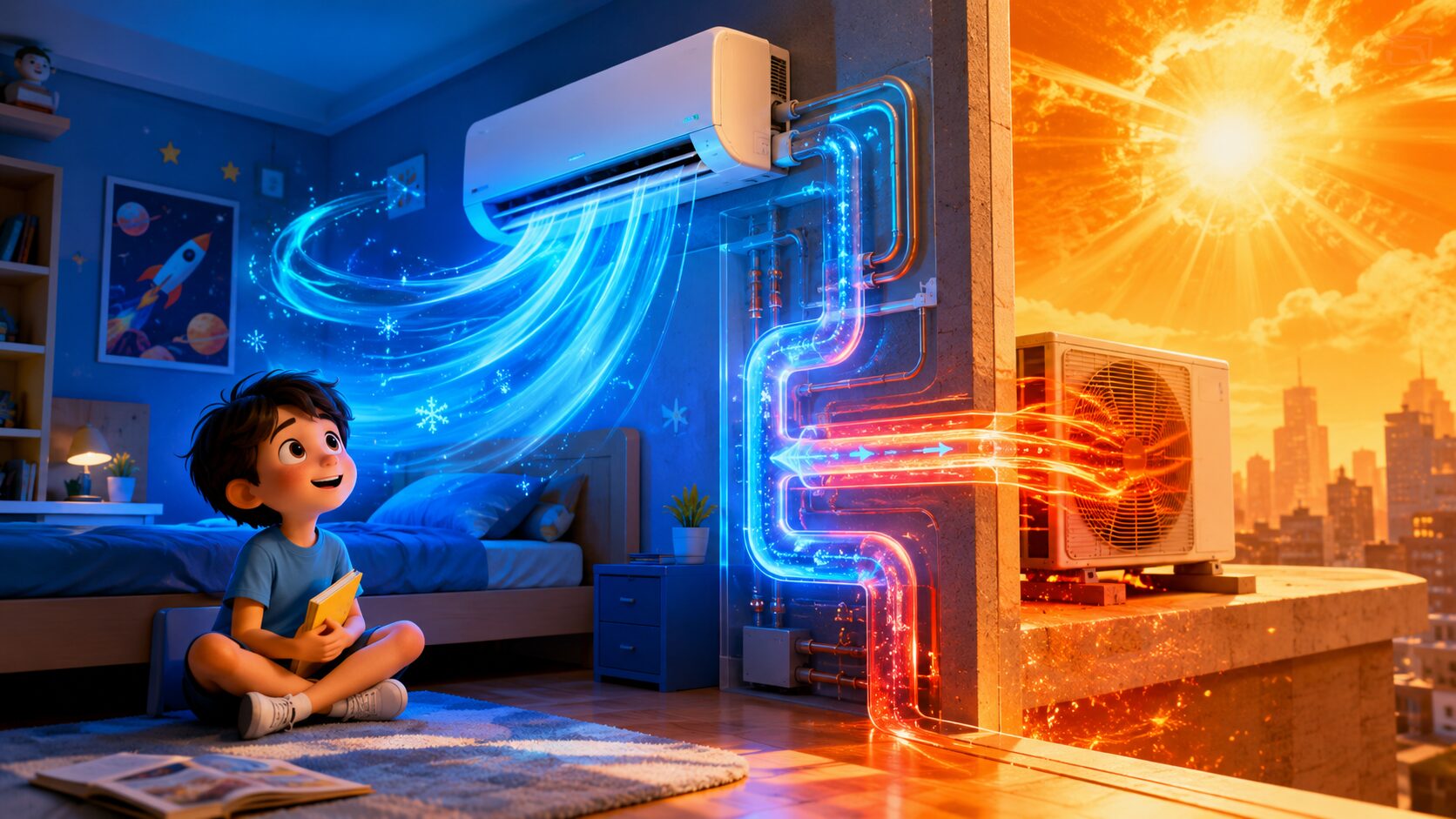
Ever wondered how an air conditioner turns a hot summer room into a cool, comfy space? Discover the exciting science of heat transfer, hidden cooling tricks, and the journey of heat in this fun science adventure for kids!
🧊 A Hot Day… and a Cool Mystery!
Imagine this…
It’s the middle of summer. The Sun is blazing outside. The sidewalk feels hot enough to fry an egg. Your room feels sticky and warm, and even your pillow feels like toast.
Then someone presses a tiny button on the remote…
BEEP!
A few minutes later, cool air starts flowing through the room like magic. Suddenly, your sweaty room feels fresh and comfortable again.
But wait…
Where did the heat go?
How can a machine make a room colder?
Does an air conditioner actually create cold air?
The answer is even cooler than you think! 😲
Air conditioners are really heat-moving machines. Instead of making “cold,” they grab heat from inside your room and throw it outside. It’s like a super-smart heat transporter working secretly inside your walls!
Let’s explore the science adventure happening inside every air conditioner. 🚀❄️
🌟 Key Highlights
- Air conditioners do not “make cold.” They remove heat.
- Heat always moves from warmer places to cooler places.
- Special liquids called refrigerants help carry heat away.
- Fans, coils, and compressors all work together like a team.
- The science behind ACs is called heat transfer.
- The same cooling science is used in refrigerators too!
❄️ The Big Secret: Air Conditioners Move Heat
Here’s the biggest surprise:
An air conditioner is not a cold-making machine.
It’s a heat-removing machine.
Think of your room like a crowded bus on a hot day. Heat energy fills the room and makes everything feel warm. The AC’s job is to collect that heat and push it outdoors.
So instead of adding coolness, the machine removes warmth.
That’s why scientists say cooling is really about taking heat away.
Pretty clever, right? 😄
🌡️ What Is Heat Transfer?
Heat transfer is the movement of heat from one place to another.
Heat naturally travels from warmer objects to cooler ones.
For example:
- A hot cup of cocoa cools down on a table.
- Ice cream melts in the Sun.
- Your hand feels warm near a campfire.
That’s heat transfer happening all around you!
There are three main ways heat moves:
1. Conduction 🔥
Heat moves through touching.
Example: A metal spoon gets hot in soup.
2. Convection 🌬️
Heat moves through moving air or liquids.
Example: Warm air rises while cooler air sinks.
3. Radiation ☀️
Heat travels through invisible waves.
Example: Feeling the Sun’s warmth on your skin.
Air conditioners mostly use convection and clever heat movement tricks.
🌀 Inside the Air Conditioner: A Heat-Catching Adventure
Now let’s peek inside the AC machine!
An air conditioner has several important parts working together like superheroes on a mission.
🧪 Meet the Refrigerant: The Heat Collector
Inside the AC is a special liquid called a refrigerant.
This liquid is amazing because it can easily change from liquid to gas and back again.
When it changes form, it absorbs and releases heat.
That’s the secret power behind air conditioning!
The refrigerant travels in a loop through pipes inside the AC system.
🌬️ Step 1: Warm Air Gets Pulled In
A fan inside the AC pulls warm room air into the machine.
That warm air passes over cold metal tubes called evaporator coils.
Inside those coils is the refrigerant.
❄️ Step 2: The Refrigerant Absorbs Heat
The refrigerant inside the coils is very cold.
As warm air touches the cold coils, heat transfers into the refrigerant.
The refrigerant “steals” the heat from the air!
Now the air becomes cooler.
The fan blows that cooled air back into the room. Ahhh… refreshing! 😌
🚚 Step 3: The Heat Travels Outside
But the heat has to go somewhere.
The refrigerant carries the trapped heat outside the building.
There, another part called the compressor squeezes the refrigerant gas tightly.
When gases are squeezed, they become hotter. Strange but true! 🔥
The hot refrigerant moves through outdoor coils where the heat escapes into the outside air.
Finally, the refrigerant cools down and becomes liquid again.
Then the whole cycle repeats over and over!
🧊 Why Does Air Feel Cooler After the AC Runs?
Cool air feels refreshing because your body constantly releases heat.
When the room is cooler, your body can get rid of heat more easily.
That’s why you feel comfortable.
Air conditioners also remove extra moisture from the air. This reduces humidity and makes rooms feel less sticky.
So ACs help in two ways:
- They remove heat 🌡️
- They remove moisture 💧
🏠 A Real-Life Analogy: The Heat Taxi!
Imagine heat is a bunch of passengers trying to leave your room.
The refrigerant is like a taxi driver 🚕.
It picks up the “heat passengers” inside your room…
…drives them outside…
…and drops them off outdoors!
Then it comes back for more heat again and again.
That’s basically what your air conditioner does all day long!
🤯 DO YOU KNOW?
❄️ Some giant buildings use enormous cooling systems as large as buses!
❄️ The first modern air conditioner was invented by Willis Carrier in 1902.
❄️ Air conditioners helped movie theaters become popular in summer because people loved escaping the heat!
❄️ Even astronauts use cooling systems inside space suits to stay comfortable in space. 🚀
🌟 Fun Science Facts
- Refrigerators and air conditioners use very similar science.
- Desert coolers work differently — they use water evaporation instead of refrigerants.
- Some penguins huddle together to control heat naturally! 🐧
- The outdoor part of an AC often feels hot because it is releasing your room’s heat outside.
- Computers and video game consoles also need cooling systems to stop overheating.
🧠 Science Words Explained
Heat Transfer
The movement of heat from one place to another.
Refrigerant
A special liquid or gas that carries heat.
Compressor
A machine part that squeezes refrigerant gas.
Evaporation
When a liquid changes into a gas.
Humidity
The amount of water vapor in the air.
Convection
Heat movement through air or liquid.
🌎 Why Air Conditioners Matter
Air conditioners do much more than keep us comfortable.
They help:
- Hospitals protect patients
- Schools stay comfortable for learning
- Computers avoid overheating
- Food stay fresh in stores
- Scientists protect important equipment
In very hot places, cooling systems can even save lives during dangerous heat waves.
🧪 Mini Quiz Time!
1. Do air conditioners create cold air?
Answer: No. They remove heat from the room.
2. What special liquid carries heat inside an AC?
Answer: Refrigerant.
3. What happens to warm air inside the AC?
Answer: Its heat gets absorbed by the refrigerant.
4. Which part squeezes the refrigerant gas?
Answer: The compressor.
5. What type of science explains heat movement?
Answer: Heat transfer.
🔍 Encouragement to Explore
Science is hiding everywhere around you.
The next time you sit near an air conditioner, remember: an invisible heat-moving adventure is happening right beside you!
Try observing:
- Why does the outdoor AC unit feel warm?
- Why does cold soda “sweat” on hot days?
- Why do fans feel cooler on your skin?
Every question is a doorway into science. 🚪✨
You don’t need a giant laboratory to become a scientist.
Sometimes all you need is curiosity.
❄️ Big Takeaway
Air conditioners may seem magical, but the real magic is science.
By using heat transfer, refrigerants, fans, and pressure, ACs move heat out of your room and help your body stay cool and comfortable.
So the next time you enjoy cool air on a hot summer day, you’ll know the secret:
Your air conditioner is actually a super-smart heat transporter working nonstop behind the scenes! 🌬️🧊
========================

The Kids Science Magazine Editorial Team brings together nearly a decade of hands-on experience in electronics engineering, IoT systems, and embedded technology — combined with a deep passion for making complex science genuinely exciting for young minds. Our writers have worked across core electronics testing and real-world technology development, giving every science mystery article a foundation in actual engineering thinking rather than surface-level storytelling. We believe every child deserves access to mind-blowing science — explained clearly, honestly, and in a way that makes them lean forward and ask “but wait, WHY?” Every mystery published on this site is thoroughly researched, fact-checked against credible scientific sources, and written to spark curiosity in kids aged 8–14 across the USA, UK, Canada, Australia & Others across the Globe. New mystery every Friday — because science never runs out of surprises.





One Comment
Comments are closed.