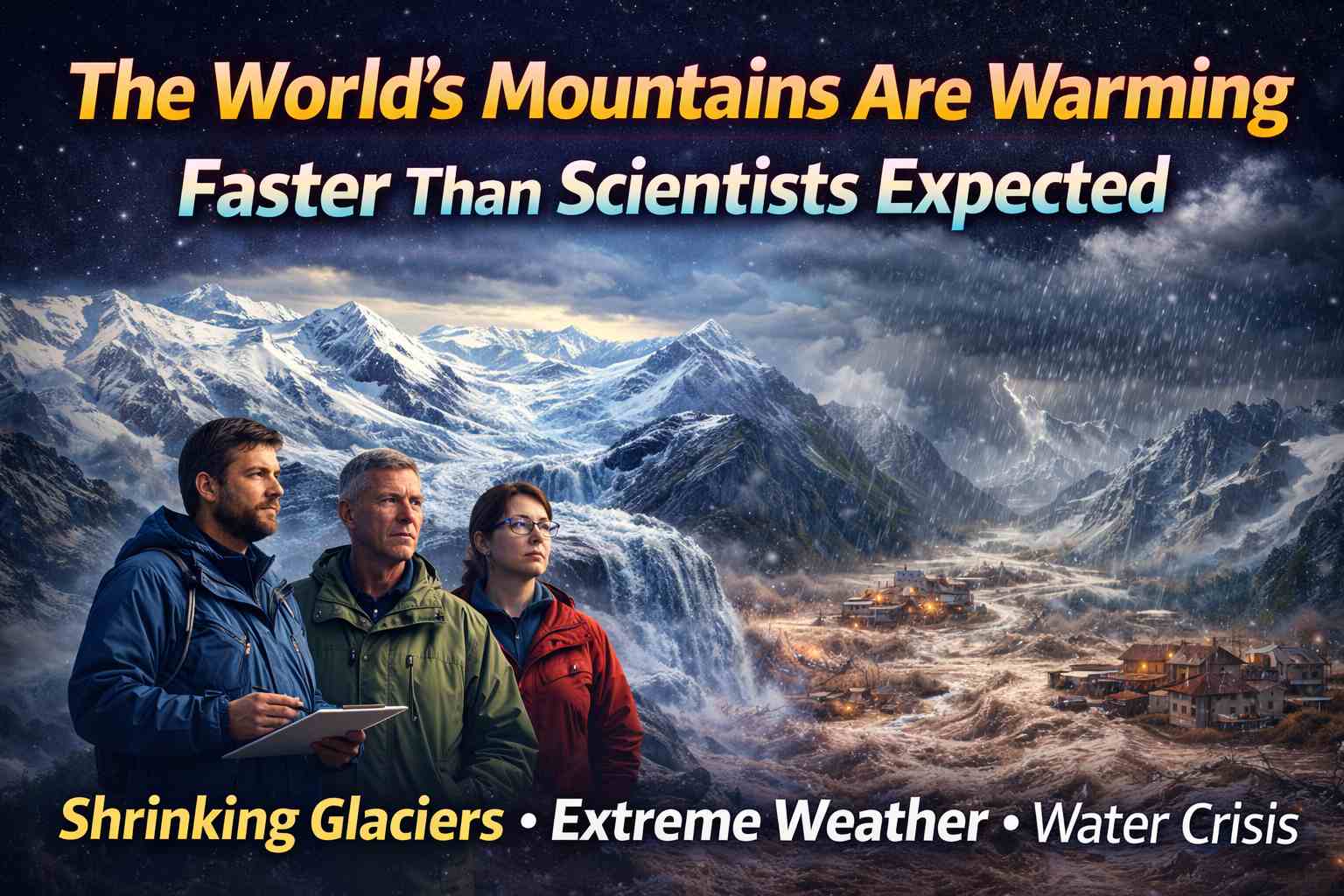
Mountain regions are warming faster than lowlands, turning snow into rain and shrinking glaciers. Scientists warn this could disrupt water supplies, ecosystems, and weather for over a billion people worldwide.
Why Snow Is Turning Into Rain—and Why It Matters to All of Us
🔍 Key Highlights (Quick Look)
- Mountains are warming faster than nearby lowlands
- Snowfall is changing into rain, even at high altitudes
- Glaciers are shrinking, and floods are becoming more dangerous
- Over one billion people depend on mountain water
- Scientists warn this could change ecosystems, rivers, and weather worldwide
A Surprising Discovery High Above the Clouds ☁️
When we think about climate change, we often imagine melting ice at the poles or hotter summers in cities. But scientists have discovered something unexpected:
👉 The world’s mountains are heating up faster than the lands below them.
A major global study led by researchers from the University of Portsmouth found that as you go higher up a mountain, climate change can actually speed up.
This discovery helps explain why snow is disappearing, glaciers are shrinking, and mountain weather is becoming more extreme.
What Is “Elevation-Dependent Climate Change”? 🧠
Scientists call this process Elevation-Dependent Climate Change, or EDCC.
Here’s a simple way to understand it:
🧗 Imagine climbing a mountain where each step up makes climate change act stronger and faster.
At higher elevations:
- Snow and ice melt more easily
- Dark ground absorbs more heat
- Air holds more moisture
- Temperatures rise faster than expected
So mountains don’t just warm—they warm faster.
Mountains Around the World Are Changing 🌎
The scientists studied mountain regions all over the planet, including:
- The Rocky Mountains
- The Alps
- The Andes
- The Tibetan Plateau
By looking at data from 1980 to 2020, they found clear trends:
🔥 Rising Temperatures
Mountain regions warmed about 0.21°C faster per century than nearby lowlands.
🌧️ Snow Turning Into Rain
Places that once had reliable snowfall are now seeing:
- More rain
- Less snow
- Shorter snow seasons
This might sound small—but it makes a huge difference.
Why Snow vs. Rain Is a Big Deal ❄️➡️🌧️
Snow acts like a natural water bank.
- It builds up during winter
- Melts slowly in spring and summer
- Feeds rivers over many months
Rain, on the other hand:
- Falls all at once
- Runs downhill quickly
- Can cause floods
When snow turns into rain, water arrives too fast, causing floods now—and shortages later.
One Billion People Depend on Mountain Water 💧
More than one billion people rely on water that begins as snow or ice in the mountains.
This includes huge populations in China and India, where rivers fed by the Himalayas supply drinking water, farming, and electricity.
Scientists warn that Himalayan glaciers are shrinking faster than expected, putting these water supplies at risk.
Extreme Weather Is Becoming More Dangerous ⚠️
Warmer mountains also mean more extreme weather.
Dr. Nick Pepin, who led the study, pointed to recent disasters in Pakistan, where intense mountain rainstorms caused deadly floods that killed over 1,000 people.
Why is this happening?
- Warmer air holds more moisture
- Storms release more rain at once
- Mountain slopes send water rushing downhill
Mountains can turn heavy rain into fast-moving disasters.
What Happens to Animals and Plants? 🐐🌲
As mountains warm, plants and animals try to escape the heat by moving higher uphill.
But there’s a problem.
🏔️ Eventually, they run out of mountain.
When species can’t move higher:
- Ecosystems can collapse
- Some species may disappear
- Entire mountain environments can change forever
Scientists call this being “pushed off the top.”
Why Studying Mountains Is So Hard 🔬
Mountains are:
- Remote
- Cold
- Dangerous
- Difficult to reach
That makes it hard to install and maintain weather stations.
Because of this, scientists worry they might be underestimating how fast mountain climates are changing.
New computer models are improving, but experts say we need:
- Better monitoring
- More weather stations
- Faster action on climate change
🌟 Big Takeaway
Mountains may look strong and unchanging—but they are actually some of the most sensitive places on Earth.
What happens high in the mountains affects:
- Rivers
- Food
- Weather
- People far below
🏔️ When mountains change, the whole world feels it.
🧠 Quick Quiz: Test Your Knowledge!
1. What does EDCC stand for?
A) Extreme Desert Climate Change
B) Elevation-Dependent Climate Change
C) Environmental Data Climate Code
D) Earth’s Dynamic Climate Cycle
2. Why does snow turning into rain cause problems?
A) Rain is colder
B) Rain melts glaciers faster
C) Water arrives too quickly and causes floods
D) Snow is heavier
3. About how many people rely on mountain water?
A) 100 million
B) 500 million
C) 1 billion
D) 3 billion
4. Why do animals move higher up mountains?
A) To find more food
B) To avoid predators
C) To escape rising temperatures
D) To see better views
5. Why is mountain climate hard to study?
A) Too many animals
B) Weather stations are hard to maintain
C) Mountains block satellites
D) Data is not important
✅ Answers:
1-B, 2-C, 3-C, 4-C, 5-B
🤔 Think About This…
If mountains—some of the coldest places on Earth—are warming this fast, what does that tell us about climate change everywhere else?