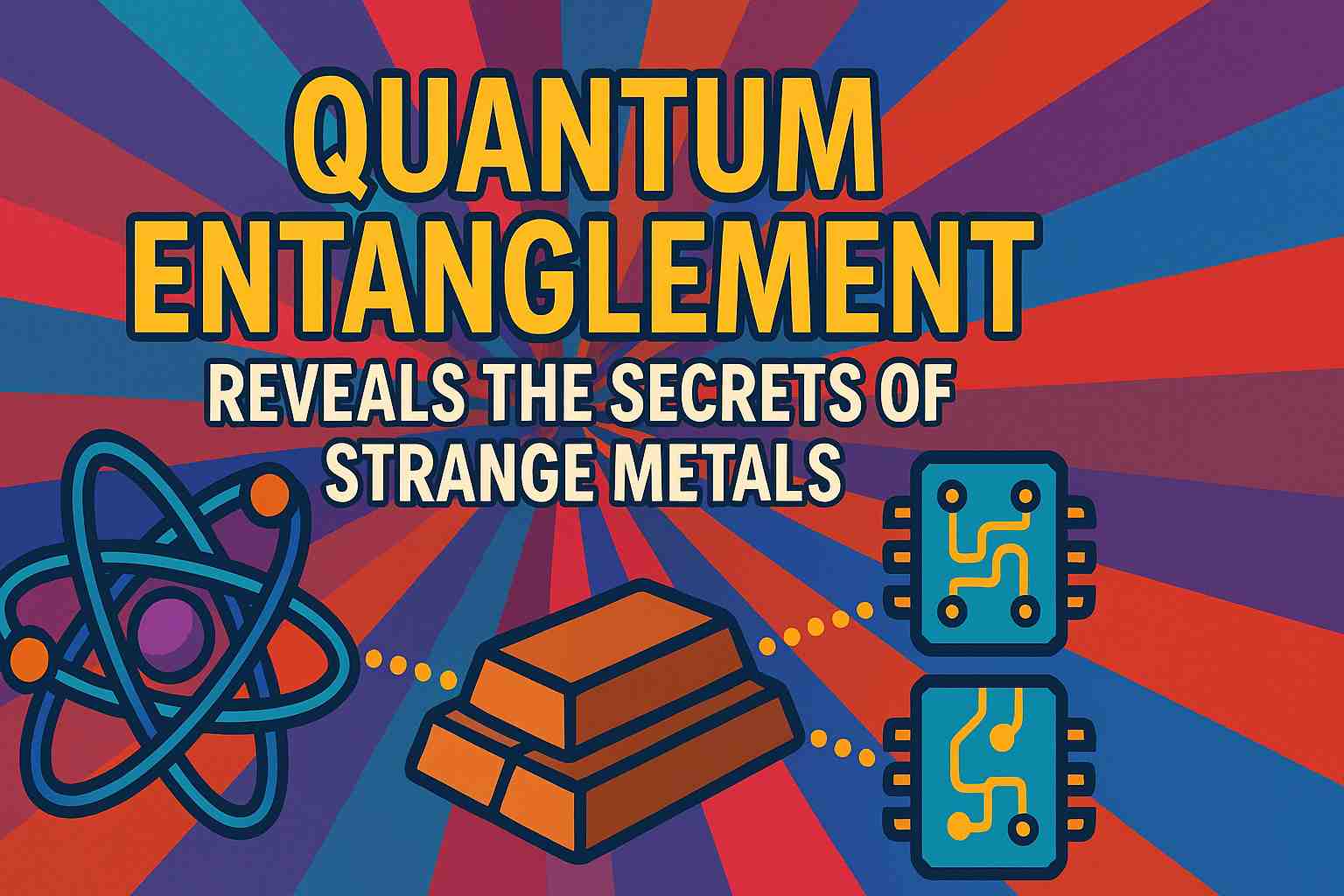
Imagine a world where electricity flows without losing any energy—no overheating phones, no power wasted in wires, and super-efficient energy grids! Scientists at Rice University have made an exciting discovery that could bring us closer to that future. They’ve found a new way to understand strange metals, a type of material that behaves in mysterious ways, using quantum entanglement—one of the spookiest effects in physics!
What Are Strange Metals? ⚡🔬
Most metals, like copper and gold, follow clear and predictable electrical rules. But strange metals are different. Their electrons don’t behave in an orderly way and act unpredictably, especially at very low temperatures. Scientists have been puzzled by this for years, but now, they’ve found a clue!
A research team led by Professor Qimiao Si at Rice University used a tool from quantum information science called quantum Fisher information (QFI) to study these metals. QFI helps scientists track how electrons interact under extreme conditions. What they found was surprising—electrons in strange metals become more entangled at a critical tipping point, which changes how the material behaves!
The Secret of Entangled Electrons 🔗✨
Entanglement is a special property of quantum physics where two or more particles become linked, even when they’re far apart. If you change one, the other instantly changes too—almost like they’re talking to each other faster than the speed of light!
Using the Kondo lattice model, the scientists discovered that at a certain point, the usual building blocks of electricity—called quasiparticles—simply disappear. Why? Because the electrons’ spins become super entangled, breaking the normal rules of metal behavior.
“Strange metals show a special entanglement pattern, and we can now see it clearly using quantum information science,” said Professor Si. “This gives us a new way to understand their exotic behavior.”
Why Is This Discovery Important? 🌍🔋
This breakthrough could help create better superconductors—materials that let electricity flow without any resistance. That means:
- No wasted energy in power lines!
- Faster, more powerful computers!
- More efficient transportation, like super-fast magnetic trains!
Superconductors already exist, but they usually only work at extremely cold temperatures. If scientists can use these new findings to improve superconductors, we might see everyday technologies that are much more energy-efficient!
The Future of Quantum Science 🚀🧪
This research is a big step forward because it shows that tools from quantum computing can also help solve mysteries in material science. The scientists’ calculations even matched real-world experiments using neutron scattering, proving their theory works in real life!
The discovery doesn’t just help with superconductors—it could also be useful for future quantum computers and new high-tech materials. The research team now plans to explore other exotic materials using their quantum techniques.
So next time you flip a light switch, remember—there’s a whole world of tiny, tangled electrons at work, and thanks to quantum science, we’re getting closer to making energy flow perfectly! 🔬⚛️
The Kids Science Magazine Editorial Team brings together nearly a decade of hands-on experience in electronics engineering, IoT systems, and embedded technology — combined with a deep passion for making complex science genuinely exciting for young minds. Our writers have worked across core electronics testing and real-world technology development, giving every science mystery article a foundation in actual engineering thinking rather than surface-level storytelling. We believe every child deserves access to mind-blowing science — explained clearly, honestly, and in a way that makes them lean forward and ask “but wait, WHY?” Every mystery published on this site is thoroughly researched, fact-checked against credible scientific sources, and written to spark curiosity in kids aged 8–14 across the USA, UK, Canada, Australia & Others across the Globe. New mystery every Friday — because science never runs out of surprises.