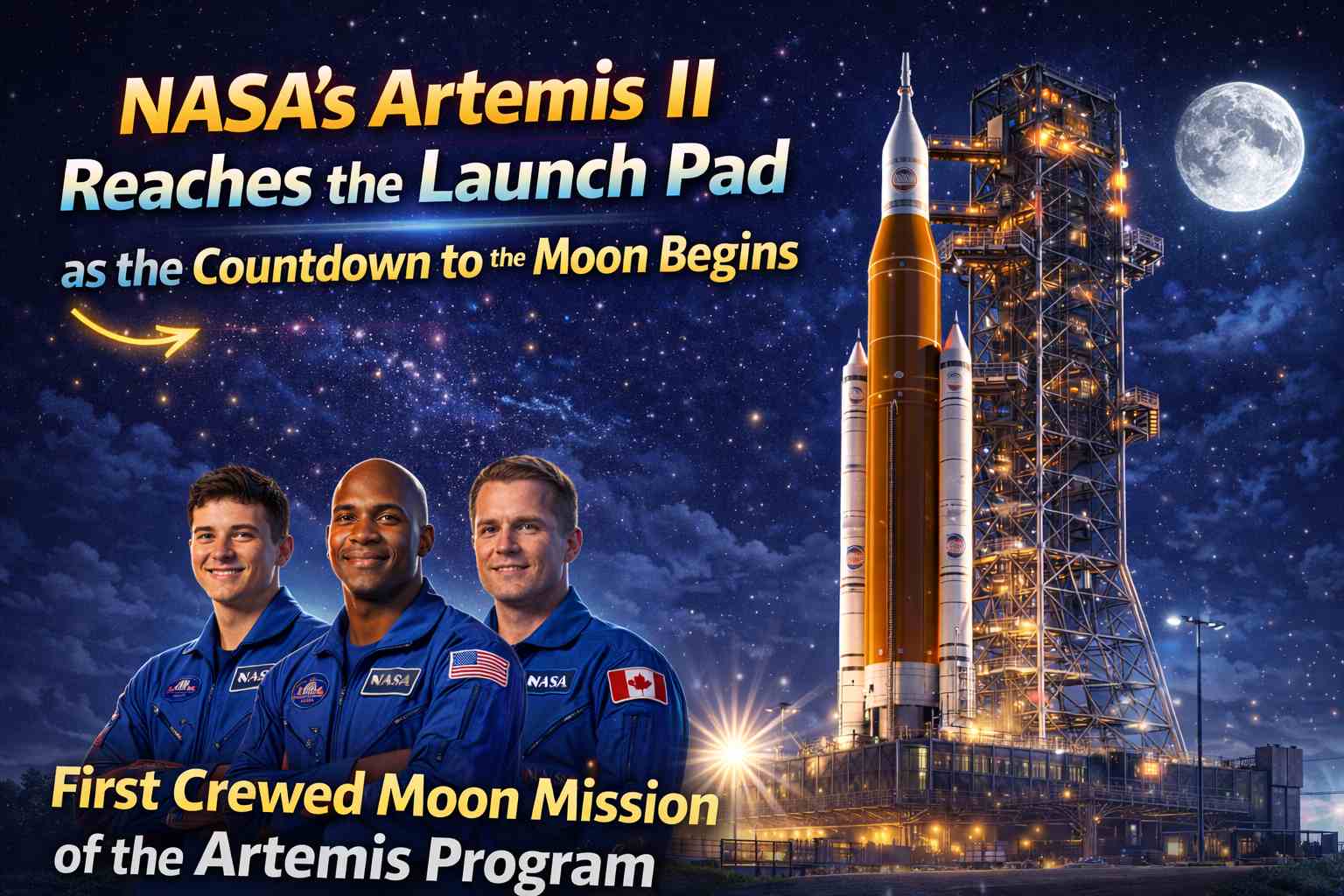
NASA’s Artemis II rocket has arrived at its launch pad as engineers prepare for final countdown tests. The mission will send four astronauts around the Moon and marks a major step toward future Moon landings and Mars exploration.
NASA’s Artemis II Rocket Reaches the Launch Pad
🔍 Key Highlights (Quick Look)
- NASA’s Artemis II rocket has arrived at its launch pad in Florida
- This mission will send four astronauts around the Moon and back
- It’s the first crewed mission of NASA’s Artemis program
- Engineers are now testing the rocket before launch
- Artemis II is a major step toward future Moon landings and Mars missions
A Giant Rocket Takes a Slow Night Walk 🌙
Late at night, under bright lights and starry skies, something incredible happened at NASA’s Kennedy Space Center.
NASA’s huge Artemis II Moon rocket slowly rolled its way to Launch Pad 39B—the same historic launch complex used by Apollo astronauts more than 50 years ago.
But this wasn’t a fast trip.
The rocket moved at a top speed of just 0.82 miles per hour, slower than a bicycle! Why so slow? Because this rocket is one of the largest and most powerful rockets ever built, and every step must be carefully controlled.
Meet the Moon Rocket: SLS + Orion 🚀🧑🚀
The Artemis II mission uses two main parts:
🔹 Space Launch System (SLS)
- A giant multistage rocket
- Provides the powerful push needed to escape Earth’s gravity
- Taller than the Statue of Liberty!
🔹 Orion Spacecraft
- The crew capsule where astronauts sit
- Designed to travel far beyond Earth
- Has heat shields to survive fiery re-entry
Together, SLS and Orion will carry humans around the Moon for the first time since 1972.
How Did the Rocket Get There?
The journey from the assembly building to the launch pad took nearly 12 hours.
NASA used a massive machine called the crawler-transporter.
Think of it like this:
Imagine a giant moving platform the size of a baseball field, carrying a skyscraper-sized rocket on its back. That’s the crawler!
It carried the fully stacked rocket from the Vehicle Assembly Building (VAB) along a 4-mile road made specially for rockets.
A Small Pause for a Big Adjustment 🔧
During the rollout, the team briefly stopped the rocket to adjust the crew access arm.
👉 This arm is like a space bridge that allows astronauts to walk into the Orion spacecraft on launch day.
Every detail matters when humans are involved.
What Happens Next? The “Wet Dress Rehearsal” 💧
Before astronauts ever climb aboard, NASA must run a major test called a wet dress rehearsal.
What does that mean?
It’s a full practice launch—without actually launching.
Engineers will:
- Fill the rocket with cryogenic fuel (super-cold liquid hydrogen and oxygen)
- Run through the entire countdown
- Drain the fuel safely
This helps NASA make sure everything works perfectly.
The rehearsal is planned for early February 2026.
Who’s Going to the Moon? 🌕👩🚀👨🚀
Artemis II will carry four astronauts:
- Reid Wiseman – Commander
- Victor Glover – Pilot
- Christina Koch – Mission Specialist
- Jeremy Hansen – Mission Specialist from the Canadian Space Agency
This is special because:
- It’s the first Artemis mission with people
- It includes an international astronaut
The crew will spend about 10 days traveling around the Moon before returning safely to Earth.
Why Artemis II Is a Big Deal 🌍➡️🌕➡️🔴
Artemis II is not landing on the Moon—but it’s a crucial step.
This mission helps NASA:
- Test systems needed for future Moon landings
- Prepare for astronauts living and working near the Moon
- Learn how to travel farther into deep space
All of this supports NASA’s long-term goal:
👉 Sending humans to Mars one day
Fun Science Fact 🤯
The Moon is about 384,400 km (238,855 miles) away. Artemis II astronauts will travel farther from Earth than any humans have in over 50 years!
🌟 Big Takeaway
Artemis II shows how patience, testing, and teamwork are essential in space exploration.
Every slow roll, careful test, and practice countdown brings humans closer to exploring new worlds.
🚀 The journey back to the Moon has truly begun.
🧠 Quick Quiz: Test Your Space Smarts!
1. What is the name of NASA’s Moon rocket?
A) Falcon Heavy
B) Saturn V
C) Space Launch System (SLS)
D) Starship
2. Why did the rocket move so slowly to the launch pad?
A) It was low on fuel
B) To avoid damaging the rocket
C) Because of traffic
D) To save time
3. What is a wet dress rehearsal?
A) Astronaut training
B) A spacesuit test
C) A full practice launch without liftoff
D) A weather check
4. How long will the Artemis II crew travel around the Moon?
A) 1 day
B) 3 days
C) 10 days
D) 1 month
5. Which country is partnering with NASA on Artemis II?
A) Japan
B) Canada
C) France
D) Australia
✅ Answers:
1-C, 2-B, 3-C, 4-C, 5-B

The Kids Science Magazine Editorial Team brings together nearly a decade of hands-on experience in electronics engineering, IoT systems, and embedded technology — combined with a deep passion for making complex science genuinely exciting for young minds. Our writers have worked across core electronics testing and real-world technology development, giving every science mystery article a foundation in actual engineering thinking rather than surface-level storytelling. We believe every child deserves access to mind-blowing science — explained clearly, honestly, and in a way that makes them lean forward and ask “but wait, WHY?” Every mystery published on this site is thoroughly researched, fact-checked against credible scientific sources, and written to spark curiosity in kids aged 8–14 across the USA, UK, Canada, Australia & Others across the Globe. New mystery every Friday — because science never runs out of surprises.