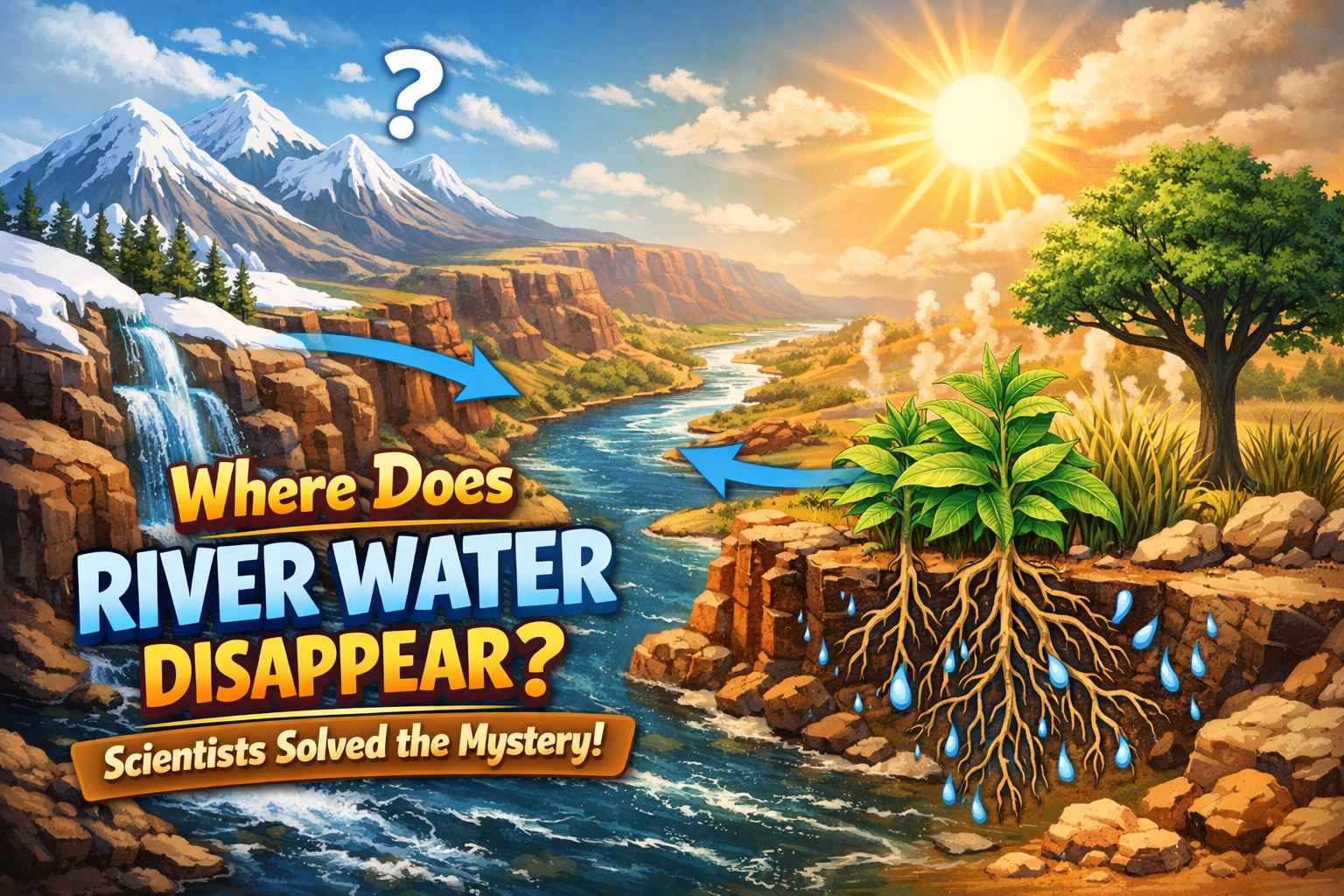
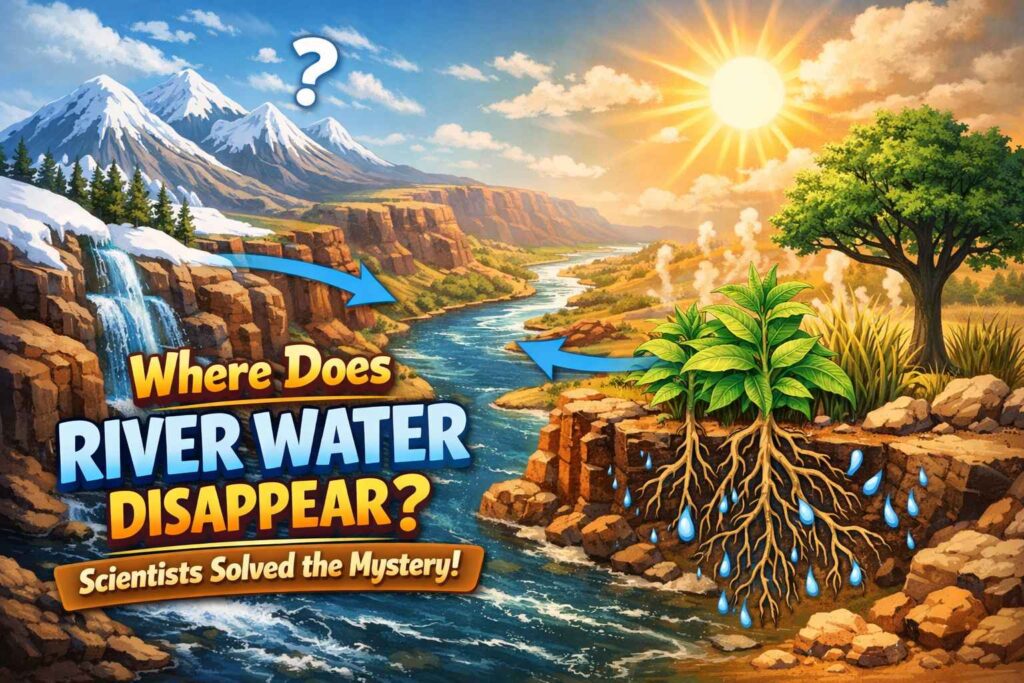
Scientists have finally cracked one of the biggest water mysteries in the American West — and the surprising answer isn’t evaporation or leaks. It’s plants. Discover how thirsty trees and wildflowers are secretly stealing the Colorado River’s water before it can reach millions of people.
💧 Curiosity
Imagine you fill a giant bathtub every winter with snow. By spring, you expect a full tub of water. But when you check — it’s barely half full. Where did all that water go? Nobody touched the taps. Nobody drilled a hole. It just… disappeared.
This is exactly what’s been happening to one of America’s most important rivers — the Colorado River — for over 25 years. And scientists have finally solved the mystery. The answer? It’s not what anyone expected.
⚡ Key Highlights
- The Colorado River has been receiving far less water than expected since around the year 2000
- New research from the University of Washington has identified the main culprit
- Warmer, drier springs mean plants absorb snowmelt like giant sponges — before it reaches the river
- This single factor explains nearly 70% of the “missing water”
- The mystery is directly tied to the ongoing Millennium Drought, which began in 2000
- Old forecasting methods that rely on winter snowpack are no longer accurate enough
📸
🔍 Main Story: Water Detective Work
The Puzzle That Stumped the Experts
Every year in early April, water scientists across the American West do something important: they measure the snowpack — the thick layers of snow piled up in the Rocky Mountains all winter long.
For decades, this measurement was like a crystal ball. More snow in winter meant more river water in spring and summer. Simple.
But something strange started happening around the year 2000.
Even in years when the snowpack looked perfectly normal, the Colorado River ended up with far less water than expected. Scientists scratched their heads. Engineers rechecked their calculations. Water managers across seven U.S. states — plus Mexico — grew increasingly worried.
The Colorado River isn’t just a pretty sight. It supplies drinking water, farming, and hydroelectric power to tens of millions of people. A missing river is a very serious problem.
🔥 What happens next might surprise you…
The First Suspects
Scientists had a few early ideas about where the water might be going.
One theory: maybe snow was simply evaporating directly into the air before melting — a process called sublimation. Think of dry ice “smoking” at room temperature. Could mountain snow be doing the same?
Researchers investigated. And yes, sublimation does happen. But here’s the twist — it only accounts for about 10% of the missing water. That still left a massive, unexplained gap.
Back to square one.
The Surprising Culprit: Plants!
Then a team of researchers at the University of Washington looked at something everyone had been ignoring — spring rainfall.
Or more precisely, the lack of spring rainfall.
Since the year 2000, a period scientists now call the Millennium Drought, springs in the Colorado River region have become noticeably drier and warmer. Less rain was falling in spring. Skies were clearer. The sun was stronger.
And here’s where it gets fascinating.
When spring rain stops falling, plants — from tiny wildflowers to towering pines — don’t stop being thirsty. They still need water desperately. So what do they do?
They turn to the only water source available: the melting snow.
“Without spring rains, the plants — from wildflowers to trees — are like giant straws, all drawing on the snowpack,” said lead researcher Daniel Hogan of the University of Washington.
🔥 But scientists weren’t expecting just how powerful those “straws” really were…
Plants as Powerful Water Pumps
Here’s the science that makes your brain spin: plants don’t just sit there looking green. They are constantly pumping enormous amounts of water from the soil up through their roots, stems, and out through tiny pores in their leaves — a process called transpiration.
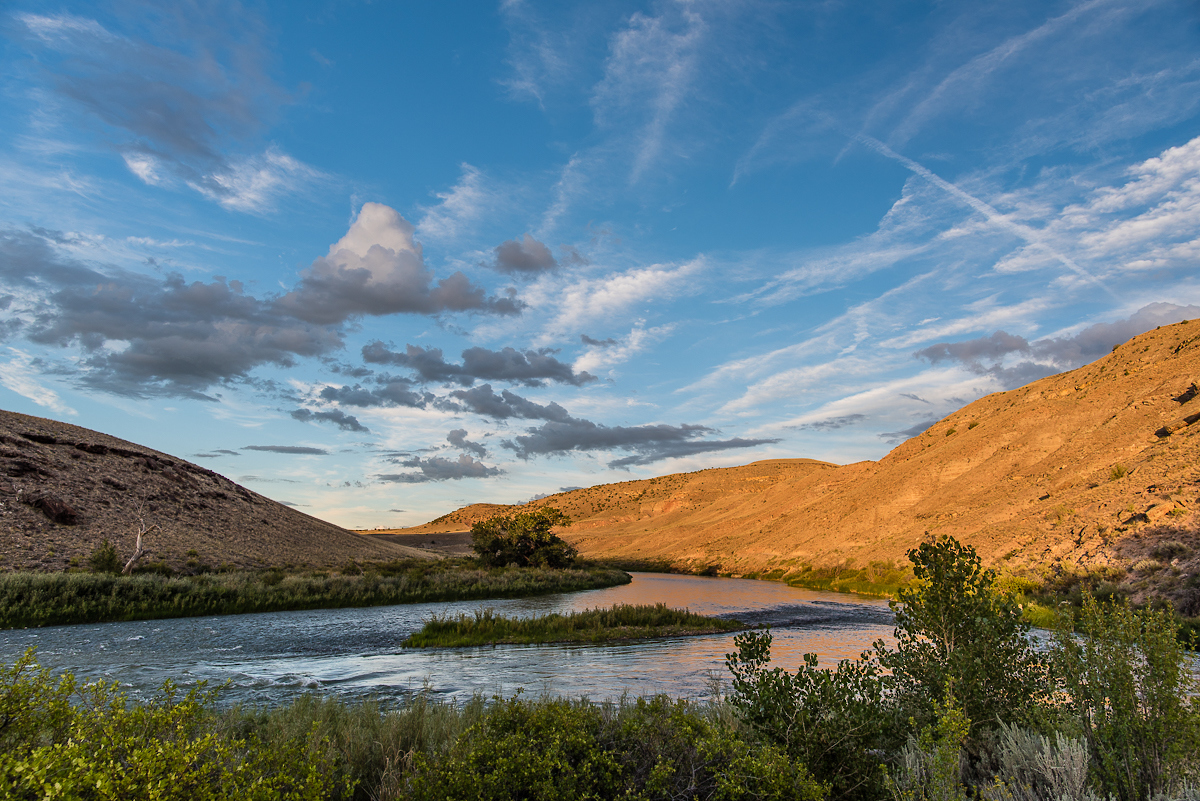
On a warm, sunny day, a single large tree can pump hundreds of litres of water into the atmosphere. Imagine an entire forest doing this simultaneously, all spring long, using melted mountain snow as their fuel source.
The new research found this accounts for nearly 70% of the difference between predicted and actual river flows.
And the more sunshine there is (because there are no rain clouds), the more vigorously plants grow and pump. It becomes a self-reinforcing cycle:
Drier spring → More sunshine → Faster plant growth → More snowmelt absorbed → Even less river water
Lower Ground, Bigger Problem
The research team didn’t just look at one area. They studied 26 different headwater basins across the Upper Colorado River at various elevations.
The pattern was consistent everywhere — but worse at lower elevations. Why? Because snow melts earlier at lower, warmer altitudes. This gives plants more time to grow tall and thirsty before the melt season ends.
🔥 Think of it like this: the plants at lower elevations get a head start in the race to grab the water…
📖 Science Terms Explained
| Term | What It Means |
|---|---|
| Snowpack | The thick layer of snow that builds up in mountains during winter and slowly melts in spring |
| Transpiration | When plants absorb water through their roots and release it as water vapour through their leaves |
| Sublimation | When snow or ice turns directly into water vapour without melting into liquid first |
| Streamflow | The amount of water flowing through a river or stream |
| Evapotranspiration | The combined water loss from both soil evaporation and plant transpiration |
| Millennium Drought | The ongoing dry period that began around 2000 in the Colorado River region |
🎨 Analogy: The Giant Straw Army
Imagine a huge pot of soup on a stove. You expect to fill 10 bowls. But before you can ladle it out, someone sneaks in a thousand tiny straws and starts sipping from the pot. By the time you arrive, there’s only enough for 5 or 6 bowls.
That’s exactly what’s happening to the Colorado River.
The mountains are the pot. The snow is the soup. The plants — millions of them across entire mountain ranges — are the thousand straws. And the drier and sunnier the spring, the faster and harder they sip.
🌍 Why This Discovery Matters
🌿 Environment
The Colorado River feeds some of the most ecologically rich landscapes in North America — deserts, canyons, and wetlands. Less water flowing through the river puts these ecosystems under severe stress.
🔮 Future
As climate change continues making springs drier and warmer across the American West, this problem is likely to grow worse. Scientists predict that in some future years, barely half of expected snowmelt may ever reach the river.
💻 Technology
Water forecasting tools will need to be completely updated. Right now, April snowpack measurements are the gold standard — but this research shows spring rainfall, plant activity, and soil moisture must now be tracked just as carefully.
🚰 Daily Life
The Colorado River provides drinking water for cities like Las Vegas, Phoenix, Los Angeles, and Denver. Farmers use it to grow food sold across the entire country. Understanding and predicting river flows accurately is literally a matter of survival for millions of people.
🧭 What If…
What if every spring suddenly got wetter again? Scientists believe that even a modest increase in spring rainfall could dramatically reverse the trend — plants would get their water from rain instead of stealing it from the snowmelt, and rivers would flow fuller again. This gives researchers hope that the problem isn’t permanent — but it depends entirely on whether climate change can be slowed down.
What if this same pattern is happening to other rivers around the world? Researchers are already asking this question. Mountain snowpack feeds major rivers on every continent. If warmer, drier springs are siphoning water before it reaches rivers globally, the implications for billions of people could be enormous.
🎯 Spot the Idea
Can you guess why plants at LOWER elevations cause a bigger problem than plants at higher elevations?
Think about it… At higher elevations, it’s still cold in spring, so plants grow slowly and the snow takes longer to melt. But lower down, it’s warmer earlier, snow melts sooner, and plants spring into action weeks faster — giving them more time to absorb the water before it can flow into the river.
Did you get it? You’re thinking like a real hydrologist!
🧩 Think Like a Scientist
Here’s a mini challenge:
Imagine you are a water manager in April. You measure the snowpack and it looks great — 100% of the normal amount. Based on old methods, you’d predict a great river year.
But now you know about spring plant behaviour. What extra information would YOU want to collect before making your prediction?
Hint: Think about clouds, rainfall forecasts, soil moisture, and plant growth data. A real scientist uses ALL of these clues together!
🏆 Big Takeaway
The Colorado River’s missing water isn’t gone — it was hijacked. Not by villains, not by leaks, but by millions of plants doing what plants have always done: surviving. The surprise is that a drier, sunnier climate has turbocharged this natural process to a level nobody anticipated.
The lesson? In science, when something mysterious happens, the answer is rarely simple. It’s usually a chain of connected events — in this case, less rain leading to more sunshine, leading to hungrier plants, leading to a thirstier river.
Understanding this chain is the first step to protecting the water that millions of people and entire ecosystems depend on. And it starts, as all great science does, with asking the right question: “Where is the water going?”
❓ Mini FAQ
1. What is the Colorado River, and why is it important? The Colorado River is a major river in the western United States that flows through seven states and into Mexico. It supplies drinking water, irrigation water for farms, and hydroelectric power to tens of millions of people across cities like Las Vegas, Phoenix, and Los Angeles.
2. How long has the “missing water” problem been happening? Scientists started noticing the gap between expected and actual river flows around the year 2000 — which marks the beginning of what researchers call the Millennium Drought. It has been ongoing ever since.
3. Why are plants absorbing so much more water now than before? Because springs have become drier, plants can’t get water from rain. So they tap into the melting snow instead. On top of that, clearer skies mean more sunshine, which encourages plants to grow faster and absorb even more water.
4. Could this problem ever be fixed? Researchers believe that if spring rainfall increases — either naturally or through climate action that slows global warming — the balance could be restored. Better water forecasting methods could also help cities and farms plan more carefully for reduced river flows.
5. Does this only affect the Colorado River? This specific study focused on the Colorado River Basin, but scientists are investigating whether similar patterns are affecting snow-fed rivers in other mountain regions around the world, including parts of Asia, Europe, and South America.
⭐ Did You Know Section
DO YOU KNOW?
The Colorado River supplies water to over 40 million people across seven U.S. states and Mexico!
A single large tree can pump hundreds of litres of water into the atmosphere on just one sunny day!
Since 1999, some years only about half of the expected snowmelt actually reaches the Colorado River!
In extreme cases, snow in the Colorado River Basin is melting weeks earlier than normal due to rising temperatures!
Scientists studied 26 different mountain river basins to crack this water mystery — going back to data from 1964!
FUN SCIENCE FACTS!
Snow doesn’t always melt into water — it can turn directly into invisible water vapour in a process called sublimation, just like dry ice “smoking”!
Plants act like natural water pumps — they pull water from deep underground and release it through tiny holes in their leaves called stomata!
More sunshine doesn’t just mean warmth — it actually turbocharges plant growth, making them absorb water even faster from the soil!
Every April, water managers across the American West measure mountain snowpack to predict river flow for the whole year ahead!
The Millennium Drought has been going on since the year 2000 — making it one of the longest droughts in modern recorded history for the region!
The Secret Life of Hibernation 🐻 Science Kids Love!
{ “questions”: [ { “q”: “Question here?”, “opts”: [“Option A”, “Option B”, “Option C”, “Option D”], “ans”: 0, “exp”: “Short explanation shown after answering.” } ] }
The Kids Science Magazine Editorial Team brings together nearly a decade of hands-on experience in electronics engineering, IoT systems, and embedded technology — combined with a deep passion for making complex science genuinely exciting for young minds. Our writers have worked across core electronics testing and real-world technology development, giving every science mystery article a foundation in actual engineering thinking rather than surface-level storytelling. We believe every child deserves access to mind-blowing science — explained clearly, honestly, and in a way that makes them lean forward and ask “but wait, WHY?” Every mystery published on this site is thoroughly researched, fact-checked against credible scientific sources, and written to spark curiosity in kids aged 8–14 across the USA, UK, Canada, Australia & Others across the Globe. New mystery every Friday — because science never runs out of surprises.