❄️🌍 Key Highlights (For Kids)
🧊 Scientists predicted when glaciers around the world could disappear for the first time ever.
🌡️ Small temperature changes make a BIG difference — even half a degree can save or lose thousands of glaciers.
⏰ “Peak Glacier Extinction” is the year when the most glaciers melt in one year.
🏔️ Alpine glaciers are in serious danger, with many likely to vanish this century.
🌱 What humans do now matters — today’s choices shape the future of Earth’s ice.
High in the mountains, giant rivers of ice slowly creep downhill.
They sparkle in the Sun, carve valleys, feed rivers, and store Earth’s frozen memories.
These are glaciers — and scientists have just learned when many of them may vanish forever.
A new study from ETH Zurich has made the most detailed glacier forecast ever created. For the first time, researchers didn’t just ask how much ice will melt — they asked something even more powerful:
Which glaciers will survive… and which ones will disappear — and when?
🧊 What Exactly Is a Glacier?
A glacier is not just a pile of snow.
It is:
- ❄️ Snow that piles up for many years
- 🧊 Slowly squeezed into solid ice
- 🏔️ Heavy enough to flow like a frozen river
Glaciers help:
- Supply fresh water
- Shape mountains
- Support ecosystems
- Preserve history
But they are extremely sensitive to temperature.
🌡️ The Big Question Scientists Asked
Scientists know Earth is warming — but how much warming makes the biggest difference?
So researchers ran powerful computer simulations using three advanced glacier models. They tested different future warming scenarios, including:
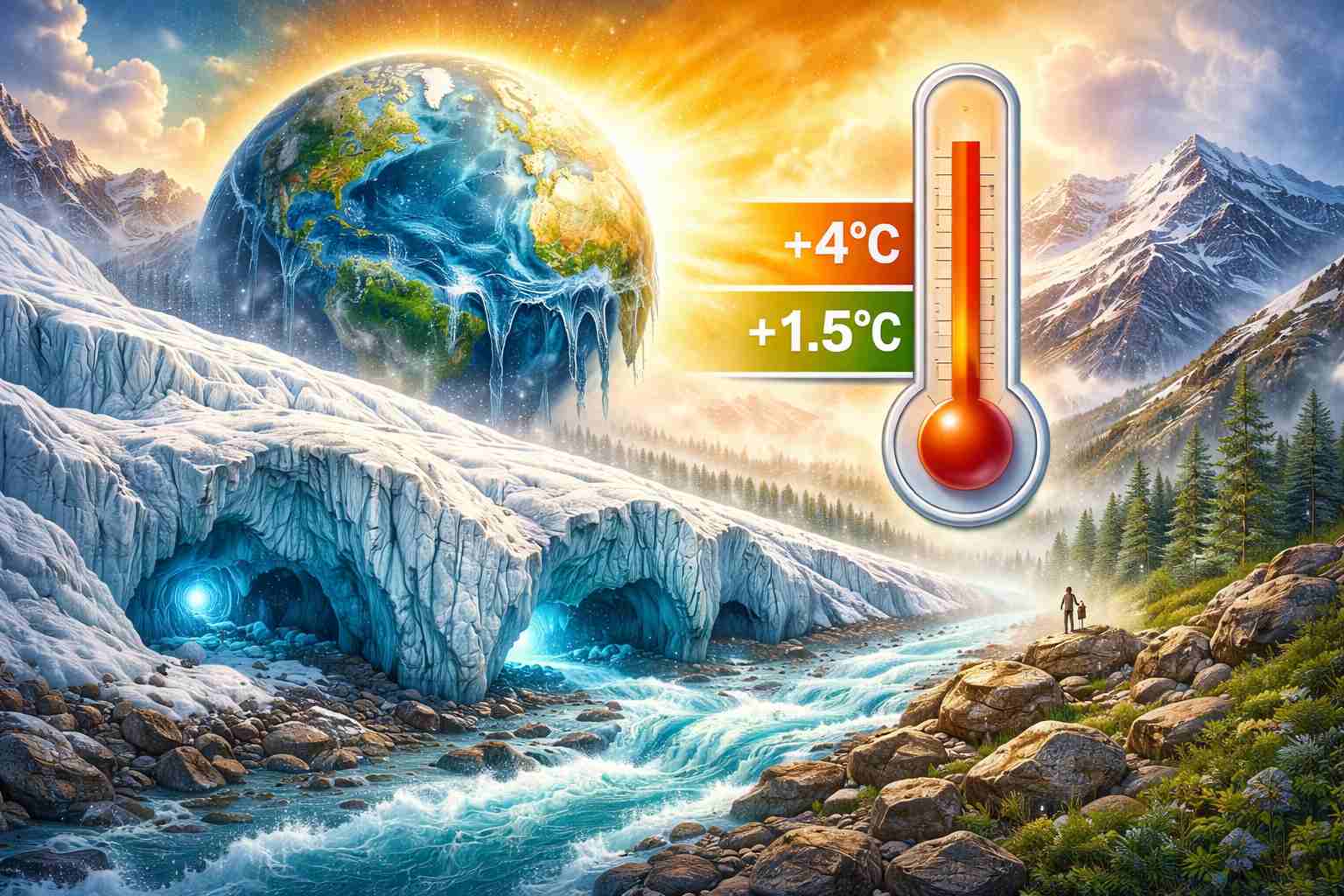
- 🌍 +1.5°C (the Paris Agreement goal)
- 🌍 +2.7°C (current global policies)
- 🌍 +4.0°C (very high warming)
Then they tracked every single glacier on Earth.
📉 The Shocking Results
Here’s what they found:
❄️ If warming is limited to +1.5°C
➡️ Around 100,000 glaciers could still exist by 2100
❄️ If warming reaches +4.0°C
➡️ Only about 18,000 glaciers would remain
That means tens of thousands of glaciers could disappear, depending on just a few degrees of temperature change.
⏰ A New Idea: “Peak Glacier Extinction”
The scientists introduced a brand-new term:
Peak Glacier Extinction
This is the year when the most glaciers disappear in a single year.
- 🌍 At +1.5°C, the peak happens around 2041
- About 2,000 glaciers vanish in one year
- 🌍 At +4.0°C, the peak shifts to 2055
- Up to 4,000 glaciers vanish in one year
After this peak, losses slow down — not because things get better, but because many glaciers are already gone.
🏔️ Why the Alps Are in Serious Trouble
The European Alps are one of the most vulnerable regions.
If warming reaches +2.7°C:
- Only about 110 glaciers may remain by 2100
- That’s just 3% of today’s glaciers
At +4°C:
- Only around 20 glaciers survive
- Even famous glaciers like the Rhône could vanish
- The massive Aletsch Glacier could break into pieces
Between 2033 and 2041, the Alps may lose more glaciers than at any time in history.
🌎 This Isn’t Just an Alpine Problem
The same pattern appears worldwide:
- 🏔️ Rocky Mountains: up to 99% loss at +4°C
- 🏔️ Andes: about 94% loss at +4°C
- 🏔️ Central Asia: around 96% loss at +4°C
Even regions where glaciers once seemed stable are expected to shrink over time.
No place is completely safe.
Robot “Lassie” Discovers Hidden Icefish City Beneath Antarctic Ice!
💧 Why Losing Glaciers Matters
Glacier loss affects more than just ice:
- 🚰 Less water for rivers and farming
- 🏞️ Changes to landscapes and tourism
- ⚠️ More natural hazards like floods and landslides
- 📜 Loss of cultural history tied to glaciers
Scientists are even creating a Global Glacier Casualty List to remember glaciers that have already disappeared.
🌟 The Most Important Discovery of All
The study sends one clear message:
Every fraction of a degree matters.
Just 0.5°C of extra warming can mean thousands more glaciers lost — or saved.
As one scientist explained:
“Every glacier is tied to a place, a story, and people who feel its loss.”
🧠 Fun Science Facts
❄️ Some glaciers are older than human civilization
🧊 Glaciers move — just very, very slowly
🌍 Small glaciers don’t raise sea level much, but their loss changes local life
📉 Counting glaciers tells a different story than measuring ice volume
🌈 Big Takeaway
Glaciers may look strong and unchanging, but they are sensitive storytellers of our planet’s temperature.
The future of Earth’s ice is not decided yet.
What happens next depends on choices humans make today.
And now, thanks to science, we know when those choices matter most.

The Kids Science Magazine Editorial Team brings together nearly a decade of hands-on experience in electronics engineering, IoT systems, and embedded technology — combined with a deep passion for making complex science genuinely exciting for young minds. Our writers have worked across core electronics testing and real-world technology development, giving every science mystery article a foundation in actual engineering thinking rather than surface-level storytelling. We believe every child deserves access to mind-blowing science — explained clearly, honestly, and in a way that makes them lean forward and ask “but wait, WHY?” Every mystery published on this site is thoroughly researched, fact-checked against credible scientific sources, and written to spark curiosity in kids aged 8–14 across the USA, UK, Canada, Australia & Others across the Globe. New mystery every Friday — because science never runs out of surprises.