🌊 Story Brief (Read This First!)
Deep in Greenland, a massive glacier is behaving in a way scientists have never seen before. A lake on top of the ice keeps suddenly draining through giant cracks, sending floods of water straight to the bottom of the glacier — sometimes even lifting the ice upward like a blister. Researchers are watching this happen in real time and asking an urgent question: Has this glacier changed forever?
🔑 Key Highlights (Quick & Kid-Friendly)
• 🧊 A meltwater lake on Greenland’s 79°N Glacier keeps draining suddenly through huge cracks
• ⚡ Some drainages flood the glacier’s base in just a few hours
• 🔺 Strange triangle-shaped cracks and vertical ice shafts are forming
• 🌍 Scientists worry warming temperatures may have pushed the glacier into a new unstable state
🧠 What’s Happening to This Glacier?
On Greenland’s icy surface sits a huge glacier called the 79°N Glacier. In 1995, something new appeared there — a meltwater lake formed for the first time.
That alone was unusual.
But what happened next shocked scientists.
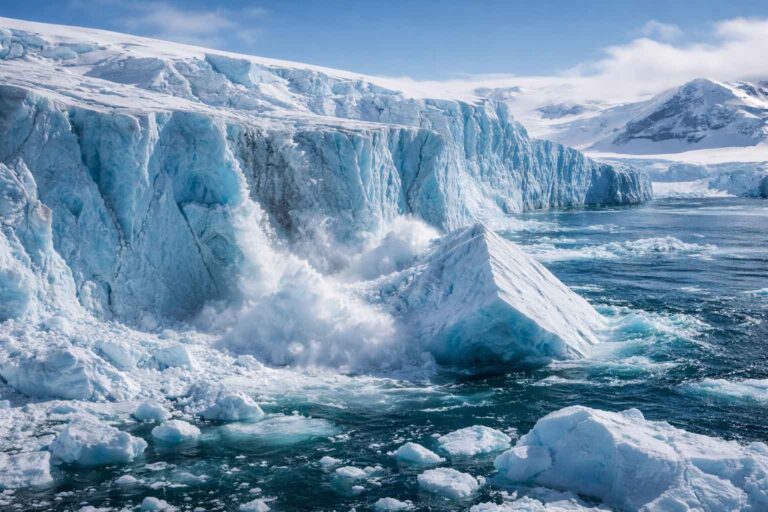
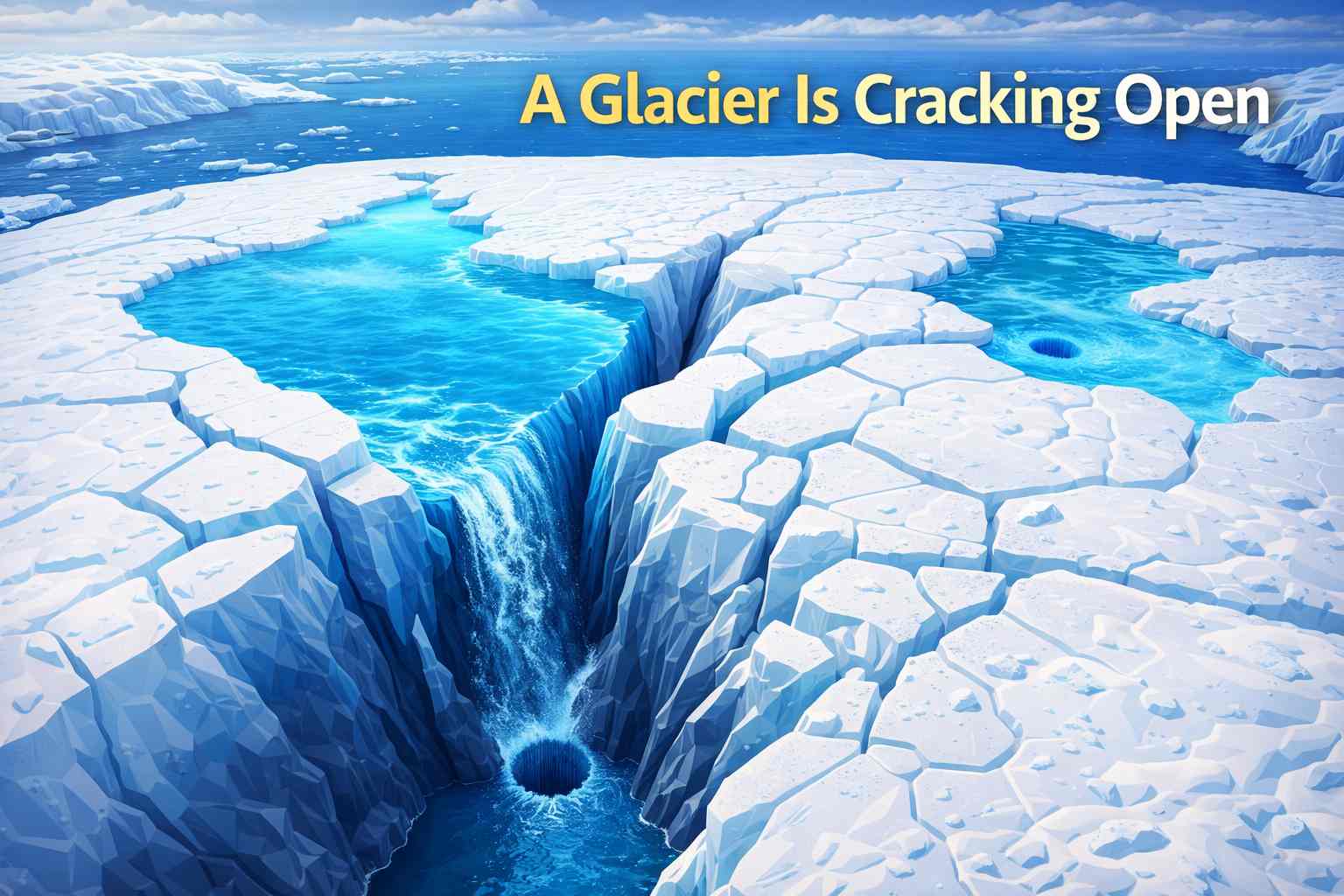
Instead of calmly freezing each winter, the lake began to drain suddenly and violently, sending massive amounts of water racing through cracks in the ice and straight down to the glacier’s base.
Scientists from the Alfred Wegener Institute have been tracking this lake for nearly 30 years.
💥 Seven Sudden Drainages — and Counting
Between 1995 and 2023, researchers recorded seven major drainage events.
What’s alarming?
👉 Four of those happened in just the last five years.
Each time the lake drains, it:
- Carves new cracks in the ice
- Sends freshwater rushing toward the ocean
- Changes the glacier from the inside out
This is happening faster and more often than before.
🔺 The Glacier Is Cracking in Strange New Shapes
During recent drainages, scientists noticed something never seen before.
Instead of long straight cracks, the ice surface broke into large triangular fracture patterns.
Some cracks turned into moulins — giant vertical shafts in the ice that can be:
- Dozens of meters wide
- Deep enough to carry water straight to the glacier’s bottom
Even after the lake empties, water keeps flowing through these moulins.
Think of them as emergency drainpipes punched into the ice.
🧊 How Can Ice Crack… Then Heal?
Glacier ice behaves in a very strange way.
It is:
- 🧈 Viscous, like super-thick honey that slowly flows
- 🪀 Elastic, like a rubber band that can bend and partly snap back
This means:
- Cracks can open suddenly
- But over time, ice can slowly squeeze them shut again
However, radar images show that many cracks from 15 years ago are still visible, meaning the glacier remembers its past damage.
⬆️ Water Is Lifting the Glacier From Below
One of the most surprising discoveries came from radar scans beneath the ice.
Scientists found evidence that:
- Meltwater pooled under the glacier
- Formed a subglacial lake
- Pushed the ice upward from below, like a bubble or blister
Some cracks even showed one side of the ice lifted higher than the other.
This means the glacier isn’t just cracking — it’s being forced upward.
🛰️ How Do Scientists Watch a Glacier Crack?
To study this glacier, researchers used:
- 🛰️ Satellite images
- ✈️ Airplane radar surveys
- 🧮 Computer models of ice behavior
This helped them track:
- How fast the lake fills
- When it drains
- Where the water flows inside the ice
For the first time, scientists could measure how ice channels form and change over many years.
🌡️ Why This Matters for the Future
As temperatures rise, meltwater lakes are forming higher and farther inland on Greenland’s ice.
That means:
- Larger areas of ice are at risk
- Cracks could spread faster
- Glaciers may flow more quickly toward the ocean
Scientists now wonder:
👉 Has this glacier entered a new long-term state?
👉 Or can it still return to a normal winter cycle?
Right now, no one knows the answer.
🧩 Fun Science Facts
❄️ Glaciers can flow like rivers — just very slowly
🔻 Moulins act like giant ice funnels
🛰️ Radar can “see” inside glaciers
🌍 Greenland holds enough ice to raise sea levels worldwide
🌈 Big Takeaway
This glacier isn’t just melting — it’s changing how it behaves.
By watching cracks form in real time, scientists are learning how Earth’s ice responds to warming — and why even hidden changes inside glaciers matter for the whole planet.
The ice may look solid…
but it’s telling a story of change.

The Kids Science Magazine Editorial Team brings together nearly a decade of hands-on experience in electronics engineering, IoT systems, and embedded technology — combined with a deep passion for making complex science genuinely exciting for young minds. Our writers have worked across core electronics testing and real-world technology development, giving every science mystery article a foundation in actual engineering thinking rather than surface-level storytelling. We believe every child deserves access to mind-blowing science — explained clearly, honestly, and in a way that makes them lean forward and ask “but wait, WHY?” Every mystery published on this site is thoroughly researched, fact-checked against credible scientific sources, and written to spark curiosity in kids aged 8–14 across the USA, UK, Canada, Australia & Others across the Globe. New mystery every Friday — because science never runs out of surprises.