Learn how Subrahmanyan Chandrasekhar discovered what happens when massive stars collapse into black holes. A fun, kid-friendly space science story with simple explanations, facts, and quizzes.
Introduction: What Happens When a Star Dies? 🌠
Stars may look calm and twinkly in the night sky, but deep inside, they live dramatic lives—they are born, they grow, and one day… they die!
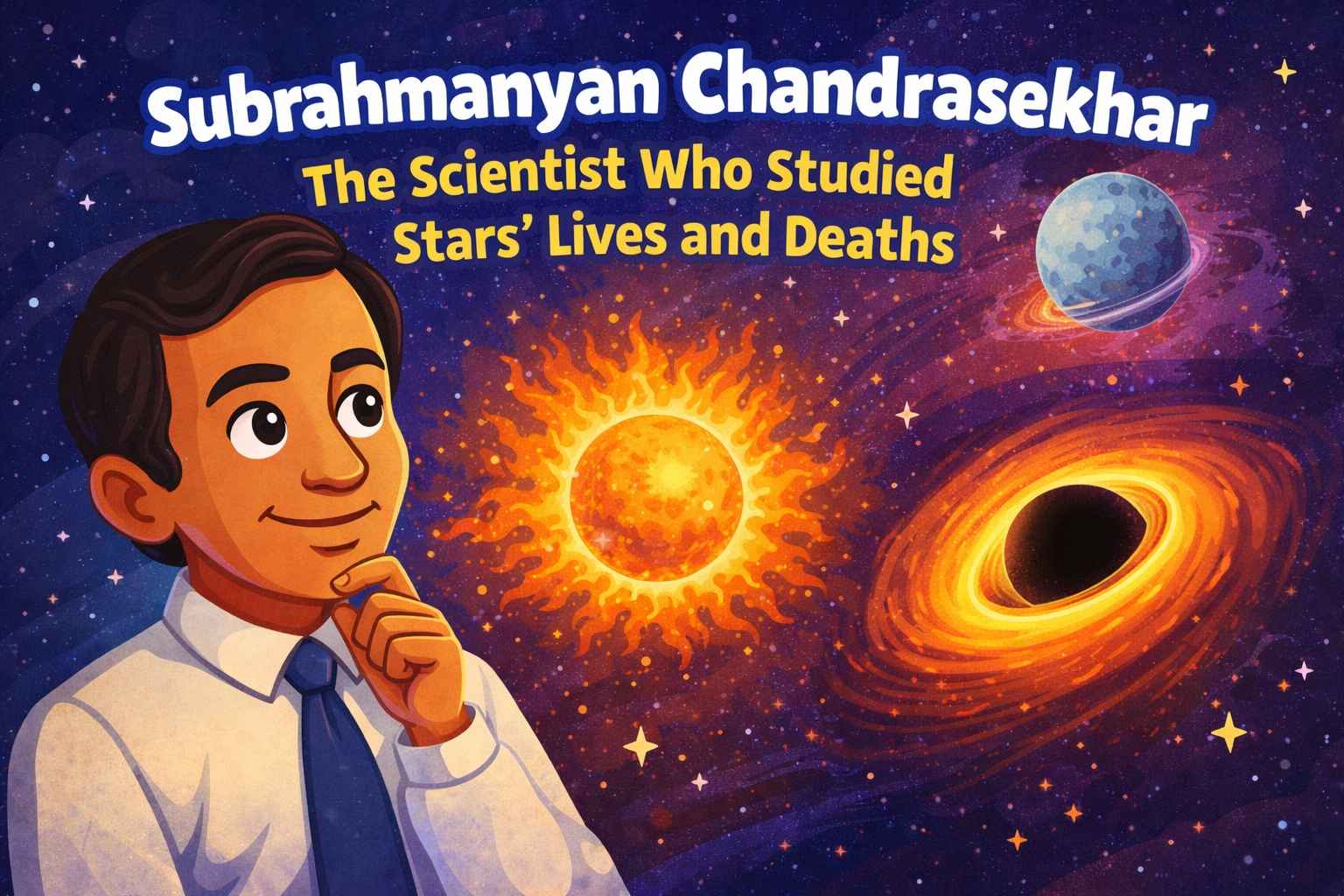
One brilliant scientist helped the world understand what happens at the end of a star’s life, especially the most massive ones. His name was Subrahmanyan Chandrasekhar, often called Chandra—and his discoveries changed astronomy forever.
🌱 Early Life: A Curious Boy Who Loved Numbers and the Sky
Subrahmanyan Chandrasekhar was born in 1910 in Lahore, which was then part of British India. From a very young age, he loved math, science, and solving difficult problems.
He grew up in a family where learning was important. His uncle was the famous scientist C. V. Raman, who later won a Nobel Prize. This inspired young Chandra to dream big and aim for the stars—literally! 🌌
Even as a teenager, he was already studying advanced physics that most adults found difficult.
🚢 A Big Idea on a Long Sea Journey
When Chandrasekhar was just 19 years old, he traveled by ship from India to England to study science further.
During this long sea journey, something incredible happened:
Chandra began thinking deeply about stars and gravity.
He asked a bold question:
👉 What happens to a star after it runs out of fuel?
Using only math, logic, and imagination, he made a shocking discovery—one that many scientists at the time didn’t believe!
⚫ The Shocking Discovery: The Fate of Massive Stars
Chandrasekhar discovered that very massive stars cannot stay stable forever. When they run out of fuel, gravity becomes too strong, and the star collapses.
He calculated a special limit—now called the Chandrasekhar Limit:
- If a dying star is below this limit, it becomes a white dwarf
- If it is above this limit, it keeps collapsing…
👉 leading to neutron stars or even black holes!
At first, many famous scientists laughed at his idea 😔. But decades later, scientists proved Chandra was right.
🌌 Why This Discovery Changed Astronomy
Chandrasekhar’s work helped scientists understand:
- How black holes are formed ⚫
- Why stars explode as supernovae 💥
- How the universe evolves over time
Today, every space telescope and astronomer studying black holes uses the ideas Chandra discovered as a young man.
🏆 Recognition and the Nobel Prize
Even though he faced criticism early in life, Chandrasekhar never gave up. He continued his research with patience and confidence.
In 1983, he was awarded the Nobel Prize in Physics for his work on the structure and evolution of stars 🌟.
NASA later named a powerful space telescope the Chandra X-ray Observatory in his honor—a fitting tribute to a man who unlocked the secrets of dying stars.
🤔 DO YOU KNOW? Fun Facts About Chandrasekhar
- He was one of the youngest scientists to make a major discovery in astrophysics
- He loved classical music and poetry 🎶📖
- He believed science should be done with beauty and elegance
- The word “black hole” became popular years after his original work—but his math predicted them long before!
🎮 Interactive Fun Zone
Quick Quiz 📝
1️⃣ What happens to very massive stars when they die?
A) They disappear quietly
B) They collapse and may form black holes
C) They turn into planets
Answer: B
2️⃣ What is the special limit discovered by Chandrasekhar called?
A) Gravity Rule
B) Star Line
C) Chandrasekhar Limit
Answer: C
3️⃣ Which space telescope is named after him?
A) Hubble
B) Chandra
C) Voyager
Answer: B
Think Like a Scientist 💭
If you discovered something amazing but people didn’t believe you at first, what would you do?
- 🔍 Keep researching
- 🧮 Trust your math
- 💪 Never give up
(Chandrasekhar did all three!)
🌈 Conclusion: A Star Scientist Who Changed How We See the Universe
Subrahmanyan Chandrasekhar showed the world that even stars are not forever—and that understanding their endings helps us understand the universe itself.
His story teaches kids an important lesson:
🌟 If your ideas are strong and your curiosity is endless, don’t be afraid to think differently—even if others doubt you.
Because sometimes, the biggest discoveries are waiting in the darkest corners of space. 🌌✨

The Kids Science Magazine Editorial Team brings together nearly a decade of hands-on experience in electronics engineering, IoT systems, and embedded technology — combined with a deep passion for making complex science genuinely exciting for young minds. Our writers have worked across core electronics testing and real-world technology development, giving every science mystery article a foundation in actual engineering thinking rather than surface-level storytelling. We believe every child deserves access to mind-blowing science — explained clearly, honestly, and in a way that makes them lean forward and ask “but wait, WHY?” Every mystery published on this site is thoroughly researched, fact-checked against credible scientific sources, and written to spark curiosity in kids aged 8–14 across the USA, UK, Canada, Australia & Others across the Globe. New mystery every Friday — because science never runs out of surprises.