🌬️🔬 Scientists Finally Solve a 100-Year-Old Mystery in the Air We Breathe
Researchers have solved a century-old problem in air pollution science by accurately predicting how irregular nanoparticles move through air, improving health and climate models.
How Tiny, Odd-Shaped Particles Really Move—and Why It Matters for Our Health
🔍 Key Highlights (Quick Look)
- Scientists solved a 100-year-old science puzzle about air pollution
- The mystery was about how tiny, oddly shaped particles move in air
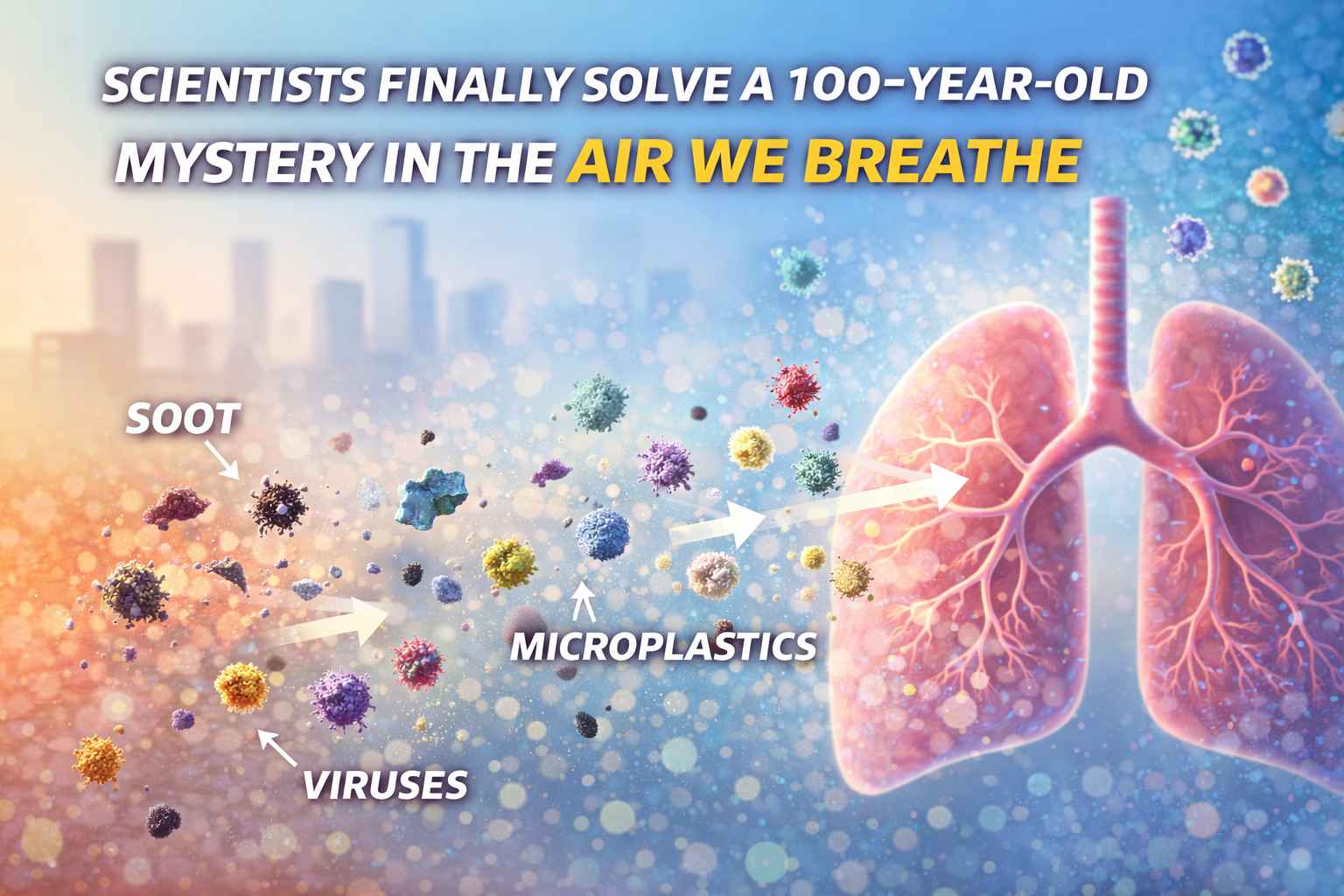
- These particles include soot, microplastics, pollen, and even viruses
- Old models treated all particles like perfect balls (which is wrong!)
- The new method helps predict pollution spread more accurately
The Invisible Crowd Around You 👀🌫️
Take a deep breath.
Right now, along with oxygen, you’re breathing in millions of tiny particles floating in the air. Most are so small you’ll never see them.
These include:
- 🖤 Soot from vehicles
- 🧵 Microplastics
- 🌾 Pollen
- 🦠 Viruses
- ⚙️ Engineered nanoparticles
Some of these particles are so tiny that they can travel deep into your lungs—and some can even enter your bloodstream.
Scientists have long known these particles are dangerous.
But here’s the mystery:
👉 How exactly do they move through the air?
A Problem That Lasted 100 Years 🕰️
For over a century, scientists tried to predict how airborne particles drift, float, and spread.
The problem?
Most particles aren’t smooth or round.
They are:
- Jagged
- Flat
- Twisted
- Clumpy
But because irregular shapes are hard to calculate, scientists made a big shortcut:
🟠 They treated all particles as perfect spheres.
That made math easier—but results less accurate.
Why Shape Matters 🧩
Imagine dropping:
- ⚽ A smooth ball
- 🍂 A crumpled leaf
Do they fall the same way?
Of course not!
The same thing happens with particles in air:
- Shape affects speed
- Shape affects direction
- Shape affects where particles end up in your lungs
So ignoring shape meant scientists were missing the real picture.
The Breakthrough Moment 💡
Now, a scientist at the University of Warwick has finally cracked the problem.
Professor Duncan Lockerby reworked a 100-year-old equation and turned it into something new and powerful.
The research was published in the journal Journal of Fluid Mechanics.
And for the first time, scientists can now:
✅ Predict how particles of almost any shape move through air
✅ Do it with a method that is simple and accurate
The Old Equation That Started It All 📜
Back in 1910, a scientist named Cunningham created a correction to explain how tiny particles behave differently than big objects.
Later, in the 1920s, famous scientist Robert Millikan refined the idea—but something important was left out.
As a result:
- The formula worked only for round particles
- Irregular particles were mostly ignored
Professor Lockerby went back to the original idea and asked:
“What if we fix what was overlooked?”
Meet the “Correction Tensor” 🧠
The solution is something called a correction tensor.
That sounds scary—but here’s the kid-friendly version:
🧮 It’s a smart math tool that:
- Accounts for drag (air resistance)
- Works for any particle shape
- Doesn’t need guessing or extra tuning
Whether a particle is:
- A sphere ⚪
- A thin disc 🥞
- A jagged clump 🪨
The new method can predict how it moves.
Why This Is a Big Deal for Health ❤️
Many of the most dangerous particles are:
- Very small
- Very irregular
These are the ones linked to:
- Heart disease
- Stroke
- Lung damage
- Cancer
By understanding how they move, scientists can:
- Predict where pollution will travel
- Improve air quality models
- Design better health protections
Beyond Pollution: Bigger Science Impacts 🌍
This breakthrough helps more than just air pollution research.
It can improve:
- 🌆 City air-quality forecasts
- 🔥 Smoke spread from wildfires
- 🌋 Volcanic ash tracking
- 🧬 Medical and nanotechnology research
To build on this, Warwick scientists are creating a new aerosol lab that can generate and study real, non-spherical particles in detail.
🌟 Big Takeaway
For 100 years, scientists simplified air pollution by pretending tiny particles were perfect balls.
Now, that shortcut is gone.
By finally understanding how real, messy, oddly shaped particles move through the air, scientists have taken a huge step toward:
🌬️ Cleaner air
❤️ Better health
🧪 Smarter science
Sometimes, solving an old mystery can make the future healthier for everyone.
🧠 Quick Quiz: Air Science Check!
1. Why were particles treated as spheres in old models?
A) They really are round
B) Spheres are easier to calculate
C) Computers were broken
D) Scientists preferred spheres
2. Which of these can be airborne nanoparticles?
A) Soot
B) Microplastics
C) Viruses
D) All of the above
3. Why does particle shape matter?
A) It changes color
B) It affects how particles move
C) It makes air heavier
D) It stops breathing
4. What tool did scientists create to fix the problem?
A) A microscope
B) A robot
C) A correction tensor
D) A filter
5. How old was the original equation before it was fixed?
A) 10 years
B) 50 years
C) 75 years
D) About 100 years
✅ Answers:
1-B, 2-D, 3-B, 4-C, 5-D
🤔 Think About This…
If tiny particles you can’t see can affect your health, how important do you think clean air is for the future of cities?

The Kids Science Magazine Editorial Team brings together nearly a decade of hands-on experience in electronics engineering, IoT systems, and embedded technology — combined with a deep passion for making complex science genuinely exciting for young minds. Our writers have worked across core electronics testing and real-world technology development, giving every science mystery article a foundation in actual engineering thinking rather than surface-level storytelling. We believe every child deserves access to mind-blowing science — explained clearly, honestly, and in a way that makes them lean forward and ask “but wait, WHY?” Every mystery published on this site is thoroughly researched, fact-checked against credible scientific sources, and written to spark curiosity in kids aged 8–14 across the USA, UK, Canada, Australia & Others across the Globe. New mystery every Friday — because science never runs out of surprises.






2 Comments
Comments are closed.