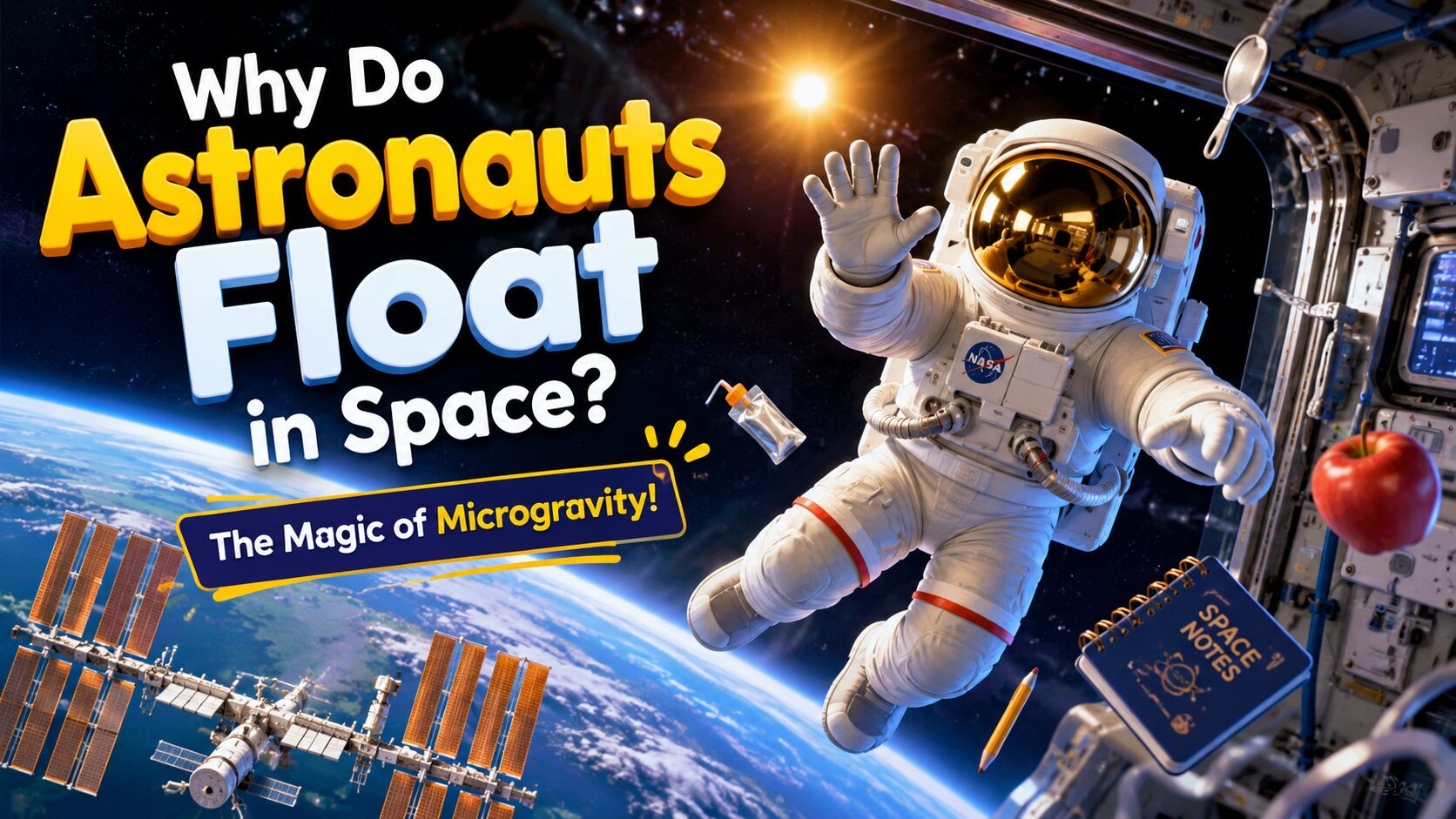
The Amazing Science of Microgravity 🌍✨ Learn why astronauts float in space with this fun, easy science article for kids. Discover microgravity, orbit, and the amazing science behind floating astronauts.

Have you ever seen astronauts floating through a spaceship like superheroes? 🦸♂️
They flip, spin, and drift through the air as if gravity suddenly disappeared!
But here’s the surprising truth:
👉 Gravity is STILL there in space! 😲
So why do astronauts float?
Let’s blast off into the amazing science of microgravity and discover what really happens in space! 🚀🌌
🌟 Key Highlights
- Astronauts float because they are in continuous free fall
- Gravity still exists in space 🌍
- The International Space Station (ISS) is constantly falling around Earth
- Microgravity makes astronauts feel weightless
- Floating in space changes the human body in surprising ways!
🌍 Wait… Is There No Gravity in Space?
Most people think astronauts float because there’s “no gravity” in space.
That sounds logical… but it’s not true!
Earth’s gravity reaches far into space. In fact, gravity is what keeps:
- 🌕 the Moon orbiting Earth
- 🛰️ satellites circling our planet
- 🚀 the ISS traveling around Earth
So gravity is definitely still working!
🛰️ The Secret: Astronauts Are Falling!
Here’s the real magic:
The International Space Station is constantly falling toward Earth.
“But if it’s falling,” you may ask, “why doesn’t it crash?” 🤔
Because it’s also moving SUPER fast sideways—about 28,000 kilometers (17,500 miles) per hour! 😱
So instead of crashing down, it keeps missing Earth over and over again.
This creates an endless loop called an orbit.
🎢 Imagine This…
Picture throwing a ball.
- Throw softly → it falls nearby
- Throw harder → it goes farther
Now imagine throwing it SO hard that Earth curves away beneath it.
That’s basically what the ISS is doing! 🌍🛰️
It’s always falling around Earth instead of straight down.
✨ What Is Microgravity?
Astronauts feel weightless because everything around them is falling together at the same speed.
This is called microgravity.
“Micro” means tiny, so microgravity means:
👉 very weak feeling of gravity
Inside the ISS:
- astronauts float
- water forms floating blobs 💧
- food drifts through the air 🍎
- even sleeping looks funny 😄
🧑🚀 Floating Is Fun… But Tricky!
Living in microgravity is exciting, but it also causes problems.
Astronauts must learn how to:
- eat without making floating crumbs 🍞
- sleep strapped to walls 😴
- move carefully without crashing into things
- exercise every day 💪
Without gravity, muscles and bones can become weaker over time.
That’s why astronauts spend hours exercising on space treadmills and bikes!
🌟 DO YOU KNOW?
🌍 The International Space Station circles Earth about 16 times every day!
😲 Astronauts see around 16 sunrises and sunsets daily because the ISS moves so fast.
💧 In microgravity, water becomes floating spheres instead of falling down.
🤯 Fun Science Facts!
✨ Astronauts can grow slightly taller in space because their spines stretch without gravity pressing down.
✨ Tears don’t fall in space—they stick to your face! 😅
✨ Space toilets use airflow instead of gravity to work. 🚽
✨ Some astronauts accidentally float into walls while sleeping!
🔬 Science Words Explained
🛰️ Orbit
The curved path something follows around a planet or moon.
🌍 Gravity
The invisible force that pulls things toward Earth.
✨ Microgravity
A condition where objects appear to float because they are falling together.
🚀 International Space Station (ISS)
A giant laboratory orbiting Earth where astronauts live and work.
🧠 A Simple Analogy
Imagine being inside a falling elevator (don’t try this! 😅).
If both you and the elevator fall together, you would feel weightless for a moment.
That’s similar to what astronauts experience all the time in orbit!
🎯 Mini Quiz Time!
1️⃣ Why do astronauts float?
A. There is no gravity
B. They are falling around Earth
C. Space is full of air
✅ Answer: B
2️⃣ What is microgravity?
A. Super strong gravity
B. No oxygen
C. Very weak feeling of gravity
✅ Answer: C
3️⃣ What keeps the ISS from crashing to Earth?
A. Rockets pushing upward
B. Its fast sideways speed
C. Giant balloons
✅ Answer: B
🧪 Try This at Home!
The Falling Coin Experiment 🪙
Ask an adult to help.
1️⃣ Hold a coin above a cup
2️⃣ Quickly move the cup sideways
The coin falls straight down because gravity pulls it.
Now imagine the coin moving sideways VERY fast—it could keep missing Earth like the ISS!
🌈 Encouragement to Explore
Next time you see astronauts floating in space, remember:
They aren’t escaping gravity…
they’re actually falling in the coolest way possible! 🚀✨
Science helps us understand amazing mysteries of the universe—and there’s still so much more to discover.
Keep asking questions, keep imagining, and keep exploring! 🌌🔭
🏆 Big Takeaway
Astronauts float because they are in constant free fall around Earth. Their spacecraft moves so fast that it keeps missing the planet, creating orbit and the feeling of weightlessness called microgravity.
❓ Mini FAQ
Why don’t astronauts fall back to Earth?
Because their spacecraft moves sideways very fast while falling.
Is there gravity on the Moon?
Yes! The Moon has gravity, but it’s weaker than Earth’s.
Can astronauts swim through the air?
Sort of! They push gently and float through the ISS.
Does floating feel fun?
Most astronauts say yes—but it also takes practice.
Can humans live forever in microgravity?
Not yet. Long periods in microgravity can weaken the body.
The Tic Tac UAP: What US Navy Pilots Really Saw in 2004

The Kids Science Magazine Editorial Team brings together nearly a decade of hands-on experience in electronics engineering, IoT systems, and embedded technology — combined with a deep passion for making complex science genuinely exciting for young minds. Our writers have worked across core electronics testing and real-world technology development, giving every science mystery article a foundation in actual engineering thinking rather than surface-level storytelling. We believe every child deserves access to mind-blowing science — explained clearly, honestly, and in a way that makes them lean forward and ask “but wait, WHY?” Every mystery published on this site is thoroughly researched, fact-checked against credible scientific sources, and written to spark curiosity in kids aged 8–14 across the USA, UK, Canada, Australia & Others across the Globe. New mystery every Friday — because science never runs out of surprises.