
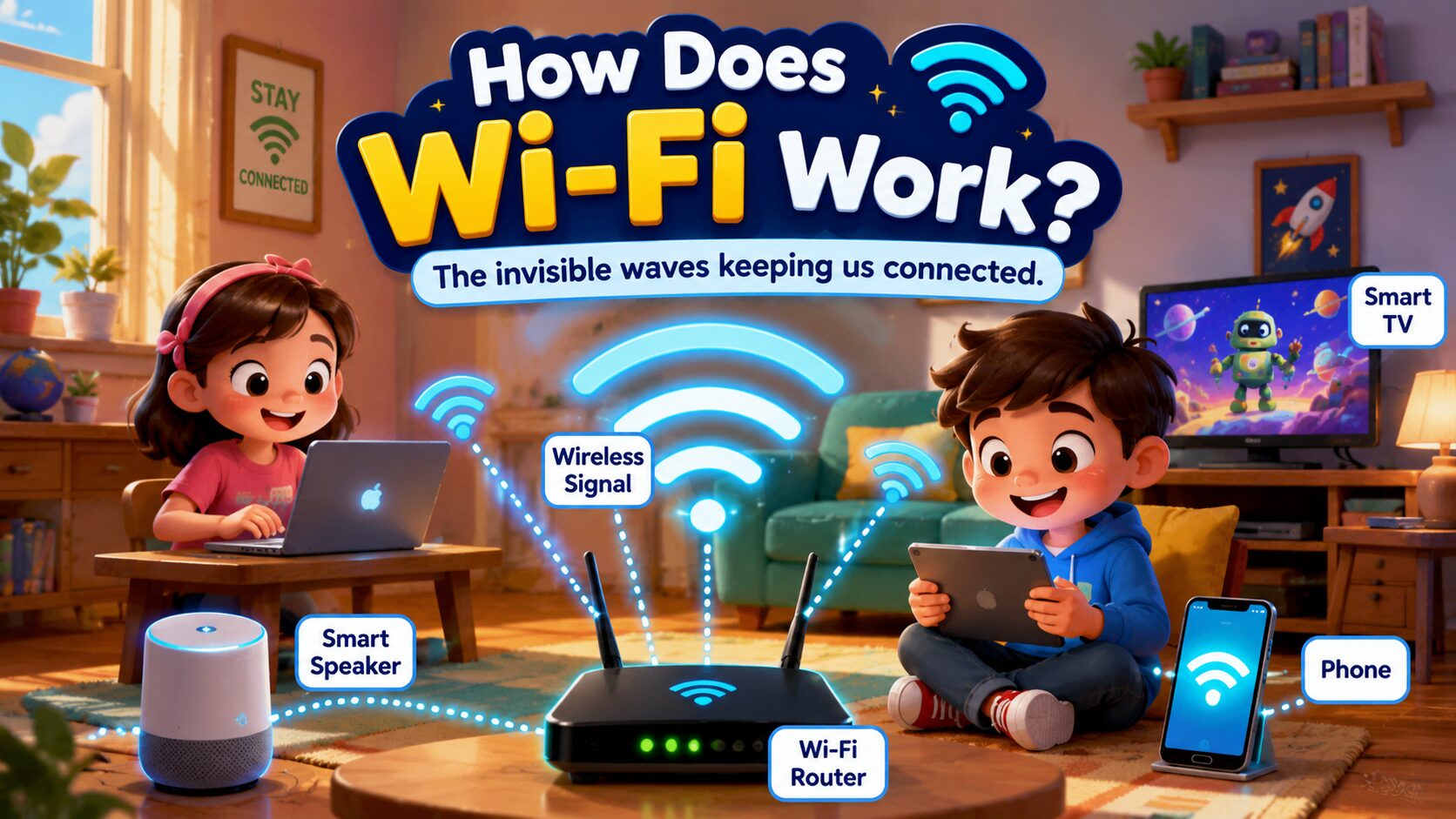
Learn how Wi-Fi works with this fun science article for kids. Discover invisible radio waves, routers, internet signals, and wireless technology explained simply.
The Invisible Waves Keeping Us Connected 🌍✨

Imagine this:
You’re watching videos on a tablet… 🎬
Your parents are working on a laptop… 💻
Someone else is playing an online game… 🎮
And somehow, all these devices connect to the internet without any wires at all! 😲
How is that possible?
The answer is something we use almost every day:
📶 Wi-Fi!
But Wi-Fi is invisible.
You can’t see it, touch it, or smell it.
So… how does it actually work?
Let’s uncover the secret science of invisible waves! 🚀
🌟 Key Highlights
- Wi-Fi uses invisible radio waves 📡
- Routers send information through the air
- Devices like phones and tablets can “read” those waves
- Wi-Fi works a little like invisible walkie-talkies
- Walls and distance can weaken Wi-Fi signals
📡 What Is Wi-Fi?
Wi-Fi is a way for devices to connect to the internet wirelessly.
Instead of using cables, Wi-Fi sends information using:
🌊 Radio waves
These are invisible waves moving through the air all around us.
Radio waves are part of the electromagnetic spectrum, the same family as:
- sunlight ☀️
- X-rays 🩻
- microwaves 🍲
But Wi-Fi waves are specially designed for communication.
🛜 Meet the Wi-Fi Router!
The most important Wi-Fi device in your home is the:
📦 Router
A router is like a traffic manager for internet data.
It:
- receives information from the internet 🌍
- turns it into radio signals 📡
- sends those signals through the air
Your devices then catch those signals!
📱 How Devices Understand Wi-Fi
Your phone, tablet, smart TV, or laptop has a tiny Wi-Fi chip inside.
This chip acts like a mini radio receiver 📻
It can:
✅ listen to Wi-Fi waves
✅ decode the information
✅ turn it into videos, games, websites, and messages
That’s how you can watch a video seconds after pressing play! 🎥
🌊 How Information Travels Through the Air
Here’s the amazing part:
When you send a message or open a website, your device changes information into patterns of radio waves.
Those waves zoom through the air at nearly the speed of light! ⚡
The router and device constantly “talk” to each other:
- “Send data!”
- “Here it is!”
- “Got it!”
This happens millions of times every second. 😲
🚪 Why Does Wi-Fi Sometimes Get Weak?
Have you noticed Wi-Fi gets slower in some rooms?
That’s because radio waves can be blocked or weakened by:
- thick walls 🧱
- metal objects 🔩
- distance 📏
- too many devices 📱
Even microwaves and other electronics can sometimes interfere with Wi-Fi signals!
🚀 What Does “5G” or “5 GHz” Mean?
Some routers use different frequencies.
A frequency is how fast waves vibrate.
📶 2.4 GHz
- travels farther
- slower
- better through walls
⚡ 5 GHz
- faster
- shorter range
- great for gaming and streaming
Newer Wi-Fi systems can even switch automatically for the best connection!
🌟 DO YOU KNOW?
📡 Wi-Fi signals travel through the air even when you can’t see them.
🌍 The word “Wi-Fi” doesn’t actually stand for anything officially!
🚀 Astronauts on the International Space Station also use wireless communication systems.
🤯 Fun Science Facts!
✨ Some modern routers can talk to dozens of devices at the same time!
✨ Wi-Fi signals move almost as fast as light. ⚡
✨ Sharks have accidentally damaged internet cables under the ocean! 🦈🌊
✨ The world’s first wireless communication experiments happened over 100 years ago.
🔬 Science Words Explained
📡 Radio Waves
Invisible waves used to send information through the air.
📦 Router
A device that sends and receives internet signals.
🌐 Internet
A giant worldwide network connecting computers and devices.
📶 Frequency
How quickly a wave vibrates.
🧠 Imagine This…
Think of Wi-Fi like invisible mail delivery 📬
Your router is the mail station.
Your tablet or phone is the mailbox.
Instead of paper letters, invisible radio waves deliver videos, games, and messages!
🎯 Mini Quiz Time!
1️⃣ What does Wi-Fi use to send information?
A. Water waves
B. Radio waves
C. Sound waves
✅ Answer: B
2️⃣ Which device sends Wi-Fi signals?
A. Refrigerator
B. Router
C. Television
✅ Answer: B
3️⃣ What can weaken Wi-Fi signals?
A. Walls
B. Distance
C. Too many devices
D. All of the above
✅ Answer: D
🧪 Try This at Home!
📶 Wi-Fi Signal Experiment
Walk around your house while watching the Wi-Fi bars on a phone or tablet.
Questions to explore:
- Where is the signal strongest?
- Which rooms are weaker?
- What objects block signals?
You’ll become a real Wi-Fi scientist! 🔬
🌈 Encouragement to Explore
Even though Wi-Fi is invisible, it’s one of the most important technologies in modern life.
Every time you stream a video, play a game, or send a message, invisible waves are racing around you! 📡✨
Science helps us understand these hidden wonders—and there are still many more mysteries waiting to be explored.
Keep asking questions, keep experimenting, and keep discovering! 🚀
🏆 Big Takeaway
Wi-Fi works by sending information through invisible radio waves. Routers and devices communicate wirelessly using these waves, helping us connect to the internet almost anywhere.
❓ Mini FAQ
Is Wi-Fi the same as the internet?
No. Wi-Fi connects your device to the internet wirelessly.
Can Wi-Fi travel through walls?
Yes, but walls can weaken the signal.
Why does Wi-Fi sometimes slow down?
Distance, walls, and too many devices can affect speed.
Are Wi-Fi waves dangerous?
Normal Wi-Fi signals are considered safe for everyday use.
Can Wi-Fi work in space?
Wireless communication systems can work in spacecraft too!

The Kids Science Magazine Editorial Team brings together nearly a decade of hands-on experience in electronics engineering, IoT systems, and embedded technology — combined with a deep passion for making complex science genuinely exciting for young minds. Our writers have worked across core electronics testing and real-world technology development, giving every science mystery article a foundation in actual engineering thinking rather than surface-level storytelling. We believe every child deserves access to mind-blowing science — explained clearly, honestly, and in a way that makes them lean forward and ask “but wait, WHY?” Every mystery published on this site is thoroughly researched, fact-checked against credible scientific sources, and written to spark curiosity in kids aged 8–14 across the USA, UK, Canada, Australia & Others across the Globe. New mystery every Friday — because science never runs out of surprises.