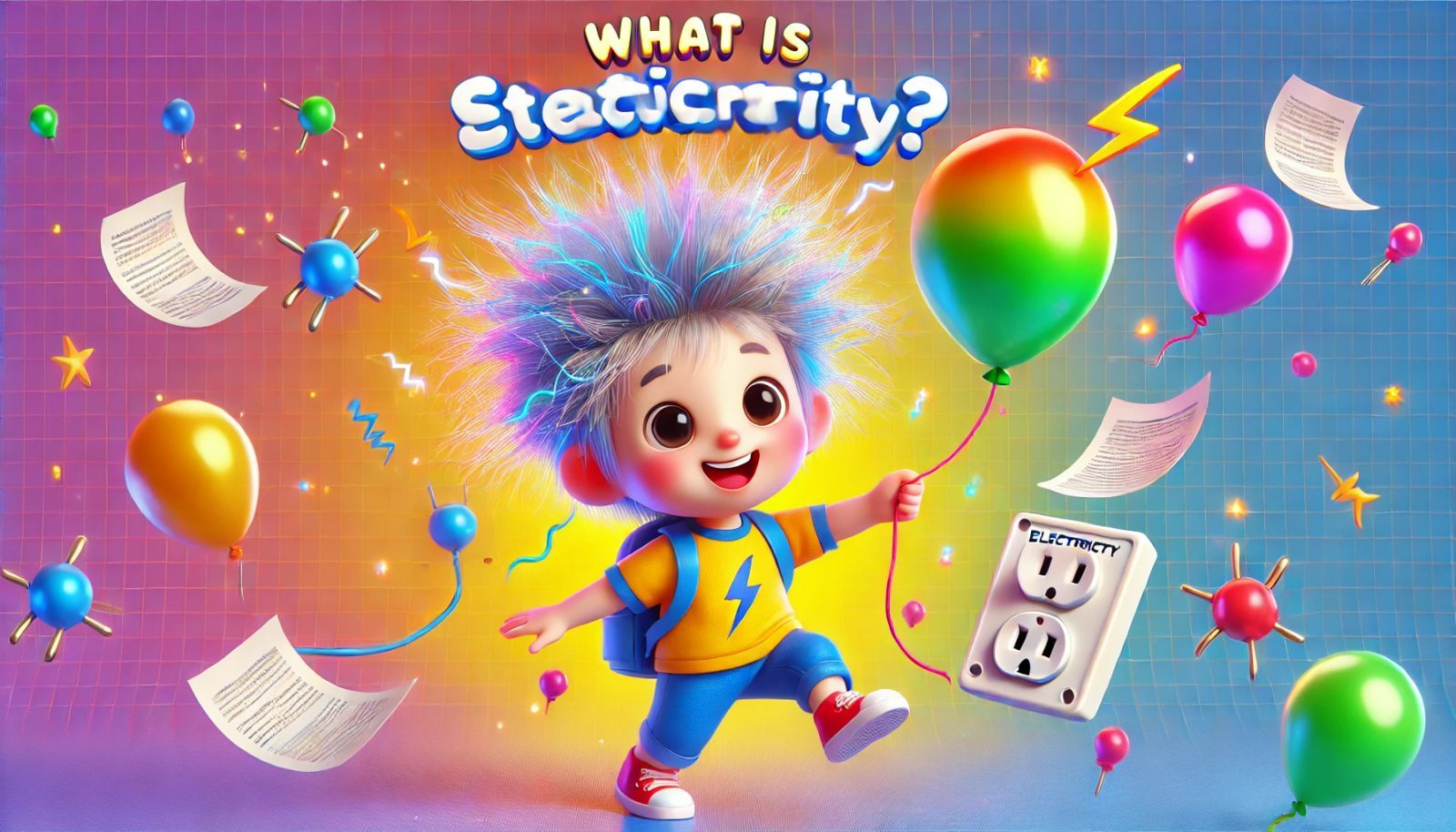
What is Static Electricity? Fun Experiments for Kids to Understand Science!
The Shocking Truth About Static Electricity and Fun Experiments for Kids
Have you ever rubbed a balloon on your head and noticed your hair standing straight up? Or felt a tiny shock when you touched a metal doorknob? That’s static electricity in action! But what is static electricity, and why does it make your hair do that crazy dance? Let’s find out with a fun explanation and experiment you can try at home!
The Shocking Truth About Static Electricity
Static electricity is a kind of electricity that happens when certain materials rub together. It all comes down to something super tiny called electrons. Electrons are part of atoms, which make up everything around us, including you! Sometimes, when two objects rub together, electrons move from one object to another. This creates a tiny electric charge—one object becomes positively charged, and the other becomes negatively charged. These opposite charges attract each other, which is why your hair reaches for the balloon!
Why Does Your Hair Stand Up?
When you rub a balloon on your hair, the balloon grabs some of your hair’s electrons. This leaves your hair positively charged, and the balloon becomes negatively charged. Since your hair strands all have the same positive charge, they repel each other (kind of like magnets pushing away). That’s why your hair stands up and spreads out in all directions!
Let’s Try a Fun Experiment!
Here’s a cool and easy experiment to see static electricity in action.
When you rub the balloon, it picks up extra electrons. The paper has fewer electrons, so it’s attracted to the balloon. That’s static electricity at work!
DO YOU KNOW?
Fun Facts About Static Electricity
Interactive Quiz: Are You a Static Electricity Expert?
(Answers: 1. c, 2. b, 3. b)
Encouragement to Explore
Now it’s your turn to become a static electricity detective! Try rubbing different objects, like a plastic ruler or a comb, on your hair and see what happens. Can you pick up paper pieces or move small objects without touching them? What happens if you try it on a rainy day instead of a dry one?
The more you explore, the more you’ll discover the “zap-tastic” world of static electricity. Who knows? Maybe you’ll even solve some science mysteries of your own! Have fun experimenting!
✨ Did You Know?
📖 Science Word
Electron
/ih-LEK-tron/A tiny, subatomic particle with a negative electrical charge that orbits an atom's nucleus.
🔤 Word Scramble
Test Yourself!
Question 1 of 4
What microscopic particles move between materials during friction to create static electricity?
Quick Poll
Where do you run into annoying static electricity shocks most often?
How fun was this article?