

How Are Rainbows Formed? Easy Science Explanation for Kids 🌈
| 🌟 Quick Answer: A rainbow forms when sunlight passes through tiny raindrops in the air. The light bends, bounces, and splits into seven beautiful colors. Keep reading to find out exactly how it works — and how to make your own rainbow at home! |
Have you ever looked up at the sky after a rainstorm and spotted a giant arc of color stretching across the clouds? Rainbows are one of the most magical things in nature — and the science behind them is just as amazing as they look!
In this guide, we’ll explain exactly how rainbows form, why they have those beautiful colors, why they’re curved, and even how to make your very own rainbow at home. Let’s dive in!
What Is a Rainbow?
A rainbow is a large arc of colored light that appears in the sky when sunlight and rain are in the sky at the same time. It always appears on the opposite side of the sky from the Sun.
Rainbows aren’t solid objects you can touch or reach — they’re actually optical illusions! That means they’re caused by the way light travels into your eyes. This is why you can never find the ‘end’ of a rainbow no matter how far you walk toward it — it moves with you!
| 🌍 Fun Fact: The word ‘rainbow’ comes from the Latin ‘arcus pluvius,’ which means ‘rainy arch.’ People have been wondering about rainbows for thousands of years! |
How Are Rainbows Formed? (Step-by-Step)
Here is exactly what happens when a rainbow forms — step by step:
- Sunlight enters a raindrop
- The light bends (refraction)
- Light reflects inside the raindrop
- The light bends again as it exits
- Colors spread apart
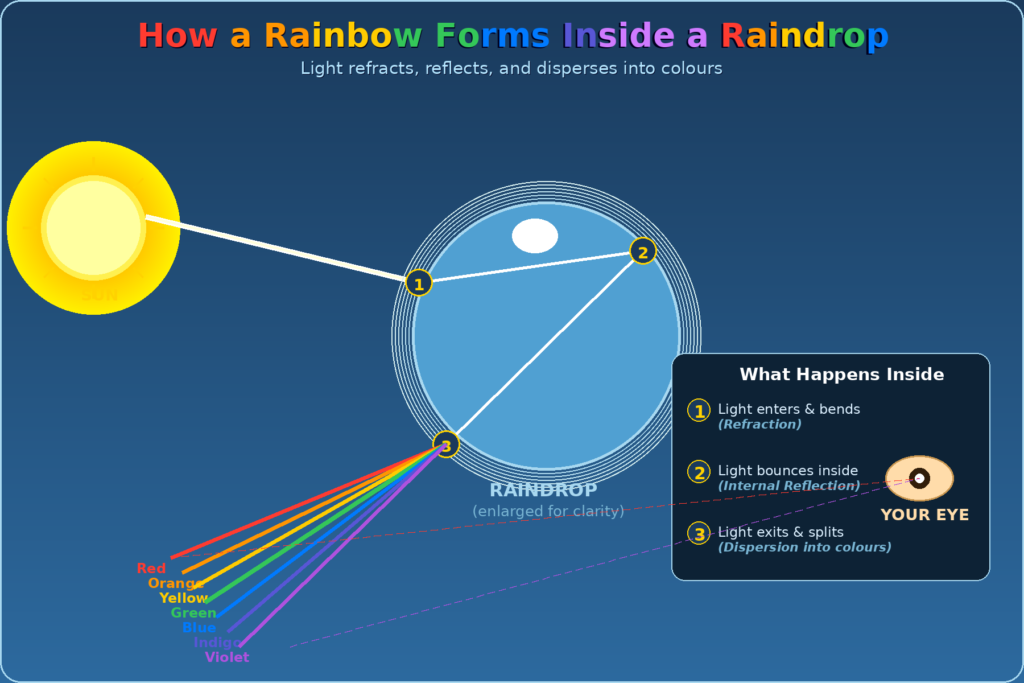
| 🔬 Key Science Word — Refraction: The bending of light when it passes from one material into another (like from air into water). This is the most important part of how a rainbow forms! |
What Colors Are in a Rainbow?
A rainbow always has exactly seven colors, always in the same order. Scientists use the name ROYGBIV to remember them:
- 🔴 Red — always on the outside (top) of the arc
- 🟠 Orange
- 🟡 Yellow
- 🟢 Green
- 🔵 Blue
- 🟣 Indigo
- 🟣 Violet — always on the inside (bottom) of the arc

These seven colors are not random — they are actually all the colors hidden inside ordinary white sunlight! Sunlight looks white, but it is actually made up of every color mixed together. A raindrop acts like a prism and separates them all out.
| 🧠 Memory Trick: Use the name ROY G BIV — each letter stands for a color: Red, Orange, Yellow, Green, Blue, Indigo, Violet. Try saying it out loud! |
Why Is a Rainbow Always Curved?
Have you ever wondered why rainbows are shaped like a giant curved arch? It all comes down to geometry!
Raindrops are perfectly round spheres (like tiny balls). When sunlight passes through millions of these round droplets, the reflected and refracted light forms a complete circle of color in the sky.
However, the ground blocks the bottom half of this circle. So from where we stand, we only see the top half — which looks like a curved arch or semicircle.
| ✈️ Mind-Blowing Fact: If you were in an airplane or standing on top of a very tall mountain, you could sometimes see a FULL CIRCLE rainbow! Pilots have reported seeing complete rainbow circles from the air. |
What Is a Double Rainbow?
Sometimes — if you’re really lucky — you might spot two rainbows in the sky at the same time! This is called a double rainbow. But how does it happen?
A double rainbow occurs when light reflects TWICE inside each raindrop instead of just once. The second rainbow appears above the first one and is always:
- Fainter and less bright than the first rainbow
- Wider than the primary rainbow
- Reversed in color order — violet is on the outside, red is on the inside
The sky between the two rainbows often looks darker than the rest of the sky. Scientists call this dark band Alexander’s Band, named after the ancient Greek philosopher Alexander of Aphrodisias who first described it.
Can You Touch or Reach a Rainbow?
This is one of the most popular questions kids ask — and the answer is no, you can never touch or reach a rainbow!
A rainbow is not a physical object. It is not ‘sitting’ in the sky somewhere. Instead, it is an optical effect — meaning it only exists because of the way light is entering your eyes from that particular angle.
If you walk toward a rainbow, it moves away from you at exactly the same speed. That is why you can never find the end of a rainbow. Two people standing in different spots will each see a completely different rainbow, even if they are looking at the same sky and the same raindrops!
| 🎨 Think About It: Everyone sees their very own personal rainbow — no two people ever see exactly the same one. Your rainbow belongs only to you! |
Make Your Own Rainbow at Home! 🧪
You don’t need to wait for rain to see a rainbow. You can make your very own with just a few things you have at home!
What You Need:
- A clear glass or bowl of water
- A sunny day (or a flashlight)
- A white piece of paper or a white wall
Steps:
- Fill a clear glass or bowl with water and place it near a sunny window.
- Hold the glass up so sunlight shines directly through the water.
- Place a white sheet of paper on the floor or wall where the light passes through.
- Look closely — you should see a rainbow of colors appear on the paper!
- Try tilting the glass at different angles to make the rainbow bigger or change its shape.
| 💡 Why It Works: The glass of water acts just like a giant raindrop! The light bends as it enters and exits the water, splitting into all the colors of the rainbow — just like in the sky after rain. |
Bonus Experiment — Rainbow With a Garden Hose:
On a sunny day, stand with your back to the Sun and spray a fine mist of water with a garden hose in front of you. If the angle is right, you will see a real rainbow appear in the mist! This works because the tiny water droplets act exactly like raindrops in the sky.
Amazing Rainbow Facts for Kids! 🌟
- Rainbows can only be seen when the Sun is behind you and rain is in front of you.
- The Sun must be less than 42 degrees above the horizon for a rainbow to be visible — that’s why rainbows are more common in the morning or late afternoon.
- Moonbows are real! On rare occasions, a very bright full moon can create a faint rainbow at night called a moonbow.
- Fogbows are white rainbows! When sunlight shines through very tiny fog droplets, the colors overlap and create a white arc called a fogbow.
- Rainbows cannot be seen from inside a moving car if the windows are up — the glass distorts the angle needed to see them properly.
- The colors of a rainbow are not completely separate — they blend smoothly into each other with millions of color shades in between.
Quiz: Test Your Rainbow Knowledge! 🎯
Think you’ve learned everything about rainbows? Test yourself with these questions!
Question 1: What two things do you need to see a rainbow?
- a) Snow and wind
- b) Sunlight and raindrops ✅
- c) Clouds and moonlight
Question 2: What is it called when light bends as it passes through water?
- a) Reflection
- b) Absorption
- c) Refraction ✅
Question 3: How many colors are in a rainbow?
- a) 5
- b) 7 ✅
- c) 10
Question 4: Why is a rainbow curved?
- a) Because the sky is curved
- b) Because raindrops are round spheres, which scatter light in a circle ✅
- c) Because wind bends the light
Question 5: In a double rainbow, which color is on the OUTSIDE of the second rainbow?
- a) Red
- b) Violet ✅
- c) Blue
| 🎓 Score: 5/5 = Rainbow Genius! 🏆 | 4/5 = Rainbow Expert! 🌈 | 3/5 = Rainbow Learner! 📚 | Below 3 = Read the article again — you’ve got this! 💪 |
Frequently Asked Questions About Rainbows
How are rainbows formed for kids?
Rainbows form when sunlight passes through raindrops in the air. The light bends as it enters the raindrop, bounces off the inside, and bends again as it exits. This splits the white sunlight into its seven separate colors — red, orange, yellow, green, blue, indigo, and violet — creating the beautiful arc we see in the sky.
How do rainbows form — what is the science behind it?
The science involves two key processes: refraction (bending of light) and reflection (bouncing of light). When sunlight enters a round raindrop, it refracts (bends), reflects off the back wall inside the drop, then refracts again on the way out. Because different colors of light bend at slightly different angles, they separate into a visible spectrum of color.
What colors are in a rainbow, and what order are they in?
There are seven colors in a rainbow, always in the same order from outside to inside: Red, Orange, Yellow, Green, Blue, Indigo, and Violet. The easiest way to remember them is with the name ROY G BIV.
Why is a rainbow always curved?
A rainbow is curved because of the shape of raindrops. Raindrops are perfectly round, and they reflect light in a circular pattern. From the ground, we see only the upper half of this circle because the earth blocks the bottom half. If you were high enough in the air, you could see a complete circle rainbow.
Why can’t you reach or touch a rainbow?
A rainbow is not a physical object — it is an optical effect created by the angle between your eyes, the Sun, and raindrops. As you move toward a rainbow, the angle changes and the rainbow appears to move away. This is why you can never reach the end of a rainbow.
What causes a double rainbow?
A double rainbow happens when sunlight reflects twice inside raindrops instead of just once. The second rainbow is fainter, wider, and has its colors in reverse order compared to the first rainbow. The dark area between the two rainbows is called Alexander’s Band.
Can you make a rainbow at home?
Yes! Fill a clear glass with water and hold it in direct sunlight. Place a white piece of paper where the light shines through the glass. The water bends the light just like a raindrop does, and you’ll see a small rainbow appear on the paper. You can also use a garden hose to spray fine mist with your back to the Sun.
What is a moonbow?
A moonbow is a rare rainbow that appears at night, created by moonlight instead of sunlight. Because moonlight is much dimmer than sunlight, moonbows are very faint and often appear white to the human eye — though cameras can capture their colors. They are most commonly seen near large waterfalls.
Conclusion
Now you know the secret science behind one of nature’s most beautiful shows! Every time you see a rainbow, you’re watching sunlight perform an amazing trick — bending, bouncing, and splitting as it travels through millions of tiny raindrops.
Rainbows remind us that science is all around us, hiding in the simplest things. The next time it rains and the Sun comes out, run to the window and look for your very own personal rainbow in the sky. And remember — that rainbow exists just for you!
| 🚀 Enjoyed this article? Explore more amazing science on KidsScienceMagazine.com! Try: ‘How Do Magnets Work?’ | ‘What Causes Earthquakes?‘ | ‘How Do Hot Air Balloons Fly?‘ |
Remember it’s a beautiful mix of sunlight and water working together to show us all the colors hidden in light. Rainbows are a wonderful reminder of the amazing science all around us!

The Kids Science Magazine Editorial Team brings together nearly a decade of hands-on experience in electronics engineering, IoT systems, and embedded technology — combined with a deep passion for making complex science genuinely exciting for young minds. Our writers have worked across core electronics testing and real-world technology development, giving every science mystery article a foundation in actual engineering thinking rather than surface-level storytelling. We believe every child deserves access to mind-blowing science — explained clearly, honestly, and in a way that makes them lean forward and ask “but wait, WHY?” Every mystery published on this site is thoroughly researched, fact-checked against credible scientific sources, and written to spark curiosity in kids aged 8–14 across the USA, UK, Canada, Australia & Others across the Globe. New mystery every Friday — because science never runs out of surprises.




One Comment