What is the polar vortex and why does it cause extreme winter cold? This kid-friendly science explainer shows how it works, where it lives, and what happens when it weakens.
The Invisible Cold Giant That Lives Above the North Pole
🔍 Quick Highlights
- The polar vortex is a huge ring of cold air spinning high above Earth.
- It usually stays locked around the North Pole.
- When it weakens or stretches, icy air can rush south and cause extreme winter weather.
- The polar vortex works closely with the jet stream.
🌍 What Is the Polar Vortex?
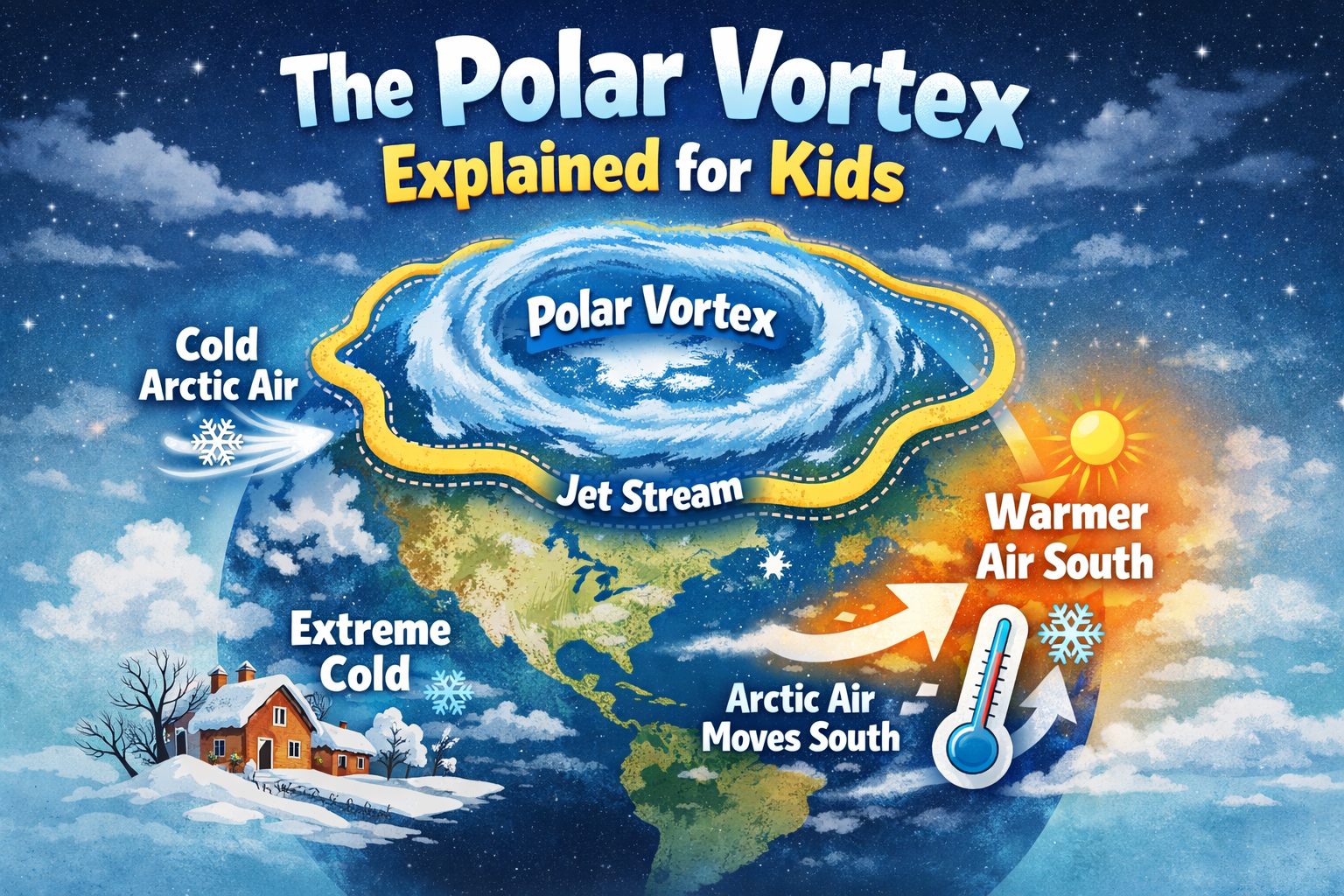
The polar vortex is a giant whirlpool of super-cold air that circles the North Pole.
You can’t see it with your eyes, but it’s always there during winter—spinning like a massive merry-go-round of cold air high above Earth.
It is not a storm by itself.
Instead, it’s a pattern of strong winds that helps keep the cold air trapped in the Arctic.
☁️ Where Does the Polar Vortex Live?
To understand the polar vortex, we need to look at the layers of the atmosphere.
🧱 Earth’s Lower Atmosphere (Kid-Friendly)
- Troposphere
- Closest to Earth
- Where clouds, rain, snow, and storms happen
- Stratosphere
- Above the troposphere
- Where the polar vortex lives
- Very cold, very stable air
The polar vortex spins about 20 miles above Earth, far above airplanes and weather clouds.
🧭 Why Does the Polar Vortex Usually Stay Near the North Pole?
Most of the time, the polar vortex is strong and stable.
Here’s why it stays put:
- The Arctic is much colder than areas farther south
- This big temperature difference creates fast-moving winds
- These winds form a tight circular barrier around the pole
👉 Think of it like a frozen fence that keeps the cold air locked in.
When this fence is strong, winter weather in the U.S. and other places stays more normal.
🌀 Is the Polar Vortex the Same as the Jet Stream?
They are related, but not the same.
✈️ Jet Stream
- A fast river of air lower in the atmosphere
- Steers storms and weather systems
- Much closer to Earth
❄️ Polar Vortex
- Higher up in the stratosphere
- Bigger and colder
- Influences how the jet stream behaves
When the polar vortex changes shape, the jet stream often reacts.
🚨 What Happens When the Polar Vortex Weakens?
Sometimes, the polar vortex loses strength or gets stretched.
When that happens:
- The tight circular winds slow down
- Cold Arctic air can leak out
- The jet stream becomes wavier
- Cold air is pushed farther south
That’s when places like the U.S., Europe, or Asia can experience:
- Sudden deep freezes
- Heavy snowstorms
- Dangerous ice storms
This is exactly what helped cause the January 2026 US winter freeze.
🧊 What Does “Stretching” Mean?
A stretched polar vortex looks less like a circle and more like a blob.
Imagine:
- A spinning ice skater pulling one arm out
- The spin becomes uneven
When the vortex stretches:
- One part may dip south over North America
- Another part may move toward Europe or Asia
Each dip can send bitter cold air into new regions.
🌡️ If Earth Is Warming, Why Does the Polar Vortex Still Cause Cold?
Great question—and one scientists are actively studying.
Here’s what we know:
- Earth is warming overall
- The Arctic is warming faster than the rest of the planet
- This may weaken the polar vortex more often
A weaker vortex doesn’t mean “no winter.”
It can actually mean more extreme swings, including intense cold outbreaks.
🧠 How Do Scientists Study the Polar Vortex?
Scientists use:
- Weather balloons
- Satellites
- Supercomputer models
Agencies like the National Oceanic and Atmospheric Administration track the polar vortex to help predict dangerous cold waves days or even weeks ahead.
This research helps:
- Issue early warnings
- Protect people and infrastructure
- Improve weather forecasts
🌟 The Big Idea to Remember
✔ The polar vortex is real and always there
✔ It usually stays near the North Pole
✔ When it weakens, cold air can escape
✔ It plays a huge role in extreme winter weather
Understanding the polar vortex helps us understand why winter can suddenly turn fierce—and why weather science matters.
🔬 Want to Explore More?
❄️ Why This Winter Storm Was So Powerful | Science Behind the January 2026 US Freeze
- Jet Stream Explained for Kids
- Why Ice Storms Are So Dangerous
- Snow vs Sleet vs Freezing Rain
🌬️ Science Around Us:
How the Polar Vortex Can Affect Your Daily Life
The polar vortex might sound like something far away in the Arctic, but when it changes, people across the United States can feel its effects right outside their homes.
When the polar vortex stays strong and circular near the North Pole, winter weather is usually more predictable. But when it weakens or stretches, cold Arctic air can rush south—and that’s when daily life changes fast.
❄️ What You Might Notice
- Sudden temperature drops, even after mild days
- School delays or closures due to snow or ice
- Power outages when freezing rain coats power lines
- Dangerous roads caused by ice instead of snow
🧥 Why It Matters to You
A polar vortex outbreak can affect:
- What you wear to school
- Whether buses run on time
- How long outdoor activities last
- How families prepare their homes for cold
Understanding the polar vortex helps you read weather forecasts better and understand why adults sometimes say, “This cold came out of nowhere!”
🌍 The Big Connection
Even though Earth is warming overall, changes in the polar vortex can still bring short bursts of extreme cold. That’s why scientists keep studying it—to help communities prepare and stay safe.
1. The polar vortex is a huge area of cold air spinning high above Earth.
The polar vortex is a large ring of super-cold air that spins in the upper atmosphere.
2. The polar vortex usually stays near the North Pole.
Strong winds normally keep the polar vortex locked around the Arctic.
3. The polar vortex lives in the troposphere, where clouds form.
The polar vortex lives higher up, in the stratosphere.
4. When the polar vortex weakens, cold Arctic air can move south.
A weaker vortex allows cold air to escape into lower latitudes.
5. The polar vortex and the jet stream can influence each other.
Changes in the polar vortex can make the jet stream wavier.
6. A stretched polar vortex can cause extreme winter weather.
When stretched, the vortex can send cold air far south.