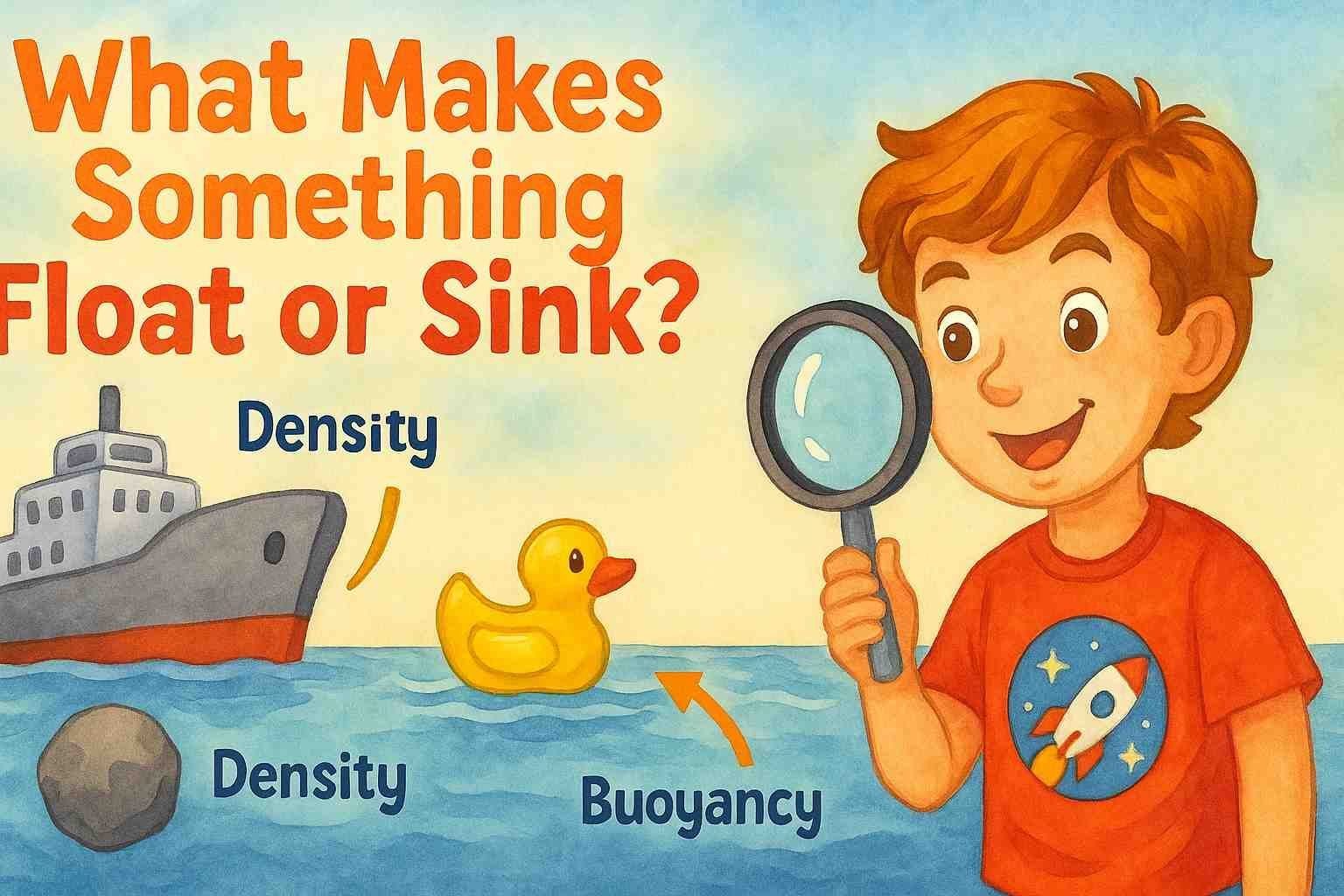
🌊 What Makes Something Float or Sink? | Buoyancy & Density Explained for Kids
Let’s Dive into the Mystery of Buoyancy and Density!
Let’s Dive into the Mystery of Buoyancy!
🚤 Have You Ever Wondered…?
Why does a giant ship made of heavy metal float, but a small stone sinks? 🤔Or why do some fruits float in water, while others plop straight to the bottom?
It might seem like magic—but it’s actually science in action! Let’s explore the fascinating world of floating and sinking with the help of two awesome science friends: Buoyancy and Density!
🔍 Meet the Heroes: Buoyancy and Density
🟡 Buoyancy: The Upward Push
When you place something in water, water pushes back. This push is called buoyancy (say: BOY-an-see). It’s the force that tries to lift objects up when they’re in water.
👉 Think of it like a secret helper that holds things up!But… is that helper always strong enough? Not always! That’s where our next friend comes in.
⚫ Density: The Packed Power
Density is how much stuff is packed inside an object. In science, we say:
In simple words, if something is very tightly packed (high density), it’s heavier for its size. If it’s loosely packed (low density), it’s lighter.
🧊 Imagine This:
So, whether something floats or sinks depends on how dense it is compared to water.
🌊 The Golden Rule of Floating
Simple, right? That’s the float or sink rule in action!
⚙️ How Does a Ship Float?
Ships are made of steel, a very dense material. So how do they float?
👉 It’s because ships are hollow inside and filled with air!The combination of metal and air lowers the ship’s overall density, making it less dense than water — and so, it floats easily across oceans!
🌟 FACTS TO KNOW!
✅ Saltwater helps things float better than freshwater. That’s why floating in the sea is easier than in a pool! 🌊
✅ Submarines adjust their density by taking in or pushing out water to sink or float!
✅ Oil floats on water because oil is less dense — that’s why when you mix them, oil stays on top.
🧠 DID YOU KNOW?
🔬 Try This At Home! (Fun Experiment)
Take a glass of water and try putting in:
What floats? What sinks? Make guesses first, then test!You’ve just done your own density detective work!
🚀 In Summary…
Whether it’s a giant cruise ship, a tiny rubber duck, or a stone, floating and sinking all depend on:
Next time you’re near water, look around. There’s a whole world of floating and sinking waiting for you to explore! 🌊🔎
✅ Bonus Quiz for Curious Kids
✨ Did You Know?
📖 Science Word
Density
/DEN-sih-tee/The measure of how tightly mass is packed into a given space or volume of an object or substance.
🔤 Word Scramble
Test Yourself!
Question 1 of 4
What is the primary condition required for an object to float in liquid water?
Quick Poll
Which of these floating science demonstrations would you like to build?
How fun was this article?