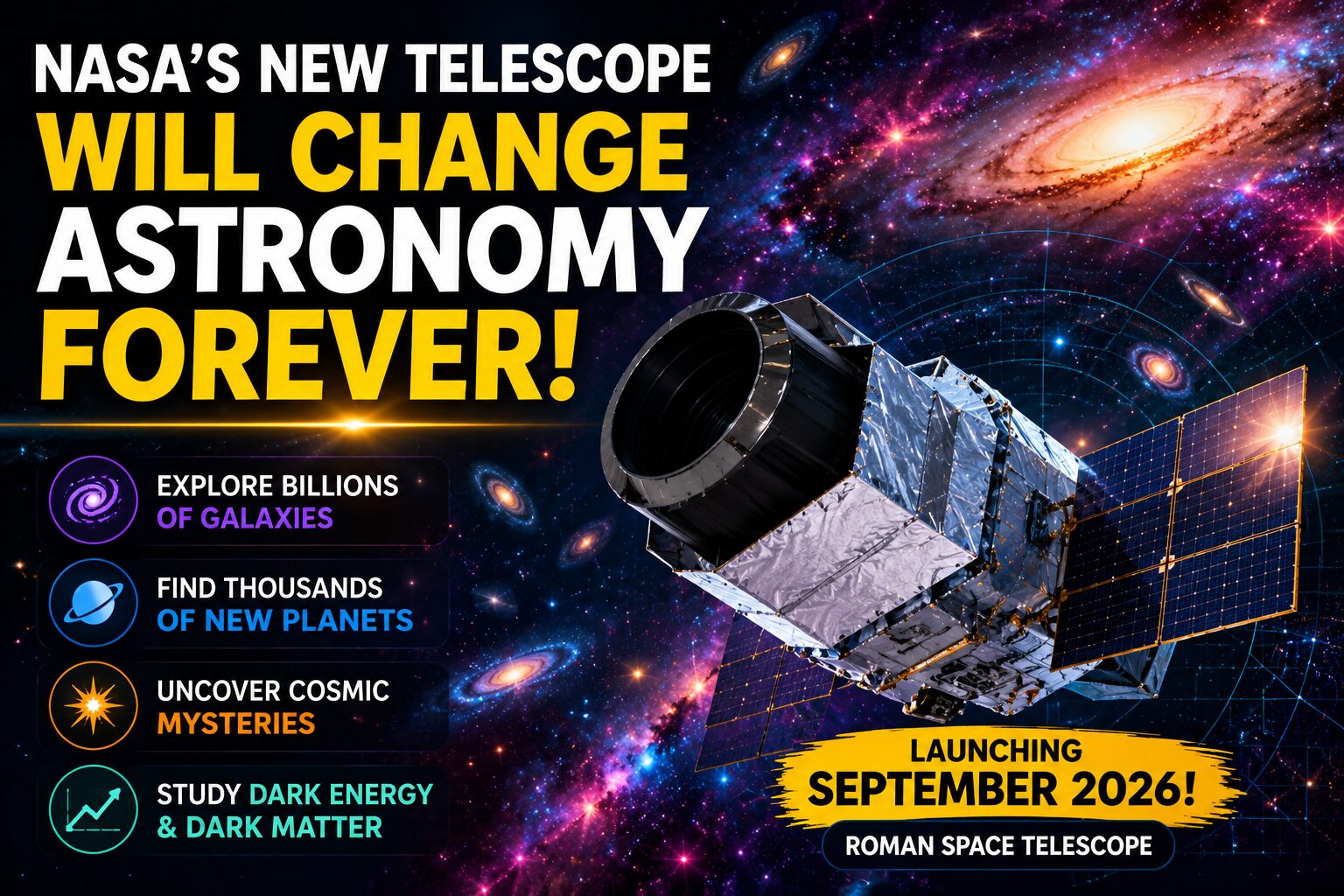
NASA’s powerful Roman Space Telescope may launch earlier than expected and could uncover new planets, mysterious galaxies, and cosmic phenomena never seen before.
🤯 What If We Could Map Huge Parts of the Universe All at Once?
Most space telescopes look at tiny slices of space.
But NASA’s upcoming NASA Nancy Grace Roman Space Telescope is different.
It’s designed to scan enormous regions of the universe in incredible detail — almost like switching from a flashlight to a giant floodlight in space.
Scientists think Roman could discover:
- entirely new planets
- hidden galaxies
- strange cosmic explosions
- and maybe even phenomena nobody has ever seen before.
So how can one telescope do so much?
🔎 Key Highlights
- NASA’s Roman Space Telescope may launch as early as September 2026
- The telescope will study dark matter, dark energy, and exoplanets
- Roman combines a huge field of view with powerful infrared vision
- Scientists expect it to detect around 100,000 exoplanets
- The mission could reveal entirely new cosmic phenomena
🖼 Feature Image Placeholder
(Insert 16:9 editorial-style feature image showing the Roman Space Telescope observing galaxies and distant stars with glowing infrared cosmic imagery.)
🚀 Meet NASA’s Roman Space Telescope
The NASA Nancy Grace Roman Space Telescope is one of the most ambitious astronomy missions ever built.
It is named after Nancy Grace Roman, often called the “Mother of Hubble” because she helped make the famous Hubble Space Telescope possible.
Roman will orbit space and study the universe using infrared light, which allows scientists to see objects hidden behind dust clouds or located extremely far away.
🌠 Why Roman Is Different From Other Space Telescopes
Most telescopes can only observe a tiny piece of the sky at once.
Roman is special because it combines:
- a huge viewing area
- extremely sharp detail
- powerful infrared imaging
Imagine taking:
- a normal phone photo
vs. - an ultra-wide panoramic image of an entire city.
That’s similar to what Roman will do for the universe.
Scientists expect Roman to create gigantic surveys containing:
- hundreds of millions of galaxies
- billions of stars
- huge amounts of cosmic data
🌌 Searching for Dark Matter and Dark Energy
One major goal of Roman is studying two of the universe’s biggest mysteries:
🌑 Dark Matter
Invisible material that creates gravity and helps hold galaxies together.
⚡ Dark Energy
A mysterious force causing the universe to expand faster and faster.
Together, dark matter and dark energy may make up most of the universe — but scientists still do not fully understand them.
Roman could help solve these cosmic puzzles.
🪐 Hunting for New Worlds
Roman will also search for planets beyond our solar system called exoplanets.
Scientists estimate the telescope could help discover about:
🌍 100,000 exoplanets
Some may orbit distant stars in completely different types of planetary systems.
Others could even challenge current ideas about how planets form.
📡 A Giant Cosmic Data Machine
During its five-year mission, Roman is expected to collect around:
💾 20,000 terabytes of data
That’s an enormous amount of information.
Scientists around the world will study this archive for decades, searching for:
- strange cosmic events
- hidden galaxies
- exploding stars
- and unexpected discoveries
Some discoveries may involve things astronomers have never seen before.
🛰 How Roman Will Reach Space
NASA plans to launch Roman aboard a SpaceX Falcon Heavy rocket from Kennedy Space Center.
The mission could launch as early as:
📅 September 2026
🧠 Science Terms Explained
Infrared Light
A type of light humans cannot see with their eyes. It helps telescopes observe distant or hidden objects in space.
Exoplanet
A planet orbiting a star outside our solar system.
Dark Matter
Invisible material believed to create extra gravity in galaxies.
Dark Energy
A mysterious force thought to be speeding up the expansion of the universe.
🎨 Analogy: Roman as a Cosmic Mega Camera
Imagine trying to photograph an entire forest.
Most telescopes zoom in on one tree.
Roman will capture huge sections of the forest at once — while still seeing tiny details on individual leaves.
That’s why scientists are so excited.
🌍 Why This Discovery Matters
Roman could completely reshape astronomy.
Its discoveries may help scientists:
- understand how galaxies formed
- learn how the universe evolved
- discover strange new planets
- investigate cosmic mysteries we still cannot explain
The telescope’s data may remain useful for generations of astronomers.
🧩 Quick Quiz: Roman Space Telescope Challenge!
1️⃣ What type of light will Roman mainly use?
A) Radio waves
B) Infrared light
C) X-rays
D) Visible light
2️⃣ What is an exoplanet?
A) A moon around Earth
B) A comet in our solar system
C) A planet outside our solar system
D) A black hole
3️⃣ What mystery force may be expanding the universe faster?
A) Gravity
B) Dark energy
C) Magnetism
D) Radiation
4️⃣ About how many exoplanets could Roman help discover?
A) 100
B) 1,000
C) 100,000
D) 1 million
5️⃣ What company’s rocket may launch Roman?
A) Boeing
B) Blue Origin
C) SpaceX
D) ESA
✅ Answers
1-B
2-C
3-B
4-C
5-C
🌟 Big Takeaway
The Roman Space Telescope may become one of the greatest cosmic explorers ever built.
By mapping huge parts of space in incredible detail, it could uncover hidden worlds, mysterious forces, and maybe even discoveries nobody has imagined yet.
Sometimes the universe reveals its biggest secrets only when we finally learn how to look wider.
❓ Mini FAQ
What is the Roman Space Telescope?
It is NASA’s upcoming space observatory designed to study galaxies, dark matter, dark energy, and exoplanets.
Why is Roman important?
It can survey enormous areas of space much faster than many previous telescopes.
What does infrared light help scientists see?
Infrared light helps reveal distant or hidden objects blocked by cosmic dust.
How many planets might Roman discover?
Scientists estimate Roman could help detect around 100,000 exoplanets.
When could Roman launch?
NASA is currently targeting a possible launch in September 2026.

The Kids Science Magazine Editorial Team brings together nearly a decade of hands-on experience in electronics engineering, IoT systems, and embedded technology — combined with a deep passion for making complex science genuinely exciting for young minds. Our writers have worked across core electronics testing and real-world technology development, giving every science mystery article a foundation in actual engineering thinking rather than surface-level storytelling. We believe every child deserves access to mind-blowing science — explained clearly, honestly, and in a way that makes them lean forward and ask “but wait, WHY?” Every mystery published on this site is thoroughly researched, fact-checked against credible scientific sources, and written to spark curiosity in kids aged 8–14 across the USA, UK, Canada, Australia & Others across the Globe. New mystery every Friday — because science never runs out of surprises.