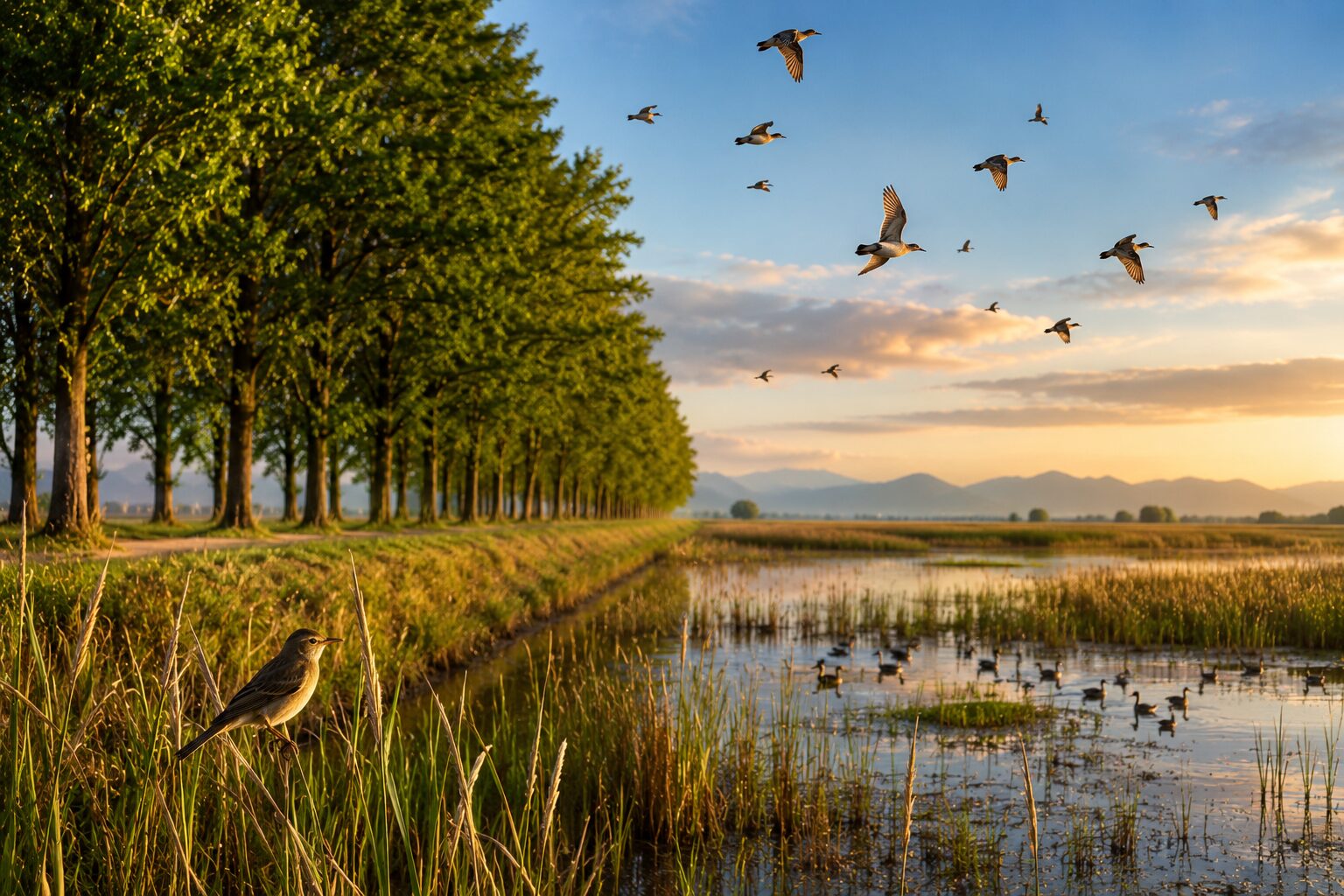
Trees are often planted to help wildlife, but scientists found that in some wetlands, adding more trees can actually reduce the number and variety of certain birds.
🤔 Kids Curiosity
If you wanted to help birds, what would you do?
Most people would probably say:
👉 “Plant more trees!”
Trees provide food, shelter, and nesting places for many animals. But what if adding trees sometimes makes life harder for other birds?
Scientists studying wetlands in Japan have uncovered a surprising conservation mystery: in some habitats, more trees can actually mean fewer birds.
🔍 Key Highlights
- Scientists studied birds in wet farmland in Japan
- Rows of trees called shelterbelts helped some bird species
- However, they reduced the number of grassland and wetland birds
- Some bird populations were more than 70% lower near tree rows
- The discovery shows that conservation solutions aren’t always one-size-fits-all
🐦 Main Story: When Helping One Bird Can Hurt Another
For many years, environmental programs around the world have encouraged farmers to plant trees and hedges.
These tree rows, known as shelterbelts, help:
- Block strong winds
- Protect crops
- Create homes for wildlife
Because trees are usually good for nature, many people assumed that planting more of them would help all birds.
But nature is often more complicated.
🌾 A Giant Outdoor Bird Investigation
Scientists from Hiroshima University studied farmland around Lake Kahokugata.
The landscape included:
- Rice paddies
- Wetlands
- Grasslands
- Agricultural fields
This area is especially important because it lies along the famous:
👉 East Asian–Australasian Flyway
Every year, thousands of migratory birds stop there during their long journeys.
Researchers counted birds during different seasons and compared areas near shelterbelts with open wetland areas.
😲 The Unexpected Result
The scientists discovered clear winners and losers.
🌳 Birds That Benefited
Some birds that like shrubs, bushes, and habitat edges became more common near shelterbelts.
🌾 Birds That Struggled
Grassland and wetland birds showed the opposite pattern.
In fact:
👉 Grassland bird numbers were more than 70% lower near tree rows.
That’s a huge difference.
🧱 Trees Acting Like Invisible Walls
The researchers came up with an interesting idea.
They described shelterbelts as:
👉 “Ecological walls.”
Even though tree rows may seem small, they change how birds see the landscape.
Open-habitat birds prefer:
- Wide open spaces
- Clear views of predators
- Large nesting areas
When trees appear, those open spaces become broken up.
Some birds avoid the area altogether.
🦊 Another Possible Problem: Predators
Trees don’t just provide homes for birds.
They can also provide hiding places for predators such as:
- Crows
- Raptors
- Mammals
Scientists think this may be another reason why some wetland birds avoid areas near shelterbelts.
Future studies will investigate this possibility.
🧠 Science Terms Explained
- Shelterbelt: A row of trees planted to protect land from wind
- Wetland: Land covered by water for part or all of the year
- Biodiversity: The variety of living things in an area
- Migratory Bird: A bird that travels long distances between seasons
🌍 Why This Discovery Matters
This study teaches an important lesson:
👉 Nature doesn’t always have simple solutions.
🐦 Wildlife Conservation
Helping one species may accidentally harm another.
🌾 Farming
Farmers can support both crops and wildlife with better landscape planning.
🌍 Environment
Protecting biodiversity means understanding the needs of many different species.
🔬 Future Science
Researchers can design smarter conservation programs based on evidence rather than assumptions.
❓ Mini FAQ
Q1: What is a shelterbelt?
A shelterbelt is a row of trees planted to protect farmland from strong winds.
Q2: Did trees harm all birds?
No. Some birds benefited, while others declined.
Q3: Which birds were most affected?
Grassland and wetland birds that prefer open spaces.
Q4: Why might birds avoid tree rows?
Trees can reduce open habitat and may attract predators.
Q5: Does this mean planting trees is bad?
No. It means trees should be planted thoughtfully in the right places.
🌟 Big Takeaway
Trees are incredibly important for nature—but where we plant them matters.
This study reminds us that protecting wildlife isn’t just about adding more trees. It’s about creating the right mix of habitats so all kinds of birds can thrive.

The Kids Science Magazine Editorial Team brings together nearly a decade of hands-on experience in electronics engineering, IoT systems, and embedded technology — combined with a deep passion for making complex science genuinely exciting for young minds. Our writers have worked across core electronics testing and real-world technology development, giving every science mystery article a foundation in actual engineering thinking rather than surface-level storytelling. We believe every child deserves access to mind-blowing science — explained clearly, honestly, and in a way that makes them lean forward and ask “but wait, WHY?” Every mystery published on this site is thoroughly researched, fact-checked against credible scientific sources, and written to spark curiosity in kids aged 8–14 across the USA, UK, Canada, Australia & Others across the Globe. New mystery every Friday — because science never runs out of surprises.