
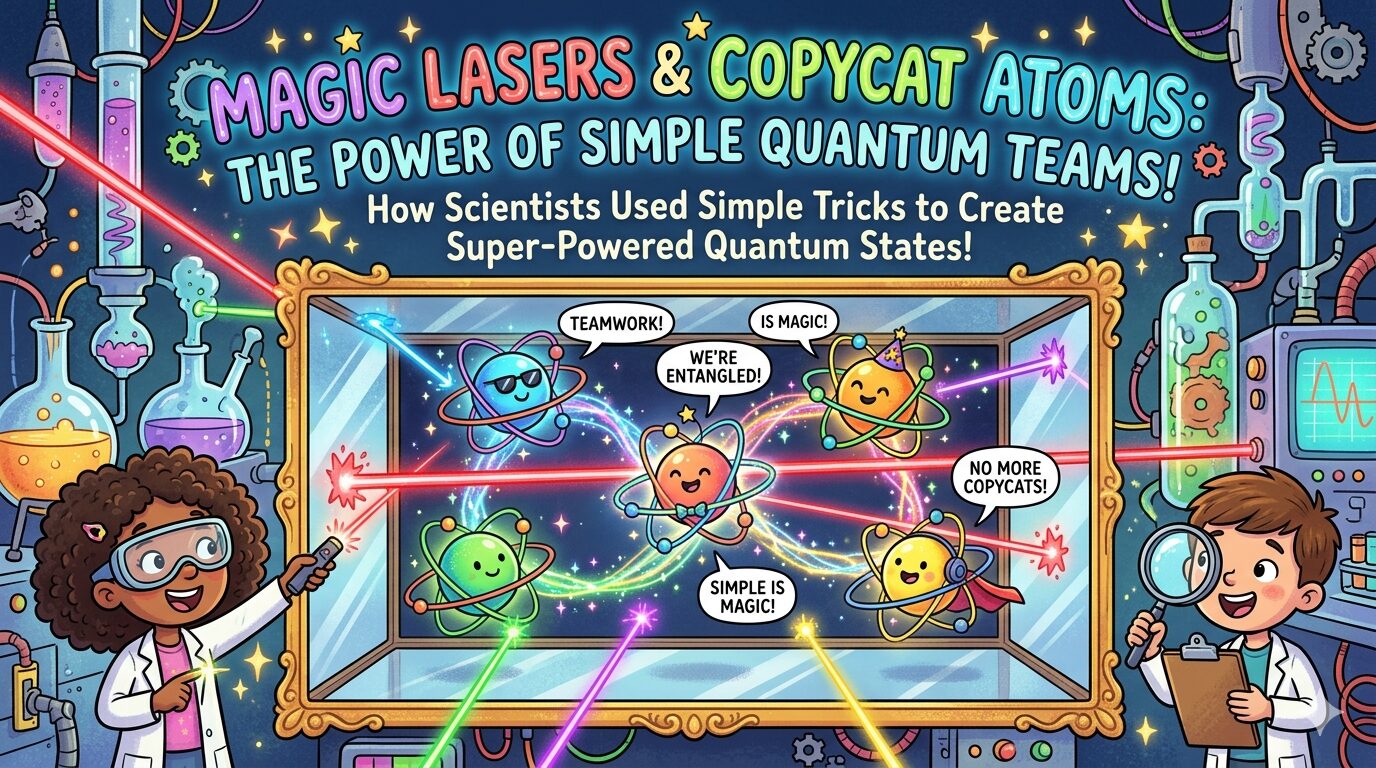
Have you ever tried to get a group of friends to do a perfectly synchronized dance, but everyone kept bumping into each other? That’s a lot like what scientists face when they try to work with quantum physics—the strange rules that govern the tiniest particles in the universe. For a long time, building powerful quantum setups required super-complicated machines. But recently, clever scientists at the University of Chicago found a surprisingly simple way to do it using regular lab lasers! By tweaking how atoms behave, they’ve unlocked a whole new way to build super-sensors that could one day map the earth, spot hidden magnetic fields, and help build ultra-fast quantum computers.
The Great Atom Copycat Problem
Imagine you are in a room full of mirrors with a bunch of your friends. If a single spotlight shines on all of you, you might all start doing the exact same dance moves at the exact same time.
This is very close to an experiment scientists use called Cavity QED. They trap tiny atoms inside a miniature box made of mirrors and shine a laser at them. The light bounces back and forth, and the atoms talk to the light.
But there was a big problem: all the atoms behaved exactly like identical copycats! Because they all did the exact same thing, the scientists couldn’t get them to form complex, teamwork-based groups called entangled states.
“The challenge has always been that these systems have too much symmetry,” explained Professor Aashish Clerk, one of the lead scientists. In other words, when everyone plays the exact same note, you can’t play a beautiful song!
Breaking the Mirror Rules with Lasers!
So, how did the scientists fix it? They didn’t buy a million-dollar new machine. Instead, they used a wonderfully simple trick.
They kept the main laser shining on all the atoms, but then they used extra lasers to gently nudge different groups of atoms. Think of it like giving half the friends in the mirror room a pair of sunglasses, and the other half a pair of funny hats.
Suddenly, the atoms weren’t perfect copycats anymore! But the scientists were very clever—they paired up the atoms so that for every atom nudged up, another atom was nudged down.
Because of this perfect balance, something magical happened. The scientists just turned on the lasers, waited a moment, and poof! The atoms automatically settled into a super-powered team. By just changing the laser beams, the scientists could create all kinds of new quantum patterns without changing a single piece of actual hardware!
The Super-Sensors That Never Get Distracted
One of the coolest things these atom teams can do is act as super-sensors.
Normally, quantum teams are incredibly fragile. If the room gets a tiny bit warm, or if there is a little bit of background noise, the team falls apart. It’s like trying to build a house of cards during a windy storm.
But this new laser trick makes the atom teams surprisingly tough! The scientists realized they could put one group of atoms in one spot and another group somewhere else to measure tiny changes in gravity or magnetic fields. If a giant wave of background noise hits both groups at the same time, the atoms naturally ignore it and only measure the real signal.
This means scientists can build a sensor that is incredibly sensitive to what they want to measure, but totally immune to distracting noise!
🧪 Word Bank: Key Scientific Terms Explained
- Quantum Physics: The science of the incredibly tiny. At this level, atoms and particles don’t follow normal rules—they can be in two places at once or pass through walls!
- Entanglement: A special quantum connection where two or more particles become a team. What happens to one particle instantly affects its partner, even if they are far apart!
- Atom: The tiny building blocks that make up everything in the universe, from the water you drink to the screen you are reading this on.
- Optical Cavity: A high-tech trap made of tiny mirrors used by scientists to bounce light back and forth to study how it interacts with atoms.
🧠 Quick Quiz: Test Your Quantum Knowledge!
1. What was the main problem with the old atom experiments?
- A) The atoms kept escaping the box.
- B) All the atoms behaved exactly like identical copycats.
- C) The mirrors kept breaking.
- D) The lasers weren’t bright enough.
2. How did the scientists break the “copycat” behavior of the atoms? - A) By using extra lasers to gently nudge different groups of atoms.
- B) By painting the atoms different colors.
- C) By making the mirror box bigger.
- D) By shaking the lab table.
3. What happens when quantum particles are “entangled”? - A) They get tangled up like holiday lights.
- B) They turn into lasers.
- C) They form a special team where they instantly affect each other.
- D) They disappear completely.
4. Why is this new quantum sensor method so special? - A) It is made entirely out of plastic.
- B) It can see through solid gold.
- C) It is super sensitive but can easily ignore distracting background noise.
- D) It doesn’t require electricity.
5. True or False: Scientists had to build a completely brand-new, expensive machine to make this discovery. - A) True
- B) False
👉 Click here to check your answers!
- B — The atoms had too much symmetry and acted like identical copycats.
- A — They used extra lasers to shift the energy levels of different groups.
- C — They become an interconnected quantum team.
- C — It combines extreme sensitivity with incredible toughness against noise.
- B — False! They used simple ingredients already found in most physics labs.

The Kids Science Magazine Editorial Team brings together nearly a decade of hands-on experience in electronics engineering, IoT systems, and embedded technology — combined with a deep passion for making complex science genuinely exciting for young minds. Our writers have worked across core electronics testing and real-world technology development, giving every science mystery article a foundation in actual engineering thinking rather than surface-level storytelling. We believe every child deserves access to mind-blowing science — explained clearly, honestly, and in a way that makes them lean forward and ask “but wait, WHY?” Every mystery published on this site is thoroughly researched, fact-checked against credible scientific sources, and written to spark curiosity in kids aged 8–14 across the USA, UK, Canada, Australia & Others across the Globe. New mystery every Friday — because science never runs out of surprises.