Scientists Find Hundreds of New Species 4,000 Meters Below the Surface
Hundreds of new species have been discovered deep beneath the Pacific Ocean. Scientists explored a hidden world 4,000 meters down, revealing fragile ecosystems and raising concerns about deep-sea mining.
🔍 Key Highlights (Quick Look)
- Scientists discovered nearly 800 species deep under the Pacific Ocean
- Many of these creatures were completely unknown to science
- The discoveries happened in an area where deep-sea mining may soon begin
- Test mining damaged local sea life—but less than scientists first feared
- The study reveals how little we know about life in the deep ocean
Welcome to Earth’s Hidden Underwater World 🌍⬇️
Imagine a place on Earth where:
- The sun never shines
- The water is freezing cold
- Food is incredibly rare
- Pressure is so strong it could crush a submarine
Now imagine that this place is full of life.
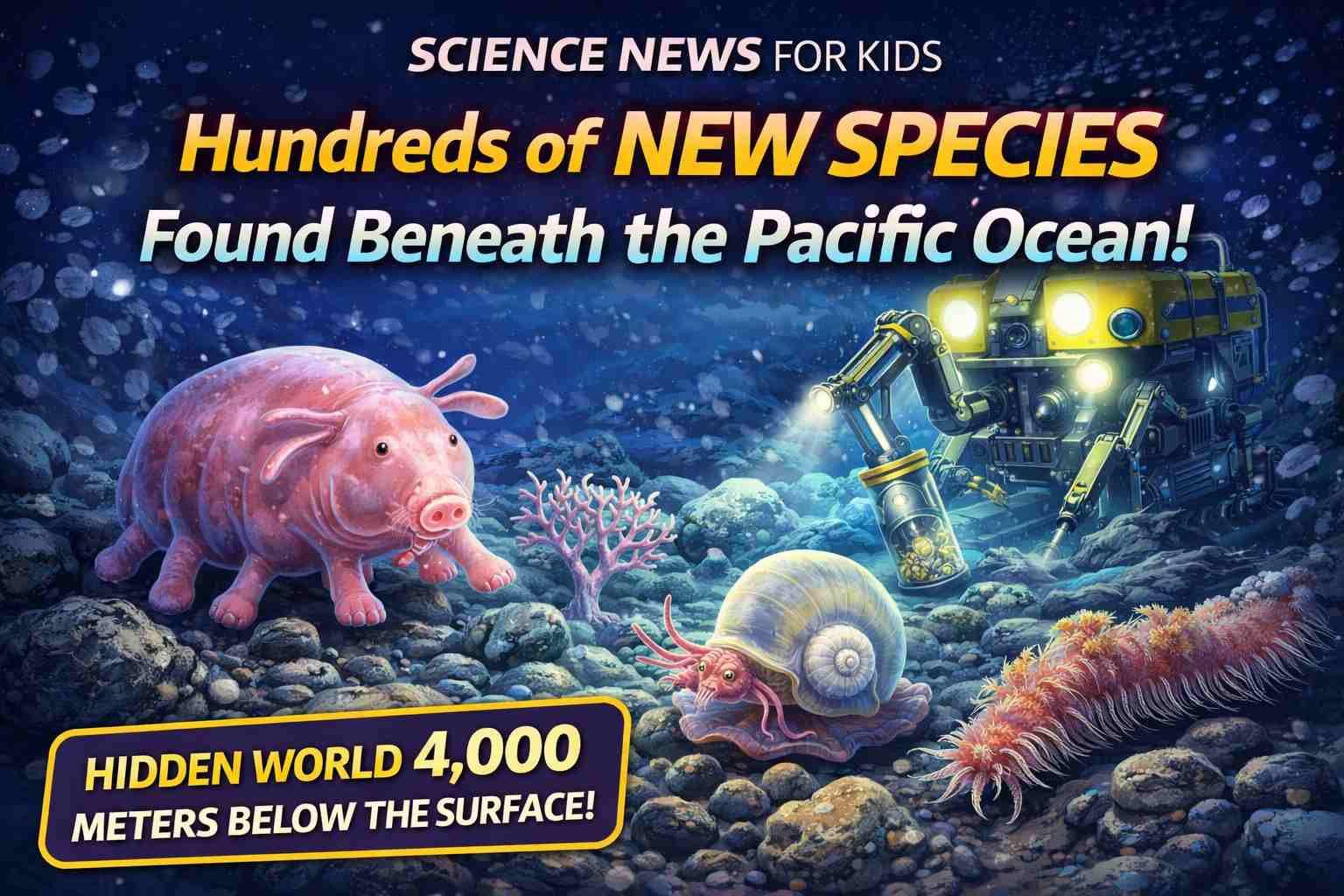
That’s exactly what scientists found deep beneath the Pacific Ocean—a secret world hiding almost 4,000 meters below the surface.
In a massive study published in Nature Ecology & Evolution, researchers revealed that the deep seafloor is home to hundreds of species no one knew existed.
Why Were Scientists Exploring So Deep? ⚙️🌱
The answer starts with critical metals.
These metals are needed to make:
- Electric car batteries 🔋
- Wind turbines 🌬️
- Solar panels ☀️
- Phones and computers 📱
Many of these metals are found in rocky lumps called nodules lying on the deep ocean floor.
As countries search for greener energy, some are considering deep-sea mining—collecting these metals from the seabed.
But first, scientists had an important question:
👉 What lives down there—and what happens if mining begins?
Meet the Clarion–Clipperton Zone 🗺️
The research took place in a vast deep-sea region called the Clarion–Clipperton Zone, located between Mexico and Hawaii.
This area is:
- One of the least explored places on Earth
- Rich in metal-filled nodules
- Home to strange and delicate deep-sea creatures
Scientists followed rules set by the International Seabed Authority, the group that controls mining in international waters.
Five Years, 160 Days at Sea, and a Big Surprise 🚢🔬
Over five years, scientists spent 160 days aboard research ships, sending robotic vehicles to the seafloor.
What they found shocked them.
🐛🐌 Deep-Sea Discoveries
- 4,350 animals collected
- 788 species identified
- Many species were brand new to science
They included:
- Marine bristle worms
- Tiny crustaceans
- Snails and mussels
- A newly discovered solitary coral
One famous deep-sea creature spotted was the “sea pig”—a squishy animal that crawls across the ocean floor like a balloon with legs!
Life Where Almost Nothing Can Live 😲
At 4,000 meters deep:
- No sunlight reaches the seafloor
- Plants can’t grow
- Food falls slowly from above like marine snow
The seafloor grows by just 0.001 millimeters per year—slower than a fingernail grows in a lifetime!
To compare:
- A shallow sea sample may contain 20,000 animals
- A deep-sea sample contains only ~200 animals
- But surprisingly, both can have similar numbers of species
That means deep-sea life is rare—but incredibly diverse.
What Happens When Mining Machines Roll In? ⚠️
Scientists also tested what happens when mining equipment disturbs the seafloor.
🧪 What They Found:
- Animal numbers dropped by 37%
- Species diversity dropped by 32%
- Damage was local—mainly where machines passed
The overall impact was smaller than expected, but still serious for fragile deep-sea life that may take hundreds of years to recover.
A Big Mystery Still Remains 🧩
Here’s the worrying part:
Scientists don’t know how far these species are spread.
If a species lives only in one small area, mining could wipe it out forever—before we even finish naming it.
About 30% of the Clarion–Clipperton Zone is protected, but scientists admit:
👉 “We barely know what lives there.”
🌟 Big Takeaway
The deep ocean isn’t empty—it’s a hidden world full of life, mystery, and species we’re only just discovering.
As humans search for resources to power a greener future, scientists warn:
🌊 We must explore carefully—because we can’t protect what we don’t understand.
🧠 Quick Quiz: Deep-Sea Detectives!
1. How deep was the seabed studied?
A) 500 meters
B) 1,000 meters
C) 4,000 meters
D) 10,000 meters
2. About how many species were discovered?
A) 80
B) 200
C) 500
D) Nearly 800
3. What are the metal-rich rocks on the seabed called?
A) Crystals
B) Fossils
C) Nodules
D) Shells
4. What happened to animal life after test mining?
A) It increased
B) It stayed the same
C) It disappeared completely
D) It dropped significantly
5. Why is deep-sea life hard to protect?
A) It moves too fast
B) Scientists don’t know where many species live
C) It lives near volcanoes
D) It eats metals
✅ Answers:
1-C, 2-D, 3-C, 4-D, 5-B
🤔 Think About This…
If we’re still discovering new species in the deep ocean, should mining begin before we fully understand what lives there?

The Kids Science Magazine Editorial Team brings together nearly a decade of hands-on experience in electronics engineering, IoT systems, and embedded technology — combined with a deep passion for making complex science genuinely exciting for young minds. Our writers have worked across core electronics testing and real-world technology development, giving every science mystery article a foundation in actual engineering thinking rather than surface-level storytelling. We believe every child deserves access to mind-blowing science — explained clearly, honestly, and in a way that makes them lean forward and ask “but wait, WHY?” Every mystery published on this site is thoroughly researched, fact-checked against credible scientific sources, and written to spark curiosity in kids aged 8–14 across the USA, UK, Canada, Australia & Others across the Globe. New mystery every Friday — because science never runs out of surprises.