Scientists discovered a mysterious chemical “fingerprint” that may help future space missions detect alien life by studying hidden molecular patterns instead of searching for specific molecules.
🚀 KIDS Curiosity
What if alien life doesn’t need to wave at us…
What if it quietly leaves behind a secret mathematical pattern hidden inside chemistry itself? 👽🧪
Scientists now believe they may have discovered a completely new way to search for life across the universe — by looking for hidden chemical “fingerprints” that living things leave behind.
And the discovery could someday help space missions identify life on distant planets, icy moons, or even ancient alien oceans.

⭐ Key Highlights
- 👽 Scientists discovered a hidden chemical pattern linked to life
- 🧪 Living systems organize molecules differently from nonliving chemistry
- 📊 Researchers used statistics to detect these patterns
- 🛰️ The method could help future alien-life missions
- 🦖 Even fossils still carried traces of the pattern
🧪 The Secret Chemical Fingerprint
For years, scientists searching for alien life mostly focused on finding certain molecules, like amino acids or fatty acids.
But there’s a problem:
Those molecules can also form naturally without life.
So how can scientists tell the difference between:
- chemistry made by life
- and chemistry made by rocks, heat, or space reactions?

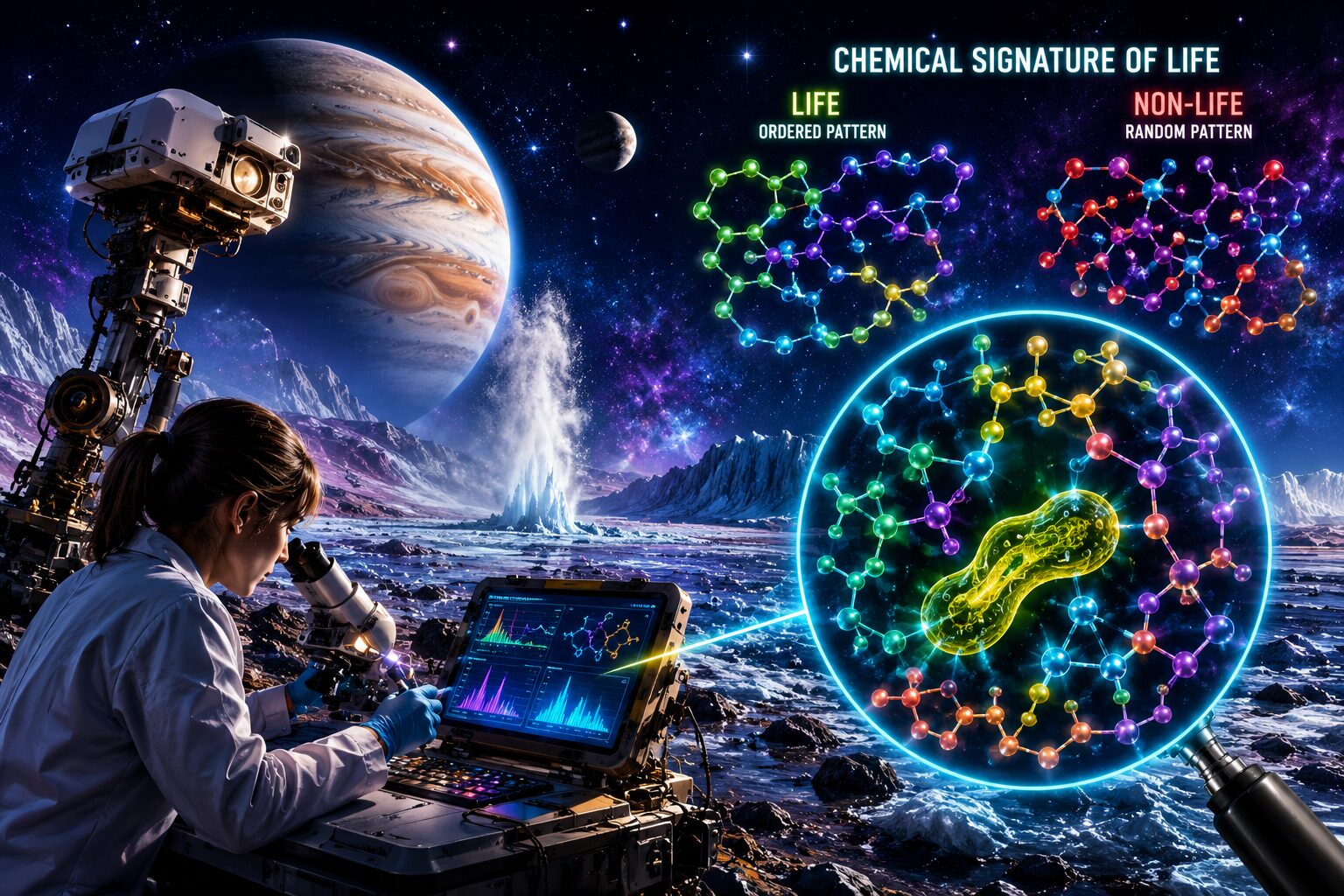
The new study suggests the answer may be hidden in the patterns of the molecules instead of the molecules themselves.
📊 Life Organizes Chemistry Differently
Researchers discovered that living systems arrange amino acids and fatty acids in unique statistical ways.
For example:
- biological amino acids were more varied and evenly balanced
- nonliving chemistry created different distributions
Using statistical analysis, scientists repeatedly separated living samples from nonliving ones.
And they did it using:
- microbes
- soils
- meteorites
- asteroids
- fossils
- lab-created samples
🦖 Even Ancient Fossils Still Showed the Pattern
One of the biggest surprises?
Even degraded fossils still carried traces of these hidden life signatures.
Scientists found detectable patterns inside fossilized dinosaur eggshells, showing that the method may recognize signs of ancient life long after organisms disappear.
🌌 Why This Could Change Space Exploration
Future missions exploring:
- Mars
- Europa
- Enceladus
- distant exoplanets
may someday use this method to help identify whether life once existed there.
Instead of asking:
“Is this molecule present?”Scientists could ask:
“Does this chemistry behave like life?”That could become a powerful new tool in astrobiology.
🧠 Science Terms Explained
👽 Astrobiology
The study of possible life beyond Earth.
🧪 Amino Acids
Important molecules used by living organisms to build proteins.
📊 Statistics
A science that studies patterns and data.
🌌 Biosignature
A clue or sign that may indicate life.
🍕 Easy Analogy
Imagine two giant LEGO collections.
Both have similar LEGO pieces…
But one collection is organized into detailed buildings and patterns, while the other is randomly scattered.
Scientists think life organizes chemistry in a similar special way.
🤯 Cool Science Fact
🧠 DID YOU KNOW?
Some moons in our solar system may hide giant oceans beneath thick ice crusts!
Scientists believe places like Europa and Enceladus could possibly support microbial life.
🌍 Why This Matters
Finding alien life is one of humanity’s biggest scientific goals.
This discovery could help scientists:
- better analyze space mission data
- detect ancient life
- study alien oceans
- recognize biology without needing Earth-like organisms
It may even help researchers identify life forms very different from anything on Earth.
🎯 Big Takeaway
Scientists discovered that life leaves behind hidden statistical chemical patterns — almost like a secret molecular fingerprint.
The finding could give future space missions a completely new way to search for alien life across the universe.
❓ Mini FAQ
Q1. What did scientists discover?
A hidden chemical pattern that may help identify life.
Q2. What molecules were studied?
Amino acids and fatty acids.
Q3. Why is this important?
Many life-related molecules can also form naturally without biology.
Q4. Could this help find aliens?
Possibly — scientists think it may help future missions search for extraterrestrial life.
Q5. What worlds could be studied?
Mars, Europa, Enceladus, and other planets or moons.
The Kids Science Magazine Editorial Team brings together nearly a decade of hands-on experience in electronics engineering, IoT systems, and embedded technology — combined with a deep passion for making complex science genuinely exciting for young minds. Our writers have worked across core electronics testing and real-world technology development, giving every science mystery article a foundation in actual engineering thinking rather than surface-level storytelling. We believe every child deserves access to mind-blowing science — explained clearly, honestly, and in a way that makes them lean forward and ask “but wait, WHY?” Every mystery published on this site is thoroughly researched, fact-checked against credible scientific sources, and written to spark curiosity in kids aged 8–14 across the USA, UK, Canada, Australia & Others across the Globe. New mystery every Friday — because science never runs out of surprises.