
🌳⚠️Scientists Warn: Forests Are Losing Their Strength and Diversity
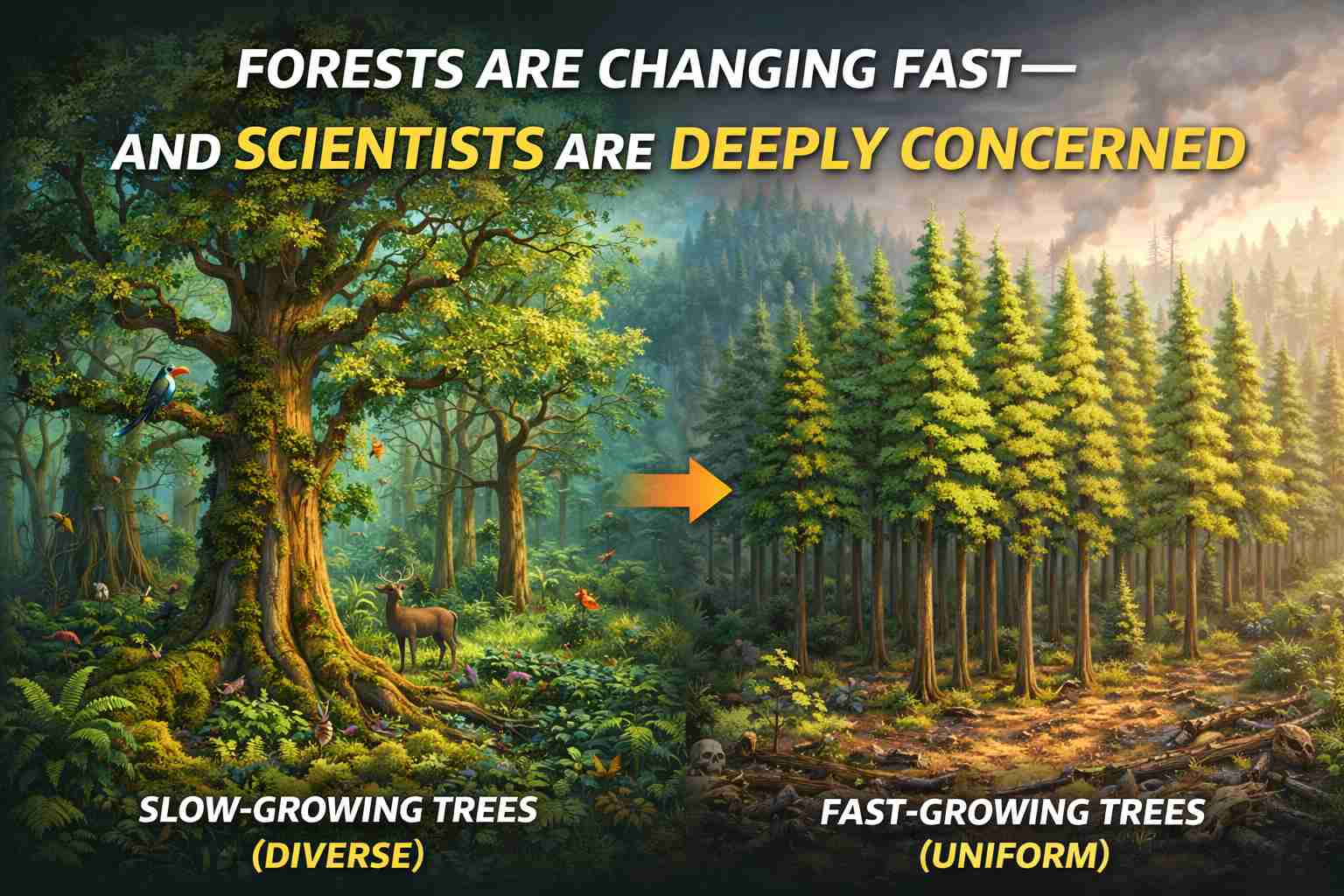
Scientists studying over 31,000 tree species warn that forests are becoming simpler and less resilient as fast-growing trees replace slow, stabilizing species.
Why Earth’s Forests May Be Growing Faster but Becoming Weaker
🔍 Key Highlights (Quick Look)
- Forests worldwide are changing in how they grow and which trees survive
- Fast-growing trees are taking over many forests
- Slow-growing, long-lived trees are disappearing
- These slower trees are crucial for carbon storage, stability, and biodiversity
- Tropical forests face the greatest risk
Forests: The Planet’s Living Safety Net 🌍🌲
Forests do a lot more than look beautiful.
They:
- Breathe in carbon dioxide (CO₂) and store it
- Give homes to animals, insects, and fungi
- Hold soil in place and help manage water
- Cool the air and protect us from extreme heat
But scientists have discovered something worrying:
👉 Forests around the world are quietly changing—and not in a good way.
A Huge Global Study Reveals a Big Shift 🔬
Scientists from Aarhus University and international partners studied more than 31,000 tree species from forests all over the world.
Their findings were published in the science journal Nature Plants.
What they found surprised even experts.
Fast “Sprinter” Trees Are Taking Over 🏃♂️🌲
Many forests are becoming dominated by fast-growing trees.
These trees:
- Grow quickly
- Spread easily
- Recover fast after disturbance
Examples include:
- Acacia
- Eucalyptus
- Pine
- Poplar
At first, this might sound like good news. More growth must be better… right?
Not always.
The Slow “Backbone” Trees Are Disappearing 🐢🌳
The trees that are slow-growing are the ones in trouble.
These trees:
- Live for a long time
- Have thick leaves and dense wood
- Store large amounts of carbon
- Make forests stable and resilient
Scientists call these trees the “backbone” of forest ecosystems.
When they disappear, forests may still grow—but they become:
❌ Simpler
❌ Less diverse
❌ More fragile
Why Tree Diversity Matters 🧩
Think of a forest like a team.
- Fast-growing trees = sprinters
- Slow-growing trees = builders and defenders
If a team has only sprinters:
- It may move fast
- But it can’t survive tough challenges
Forests dominated by fast-growing trees are:
- More vulnerable to drought
- Easier for pests and diseases to damage
- Less effective at storing carbon long-term
Tropical Forests Are in the Greatest Danger 🌴🔥
The study shows the biggest losses are expected in:
- Tropical
- Subtropical regions
These forests:
- Have the highest biodiversity on Earth
- Contain many tree species found nowhere else
Scientists warn that if these unique trees disappear, they could be lost forever.
What Are “Naturalized” Trees? 🌱🌍
Some trees now growing in forests did not originally belong there.
These are called naturalized species:
- Trees introduced by humans (on purpose or by accident)
- Often grow fast and spread easily
About 41% of these trees share fast-growth traits.
But there’s a problem…
👉 They usually cannot replace the ecological role of native trees.
They often compete for:
- Light
- Water
- Nutrients
Making it even harder for native species to survive.
Humans Are Driving These Changes 🚜🔥
Scientists say the main causes are:
- Climate change
- Deforestation
- Intensive logging
- Large-scale tree planting of fast growers
- Global trade of tree species
Fast-growing trees are often planted because they:
✔ Produce wood quickly
✔ Grow back fast
But ecologically, they can make forests weaker, not stronger.
How Can Forests Be Protected? 🌱💚
Scientists say forest management needs to change.
They recommend:
- Protecting slow-growing native trees
- Planting diverse species, not just fast ones
- Restoring forests with long-lived trees
- Supporting wildlife that helps forests recover
🌳 Healthy forests need balance, not just speed.
🌟 Big Takeaway
Forests may look like they’re growing faster—but beneath the green surface, many are becoming simpler and more fragile.
To protect the planet:
- We must protect slow, steady trees
- Preserve biodiversity
- Think long-term, not just fast growth
🌍 Strong forests are built slowly—but they protect us for generations.
🧠 Quick Quiz: Forest Science Check!
1. Which trees are increasing in forests?
A) Slow-growing trees
B) Fast-growing trees
C) Dead trees
D) Fruit trees
2. Why are slow-growing trees important?
A) They grow tall quickly
B) They store carbon and stabilize forests
C) They spread faster
D) They use less water
3. Where are forests at greatest risk?
A) Deserts
B) Polar regions
C) Tropical regions
D) Cities
4. What are naturalized trees?
A) Plastic trees
B) Trees grown in labs
C) Trees introduced from other regions
D) Trees with no leaves
5. What do scientists suggest for future forests?
A) Plant only fast-growing trees
B) Cut down old forests
C) Protect and plant diverse, slow-growing trees
D) Stop all tree planting
✅ Answers:
1-B, 2-B, 3-C, 4-C, 5-C
🤔 Think About This…
If forests grow faster but become weaker, what kind of forests do you think the future should have—fast forests or strong forests?

The Kids Science Magazine Editorial Team brings together nearly a decade of hands-on experience in electronics engineering, IoT systems, and embedded technology — combined with a deep passion for making complex science genuinely exciting for young minds. Our writers have worked across core electronics testing and real-world technology development, giving every science mystery article a foundation in actual engineering thinking rather than surface-level storytelling. We believe every child deserves access to mind-blowing science — explained clearly, honestly, and in a way that makes them lean forward and ask “but wait, WHY?” Every mystery published on this site is thoroughly researched, fact-checked against credible scientific sources, and written to spark curiosity in kids aged 8–14 across the USA, UK, Canada, Australia & Others across the Globe. New mystery every Friday — because science never runs out of surprises.





2 Comments
Comments are closed.