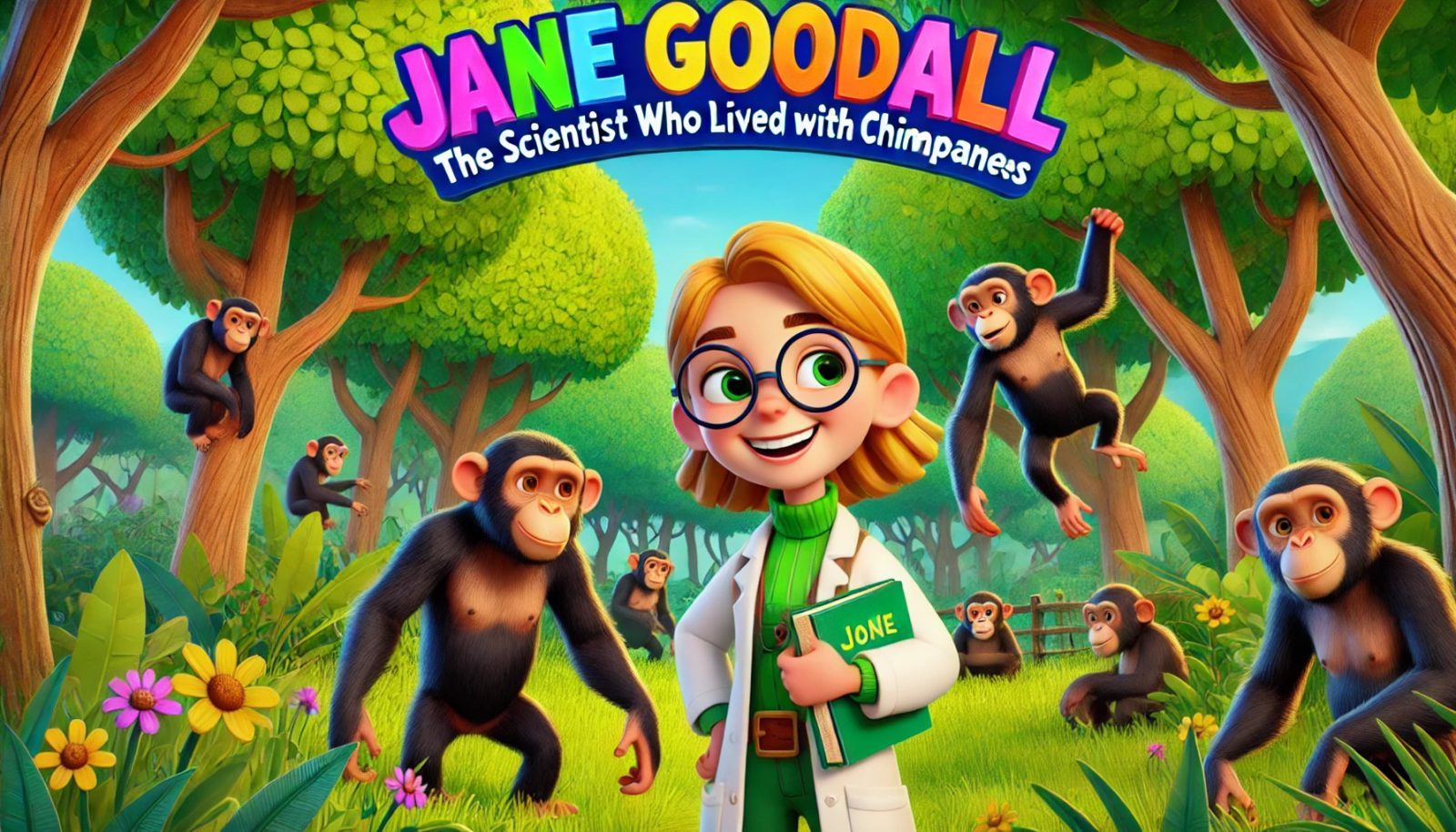
Jane Goodall: The Scientist Who Lived with Chimpanzees
Who is Jane Goodall? The groundbreaking journey of the woman who redefined humanity's relationship with animals.
Have you ever heard of someone who became best friends with chimpanzees? Meet Jane Goodall, a scientist who loved animals so much that she moved to a forest in Africa to study them! Jane is famous all over the world because of her amazing work with chimpanzees, the closest relatives to humans. Let’s learn about her exciting adventures and how she helped us understand these intelligent animals better.
Who is Jane Goodall?
Jane Goodall was born on April 3, 1934, in London, England. Ever since she was a little girl, she loved animals. Instead of dolls, Jane played with a toy chimpanzee named Jubilee! Her dream was to live in Africa and watch wild animals in their natural homes.
When she grew up, her dream came true! Jane traveled to Tanzania, a country in Africa, to study chimpanzees. She didn’t have a fancy degree at first, but her curiosity and love for animals made her one of the greatest scientists in the world.
How Did Jane Study Chimpanzees?
Jane Goodall spent years in a forest called Gombe Stream National Park in Tanzania. She wanted to learn how chimpanzees live, eat, and behave. Instead of scaring them, Jane earned their trust by sitting quietly and observing them from a distance. Slowly, the chimpanzees began to accept her as part of their group!
Jane discovered some amazing facts about chimpanzees. For example:
Why is Jane Goodall Important?
Jane’s work changed how we see animals. Before her, people thought only humans could use tools or express emotions. Thanks to Jane, we know that animals are smarter and more sensitive than we imagined.
She also taught the world about protecting forests and animals. Jane started the Jane Goodall Institute, an organization that helps animals and the environment. Even today, she travels around the globe, spreading messages of hope and how we can save nature.
DO YOU KNOW? Interesting Facts About Jane Goodall
What Can We Learn From Jane Goodall?
Jane teaches us that one person can make a big difference in the world. By following her passion, she helped protect animals and inspired others to love nature.
If you love animals, you can be like Jane too! Visit a zoo, read books about wildlife, or even start planting trees in your neighborhood. Small actions can create big changes!
1. Quick Quiz: How Much Do You Know About Jane Goodall?
Test your knowledge with these fun questions!
Question 1: Where was Jane Goodall born?A) TanzaniaB) England (Correct)C) AmericaD) Australia
Question 2: What is the name of the forest where Jane studied chimpanzees?A) Amazon RainforestB) Gombe Stream National Park (Correct)C) SerengetiD) Yellowstone
Question 3: What is one thing Jane discovered about chimpanzees?A) They can talk like humans.B) They use tools to catch termites. (Correct)C) They live underwater.D) They eat only bananas.
Question 4: What was the name of Jane’s toy chimpanzee as a child?A) Jubilee (Correct)B) TarzanC) FloD) David Greybeard
2. Puzzle: Match the Discovery to the Behavior
3. Poll: What Would You Like to Study in Nature?
4. Create Your Chimpanzee Name!
Have fun coming up with your own chimpanzee name! Combine the color of your shirt with the first fruit you ate today. (Example: If you are wearing a blue shirt and ate an apple, your name is Blue Apple!)
5. Fun Fact Crossword Clues
Conclusion
Jane Goodall is a real-life superhero for animals and nature. Her story shows us the power of kindness, patience, and curiosity. Whether you’re dreaming of exploring jungles or simply learning about animals, remember Jane’s journey and how she changed the world, one chimpanzee at a time.
Did you enjoy learning about Jane Goodall? Share this story with your friends and family, and let’s all be inspired to protect the amazing creatures we share our planet with! 🌳🐒
✨ Did You Know?
📖 Science Word
Primatology
/pry-muh-TOL-uh-jee/The branch of zoology that deals with the physical biology, evolution, and social behavior of primates.
🔤 Word Scramble
Test Yourself!
Question 1 of 4
What historic tool-use behavior did Jane Goodall witness the chimpanzee named David Greybeard perform in 1960?
Quick Poll
What quality of Jane Goodall's field research do you find most inspiring?
How fun was this article?