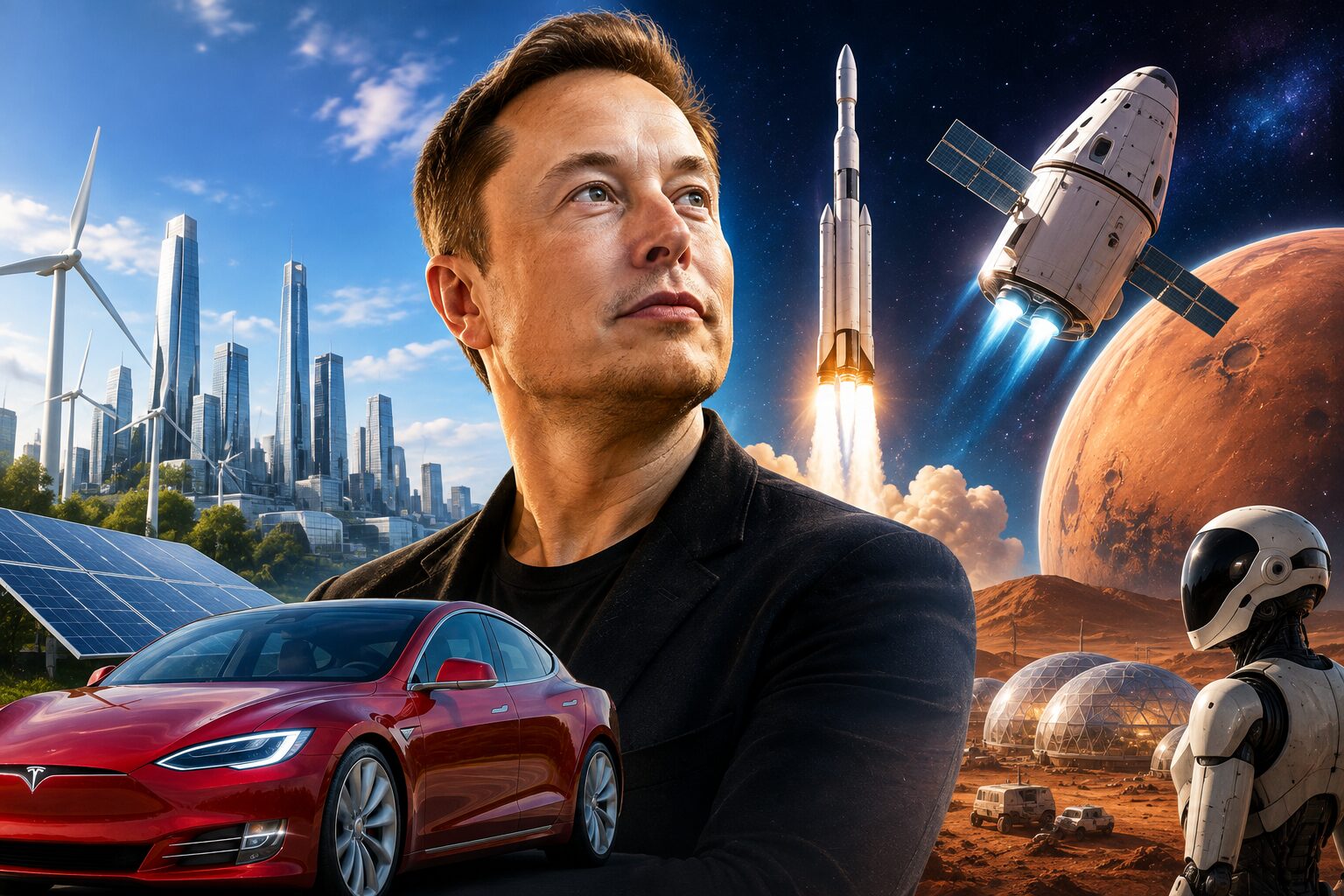
The tech visionary behind SpaceX and Tesla who dreams of making humans a multi-planet species!
What would you do if someone told you:
“Rockets are too expensive to reuse.”
“Electric cars won’t become mainstream.”
“Humans living on another planet is unrealistic.”
You might simply say, “Okay.”
Elon Musk tends to respond differently:
“What if we tried?”
That question has taken him from writing computer code as a child to helping build electric vehicles, launching rockets, developing reusable spacecraft, and pursuing the enormous goal of making humanity capable of living on more than one planet.
But his story isn’t simply a story of success.
It includes failed rockets, financial crises, difficult decisions, enormous risks, and ideas that seemed unrealistic at first.
And that’s what makes his story interesting for young scientists.
🌱 A Boy Who Became Fascinated by Computers
Elon Reeve Musk was born on June 28, 1971, in Pretoria, South Africa.
When he was young, computers fascinated him.
Instead of only playing with computers, he wanted to understand how they worked.
At about 12 years old, he created a simple computer game called Blastar, a space-themed game in which a player fought alien spacecraft.
He eventually sold the game’s code to a computer magazine for about $500.
Think about that.
A 12-year-old wasn’t building a rocket yet.
He was learning something much more basic:
How to make a computer do what he wanted.
That early experience would become important later.
🧠 Books, Questions—and a Difficult Childhood
Musk has described spending a great deal of time reading and thinking about technology.
His childhood wasn’t always easy. Biography.com reports that he was bullied at school and experienced a particularly difficult period during his teenage years.
Rather than making his story a simple “genius child” tale, it’s worth remembering something important:
Being talented doesn’t mean life is always easy.
Curiosity, persistence, and the ability to keep learning can matter just as much as natural ability.
🇨🇦 A Big Move
At 17, Musk moved to Canada.
Later, he attended Queen’s University and eventually transferred to the University of Pennsylvania, where he earned degrees in physics and business.
He then moved toward the rapidly growing world of the internet.
In 1995, he and his brother Kimbal started Zip2, a company that provided online city guides and maps for newspapers.
The company was eventually acquired by Compaq.
Musk’s next major venture was X.com, an online financial service that later became part of PayPal.
PayPal was acquired by eBay in 2002.
And then came the really unusual part of the story.
🚀 Why Would Anyone Start a Rocket Company?
In 2002, Musk founded SpaceX.
But there was a huge problem:
Rockets were incredibly expensive.
Traditional rockets were generally treated much more like disposable machines.
Imagine buying an airplane, flying it once, and then throwing the entire airplane away.
That doesn’t make much sense.
Musk wanted to change that.
His idea was:
What if rockets could come back and fly again?
That sounds simple today.
It wasn’t simple at all.
💥 Rocket Number One: FAILURE
SpaceX’s first rocket was called Falcon 1.
Its first launch in 2006 failed.
The second failed.
The third failed.
Three failures in a row.
And the company was running out of money.
Musk later described how the first three Falcon 1 launches failed and how the fourth launch was essentially the company’s last chance.
Imagine being a kid working on a science project.
Your experiment fails once.
You try again.
It fails again.
You try a third time.
Failure again.
Would you quit?
SpaceX didn’t.
🔥 The Fourth Launch
On the fourth Falcon 1 launch in 2008, the rocket finally reached orbit.
That success was enormously important.
SpaceX had demonstrated that a privately developed liquid-fueled rocket could reach orbit.
The company survived.
And the next chapter began.
🛰️ Then Came the Reusable Rocket
SpaceX eventually developed the Falcon 9 rocket.
One of its most important ideas was reusability.
Instead of letting the rocket’s first stage fall into the ocean and disappear forever, engineers worked to make it return to Earth and land.
In 2017, SpaceX achieved a major milestone by re-flying an orbital-class rocket booster.
Why is this important?
Because if a rocket can be safely reused, the cost and effort of launching things into space could potentially be reduced.
Think about it:
✈️ Airplane → flies → lands → flies again
🚀 Old-style disposable rocket → launches → parts are discarded
🚀 Reusable rocket → launches → lands → can potentially fly again
That is a completely different way of thinking about space transportation.
⚡ The Electric-Car Challenge
While SpaceX was working on rockets, Musk was also deeply involved with Tesla.
Here’s an important detail:
Musk did not single-handedly invent the electric car or found Tesla.
Tesla was founded by Martin Eberhard and Marc Tarpenning in 2003.
Musk joined the company early, became its chairman, and was heavily involved in financing, engineering, product development, and strategy. Tesla identifies him as a co-founder and says he has led the company as CEO since 2008.
That distinction matters because science stories should tell kids what actually happened—not turn complicated history into a superhero story.
🏎️ The Electric Sports Car
Tesla’s first production car was the Roadster.
It was unusual because it was:
⚡ Electric
🏎️ Fast
🔋 Battery-powered
🌍 Designed to show that an electric car could be exciting
The Roadster began deliveries in 2008.
This helped challenge an old idea:
Electric cars don’t have to be slow or boring.
Later came vehicles such as the Model S, Model X, Model 3, and Model Y.
Tesla’s growth helped push electric vehicles much further into mainstream automotive competition.
🧪 What Science Makes an Electric Car Move?
An electric car doesn’t burn gasoline inside an engine.
Instead, electrical energy stored in a battery powers an electric motor.
The basic energy pathway looks like:
Battery 🔋 → Electrical energy ⚡ → Motor 🌀 → Wheels 🚗
Electric motors can turn electrical energy into motion very efficiently.
And because the vehicle doesn’t need a gasoline engine to create motion, its design can be very different from a traditional car.
This is a beautiful example of how physics + engineering + materials science + computer technology can combine to create a machine.
🌍 From Cars to a Bigger Energy Idea
Tesla isn’t only about cars.
The company also develops batteries and solar-energy products.
The larger idea is to create systems where:
☀️ Solar energy produces electricity
🔋 Batteries store it
🚗 Electric vehicles use it
🏠 Homes and businesses can use stored energy when needed
Tesla describes its mission around sustainable energy and electric transportation.
🌙 But Why Mars?
Now we reach the biggest idea in Musk’s story.
What if Earth isn’t the only place humans live?
SpaceX’s long-term vision is to make humanity multiplanetary.
The company is developing Starship, a fully reusable transportation system designed for missions to Earth orbit, the Moon, Mars, and beyond.
But here’s an important distinction for kids:
🚀 Humans have NOT yet built a city on Mars.
Mars settlement remains a future goal.
There are enormous challenges:
- ❄️ Mars is extremely cold.
- 🌬️ Its atmosphere is very thin.
- ☢️ Space radiation is dangerous.
- 💧 Water must be found or transported.
- 🌱 Food would need to be grown or supplied.
- 🏠 Humans would need safe habitats.
- 🚀 Getting people there and back would be extremely difficult.
So the exciting part isn’t that humans have already solved these problems.
They haven’t.
The exciting part is that scientists and engineers are trying to understand how they might someday be solved.
🪐 What Would a Mars City Need?
Imagine waking up on Mars.
Your bedroom couldn’t simply have an open window.
You would need a sealed habitat.
Inside:
🌬️ Air to breathe
💧 Water
🌡️ Temperature control
🥗 Food
⚡ Energy
🛡️ Radiation protection
📡 Communication
🔧 Repair equipment
Suddenly, building a Mars city sounds less like science fiction…
and more like the world’s biggest engineering project.
🤯 The Most Important Lesson: Think in Systems
One fascinating thing about Musk’s projects is that they aren’t based on a single invention.
A reusable spacecraft requires:
Physics + propulsion + materials + computers + software + robotics + manufacturing + navigation + control systems
An electric vehicle requires:
Chemistry + batteries + motors + electronics + software + aerodynamics + manufacturing
That’s called systems engineering.
A huge invention is often not one magical idea.
It’s thousands of smaller ideas working together.
🔬 Was Elon Musk a Scientist?
Here’s an important distinction for kids:
Elon Musk is primarily an entrepreneur, engineer, and technology executive—not a laboratory scientist known for a single scientific discovery.
His academic background includes physics, and he has been deeply involved in engineering and product development at his companies. Tesla describes him as leading product design and engineering, while SpaceX describes his role in rocket and spacecraft development.
That makes his story useful for understanding another important career:
The Innovator
Scientists often ask:
“How does nature work?”
Engineers ask:
“How can we build something that works?”
Innovators often ask:
“Can we turn this idea into something useful at enormous scale?”
The real world often needs all three.
🌟 The Bigger Story Behind the Success
It would be easy to look at rockets landing upright and electric cars driving silently and think:
“He just had great ideas.”
But the story was much messier.
There were:
💥 Rocket failures
💰 Financial pressure
🔧 Engineering problems
😰 Risky decisions
⌛ Years of development
🔁 Repeated testing and redesign
The lesson isn’t:
“Never fail.”
It’s:
“Failure is information.”
When a rocket fails, engineers can investigate what went wrong.
Was it:
- Fuel?
- Engine?
- Software?
- Structure?
- Guidance?
- Temperature?
- Timing?
Then they redesign.
That’s how engineering progresses.
🧠 THINK LIKE AN INNOVATOR
Imagine you have unlimited engineering talent but only one goal.
Which problem would you attack?
🌍 Climate change
Design a cleaner energy system.
🚀 Space exploration
Create a spacecraft that can travel farther.
💧 Clean water
Build an inexpensive purification system.
🧠 Education
Create a learning tool that adapts to every student.
🗑️ Waste
Invent a machine that turns waste into useful materials.
Now ask yourself:
What is the problem?
Why hasn’t it been solved yet?
What would you need to build?
That’s how an innovator thinks.
🔭 WHAT HAPPENS NEXT?
Musk’s story is still being written.
SpaceX continues developing Starship and reusable space transportation, while Tesla continues developing electric vehicles and energy systems.
Whether humanity eventually builds a permanent settlement on Mars is still unknown.
And that’s exactly what makes it interesting.
The future isn’t a finished story.
Scientists and engineers are still writing it.
🌟 BIG TAKEAWAY
Elon Musk’s most interesting lesson isn’t simply “build rockets” or “build electric cars.”
It’s this:
Start with a difficult problem. Ask whether the usual way is really the only way. Then learn, test, fail, improve, and try again.
Sometimes the biggest breakthroughs begin with a question that sounds almost impossible.
“Can we reuse a rocket?”
“Can electric cars become exciting?”
“Could humans someday live on another planet?”
We don’t know which of today’s crazy questions will become tomorrow’s technology.
Maybe one of them will come from you. 🚀🔬✨
🧠🌍 Top 75 Famous Scientists in the World for Kids | Great Scientists Who Changed the World 🌍

The Kids Science Magazine Editorial Team brings together nearly a decade of hands-on experience in electronics engineering, IoT systems, and embedded technology — combined with a deep passion for making complex science genuinely exciting for young minds. Our writers have worked across core electronics testing and real-world technology development, giving every science mystery article a foundation in actual engineering thinking rather than surface-level storytelling. We believe every child deserves access to mind-blowing science — explained clearly, honestly, and in a way that makes them lean forward and ask “but wait, WHY?” Every mystery published on this site is thoroughly researched, fact-checked against credible scientific sources, and written to spark curiosity in kids aged 8–14 across the USA, UK, Canada, Australia & Others across the Globe. New mystery every Friday — because science never runs out of surprises.