🤔 Kids Curiosity
Imagine drawing two tiny dots on a balloon.
Now slowly blow up the balloon.
What happens?
The dots move farther apart—even though they aren’t crawling across the balloon!
Something similar is happening in our universe.
Astronomers have discovered that the universe is constantly expanding. Every second, the vast stretches of space between distant galaxies become a little bigger.
But here’s the really surprising part…
Some galaxies are now moving away from us faster than the speed of light!
Wait a minute…
Didn’t Albert Einstein say that nothing can travel faster than light?
Has the universe broken one of the most famous rules in science?
The answer is no—and understanding why will take us on one of the most amazing journeys in modern astronomy.
⭐ Key Highlights
- 🌌 The universe has been expanding since the Big Bang.
- 💡 Nothing nearby can travel through space faster than light.
- 🚀 Space itself can stretch, carrying galaxies farther apart.
- 🔭 Some very distant galaxies are now moving away faster than light because space is expanding.
- 🌠 Astronomers can still see many of these galaxies because their light began its journey billions of years ago.
- 🔬 Dark energy is making the expansion of the universe speed up.
🌍 The Big Discovery
More than one hundred years ago, astronomers believed the universe was calm and unchanging.
Most scientists thought galaxies stayed in fixed positions forever.
Then, in the 1920s, astronomer Edwin Hubble made a remarkable discovery.
By studying the light coming from distant galaxies, he found that nearly all of them were moving away from us.
Even more surprising, the farther away a galaxy was, the faster it appeared to be receding.
This discovery completely changed our understanding of the universe.
Instead of being still, the universe is expanding.
Imagine placing raisins inside a loaf of bread before baking it.
As the bread rises, every raisin moves farther away from the others—not because the raisins are crawling through the dough, but because the dough itself is expanding.
Astronomers think something similar happens in space.
Galaxies are carried apart as the fabric of space stretches over billions of years.
Today, scientists estimate that the universe is about 13.8 billion years old.
Yet the most distant places we can observe are now around 46.5 billion light-years away in every direction.
That means the observable universe is about 93 billion light-years across.
At first, this sounds impossible.
How can we see something farther away than light should have traveled in 13.8 billion years?
The answer lies in one of the strangest ideas in modern physics:
The space between galaxies has been expanding while the light was traveling toward us.
🔬 Science Behind the News
🌟 What Is the Universe?
The universe includes everything that exists:
- Every star
- Every planet
- Every galaxy
- Every black hole
- Every atom
- Even space and time themselves
Scientists think the universe began about 13.8 billion years ago in an event called the Big Bang.
Contrary to what many people imagine, the Big Bang was not an explosion in empty space.
Instead, it was the rapid expansion of space itself.
Since then, the universe has continued expanding.
📏 What Is a Light-Year?
When astronomers talk about huge distances, kilometers become far too small.
Instead, they use a unit called the light-year.
A light-year is not a measure of time.
It measures distance.
Light travels incredibly fast—about 300,000 kilometers every second (186,000 miles per second).
In one year, light travels nearly:
9.46 trillion kilometers (5.88 trillion miles).
That’s one light-year!
So if a galaxy is 100 light-years away, the light you see today actually left that galaxy 100 years ago.
Looking far into space is like looking back in time.
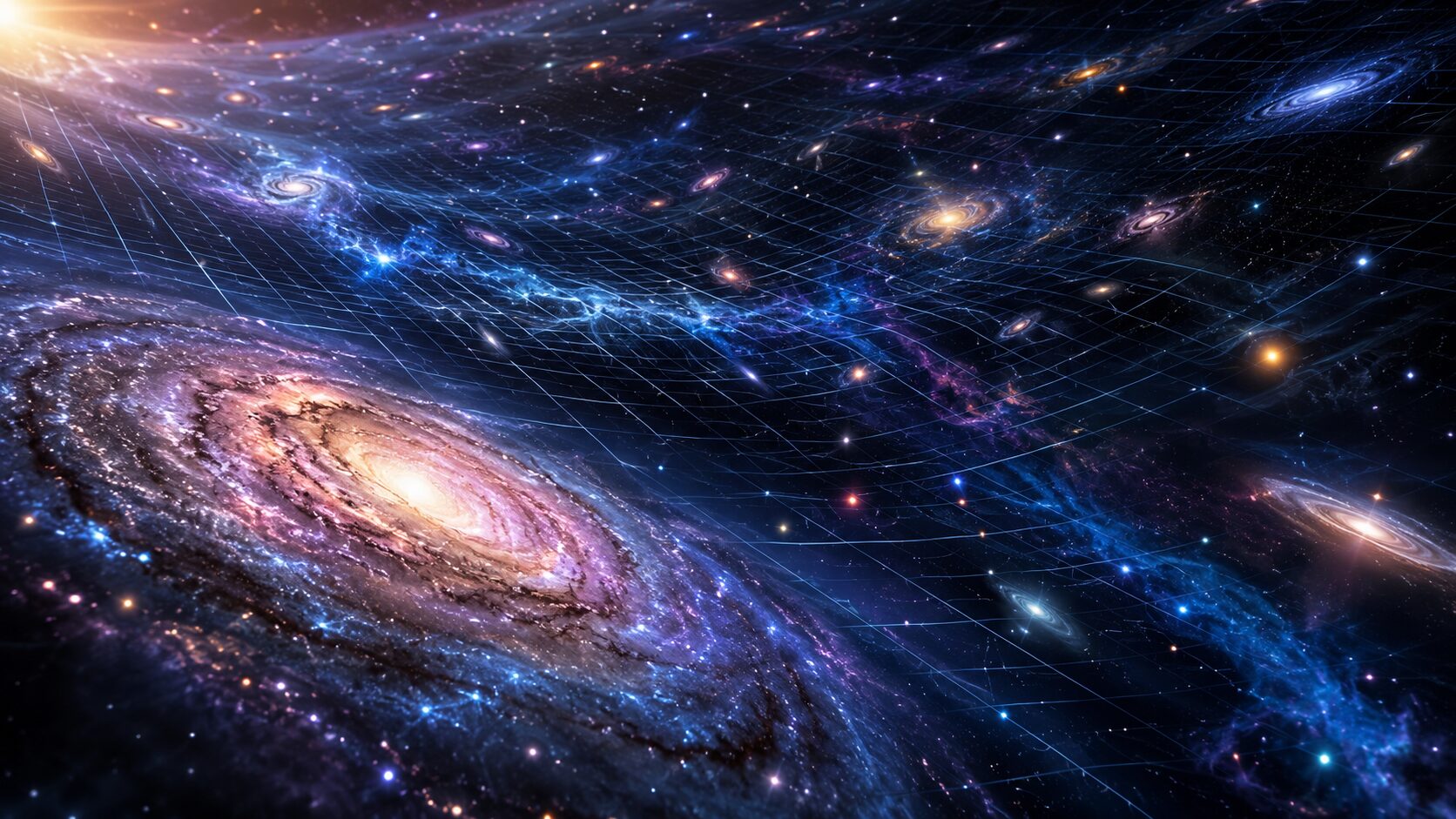
🧵 The Expanding Fabric of Space
One of the biggest misunderstandings about the universe is thinking that galaxies are racing through empty space like cars speeding down a highway.
That isn’t what’s happening.
Scientists believe space itself is stretching.
Imagine drawing a checkerboard on a giant rubber sheet.
Place several marbles on the squares.
Now gently stretch the sheet.
The marbles move farther apart even though they never rolled across the rubber.
The sheet expanded underneath them.
Space behaves in a similar way.
As space stretches, galaxies become farther apart.
This is why distant galaxies can seem to move away incredibly fast without actually zooming through space faster than light.
⚙️ How Does It Work?
Astronomers measure the expansion of the universe using something called redshift.
Light behaves like waves.
When a galaxy moves away from us—or more accurately, when space expands between us and the galaxy—the light waves become stretched.
As they stretch, they shift toward the red end of the spectrum.
The greater the redshift, the farther away the galaxy is and the faster space has expanded during the light’s journey.
By measuring the redshift of thousands of galaxies, scientists discovered that:
- Nearby galaxies move away slowly.
- Distant galaxies move away faster.
- Extremely distant galaxies can appear to recede faster than light because there is so much expanding space between us.
This doesn’t mean the galaxies are breaking Einstein’s speed limit.
Instead, it means the distance between us is increasing because space itself is expanding.
It’s an important difference.
Think of two ants standing still on opposite ends of a stretchy rubber band.
If someone stretches the rubber band, the ants move farther apart even though neither ant is walking.
The ants didn’t break any speed limits.
The rubber band simply became longer.
The universe behaves in a similar way.
👨🔬 Meet the Scientists
🌟 Edwin Hubble (1889–1953)
American astronomer Edwin Hubble transformed astronomy forever.
Using observations from the Mount Wilson Observatory in California, he showed that many fuzzy patches in the sky were actually entire galaxies far beyond the Milky Way.
He also discovered that almost every galaxy is moving away from us.
This became the first strong evidence that the universe is expanding.
Today, the famous Hubble Space Telescope is named in his honor.
🌟 Albert Einstein (1879–1955)
Albert Einstein developed the theory of Special Relativity, which says that nothing with mass can travel through space faster than the speed of light in its local surroundings.
Later, his theory of General Relativity showed that space and time themselves can bend, stretch, and change.
Modern cosmology uses Einstein’s equations to explain how the universe expands.
Interestingly, Einstein first believed the universe was static. When evidence for expansion became overwhelming, he accepted that the universe was changing.
More than a century later, astronomers continue using Einstein’s ideas to explore the biggest mysteries of the cosmos—including dark matter, dark energy, black holes, and the evolution of the universe.

Jamie Ellis is a science educator and writer who has spent years in the classroom watching students transform the moment science stops being a lesson and starts being a story. With a background in science education and a genuine love for the history of discovery, Jamie writes the kind of articles that teachers bookmark and parents read over their children’s shoulders. The Monday “Science Around Us” column and Wednesday “Great Scientists” features at Kids Science Magazine both reflect Jamie’s core teaching philosophy: the most powerful science lesson is the one that makes a child look up from the page, stare into the middle distance, and whisper “wait — really?” Jamie writes for the curious kid who always asks one more question after class, the student who Googles things they didn’t need to know, and every young reader who has ever secretly suspected that science might actually be the most exciting thing in the world.