Meta Description
A vital ocean process suddenly stopped in Panama—discover how upwelling works and why this change could affect marine life and climate.
🤔 Curiosity Hook
What if the ocean had a secret way of “breathing”… and one year, it suddenly stopped?
That’s exactly what scientists noticed in the waters near Panama—and it has surprised researchers around the world.
🔍 Key Highlights
- A natural ocean process called upwelling suddenly didn’t happen
- This event had been reliable for over 40 years
- Scientists link the change to weaker winds
- It caused warmer water and less marine food
- The discovery raises concerns about climate change effects
🌊 Main Story: The Ocean’s Hidden Lifeline
In the warm waters of the Gulf of Panama, something incredible usually happens every year.
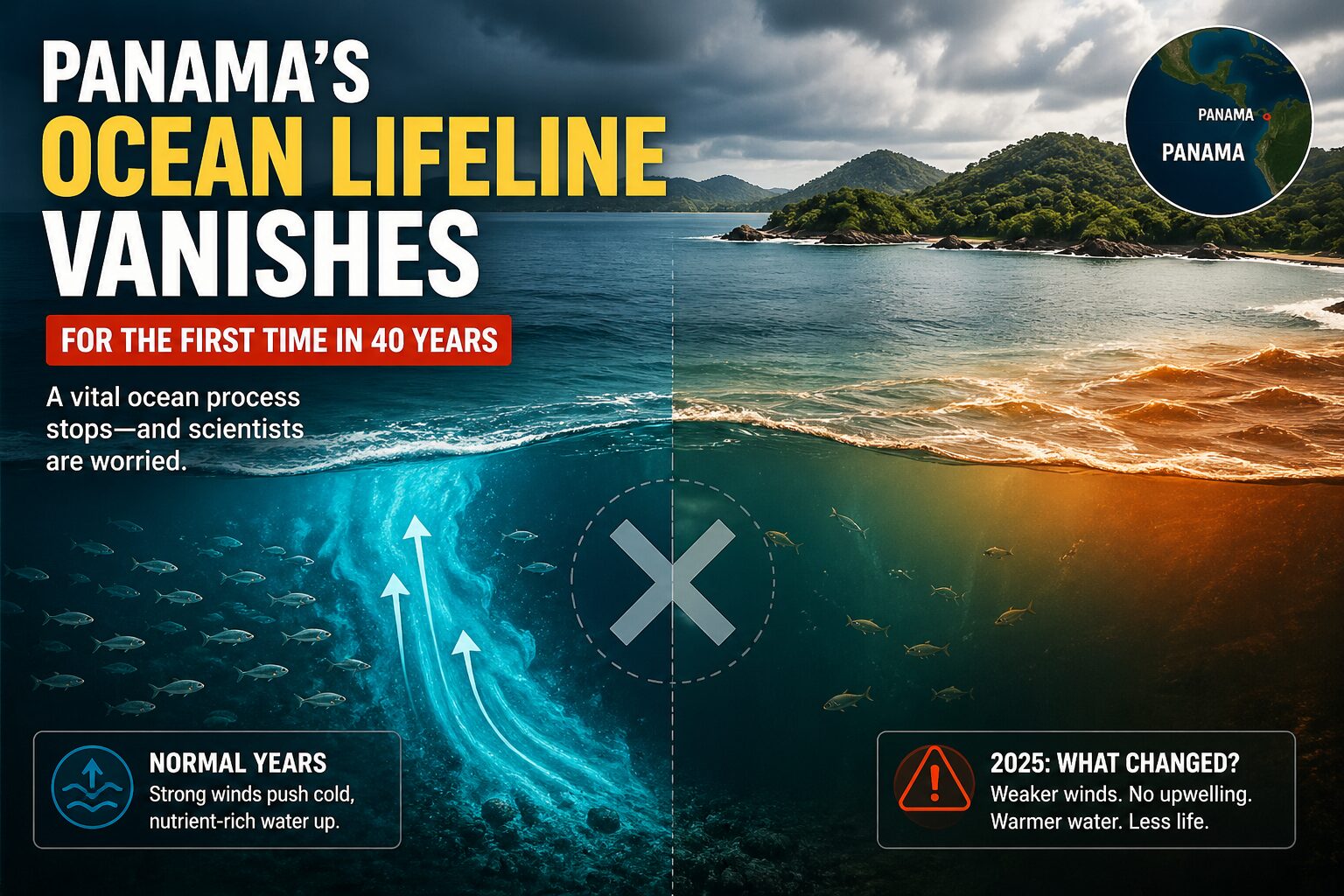
Strong seasonal winds push surface water away, allowing cold, nutrient-rich water from deep below to rise up.
This process is called upwelling—and it’s like a lifeline for the ocean.
🐟 Why Is Upwelling So Important?
- It brings nutrients that feed tiny ocean plants
- These plants feed fish
- Fish feed larger animals—and even humans
👉 In simple terms:
No upwelling = less food in the ocean
😲 A 40-Year Pattern Suddenly Broke
For more than 40 years, scientists had seen this process happen every single year.
But in 2025…
👉 It didn’t happen.
No strong upwelling.
No usual cooling.
Less ocean productivity.
This was the first time ever recorded.
💨 What Went Wrong?
Scientists believe the main reason could be weaker winds.
Normally, strong winds act like a “pump,” pulling deep water upward.
But when the winds weaken:
👉 The ocean’s “nutrient supply system” slows down—or stops.
🌡️ What Changed in the Ocean?
Because upwelling didn’t occur:
- Water stayed warmer than usual
- Fewer nutrients reached the surface
- Marine life had less food available
👉 This could affect:
- Fish populations
- Coral reefs
- Coastal communities
🧠 Science Terms Explained
- Upwelling: When deep, cold, nutrient-rich water rises to the surface
- Nutrients: Substances that help plants and animals grow
- Ocean Productivity: How much life the ocean can support
- Climate Change: Long-term changes in Earth’s weather and temperature patterns
🌍 Why This Discovery Matters
This is more than just one missing event—it’s a warning sign.
🌊 Environment
Marine ecosystems depend on upwelling to survive.
🐟 Food Supply
Fewer nutrients → fewer fish → impacts fishing communities
🌡️ Climate
Warmer oceans can affect weather and coral reefs
🔬 Science & Future
Scientists now realize how fragile ocean systems can be
❓ Mini FAQ
Q1: What is upwelling in simple words?
It’s when deep ocean water rises up and brings nutrients to the surface.
Q2: Why didn’t it happen in 2025?
Scientists think weaker winds may be the cause.
Q3: Is this dangerous?
It can affect marine life and food chains if it happens often.
Q4: Does this mean climate change is affecting oceans?
It could be a sign, but scientists are still studying it.
Q5: Can this happen again?
Possibly—and that’s why scientists are closely monitoring it.
🌟 Big Takeaway
The ocean may look calm on the surface—but deep inside, it depends on powerful hidden systems.
And now we know:
👉 Even those systems can suddenly change.

The Kids Science Magazine Editorial Team brings together nearly a decade of hands-on experience in electronics engineering, IoT systems, and embedded technology — combined with a deep passion for making complex science genuinely exciting for young minds. Our writers have worked across core electronics testing and real-world technology development, giving every science mystery article a foundation in actual engineering thinking rather than surface-level storytelling. We believe every child deserves access to mind-blowing science — explained clearly, honestly, and in a way that makes them lean forward and ask “but wait, WHY?” Every mystery published on this site is thoroughly researched, fact-checked against credible scientific sources, and written to spark curiosity in kids aged 8–14 across the USA, UK, Canada, Australia & Others across the Globe. New mystery every Friday — because science never runs out of surprises.