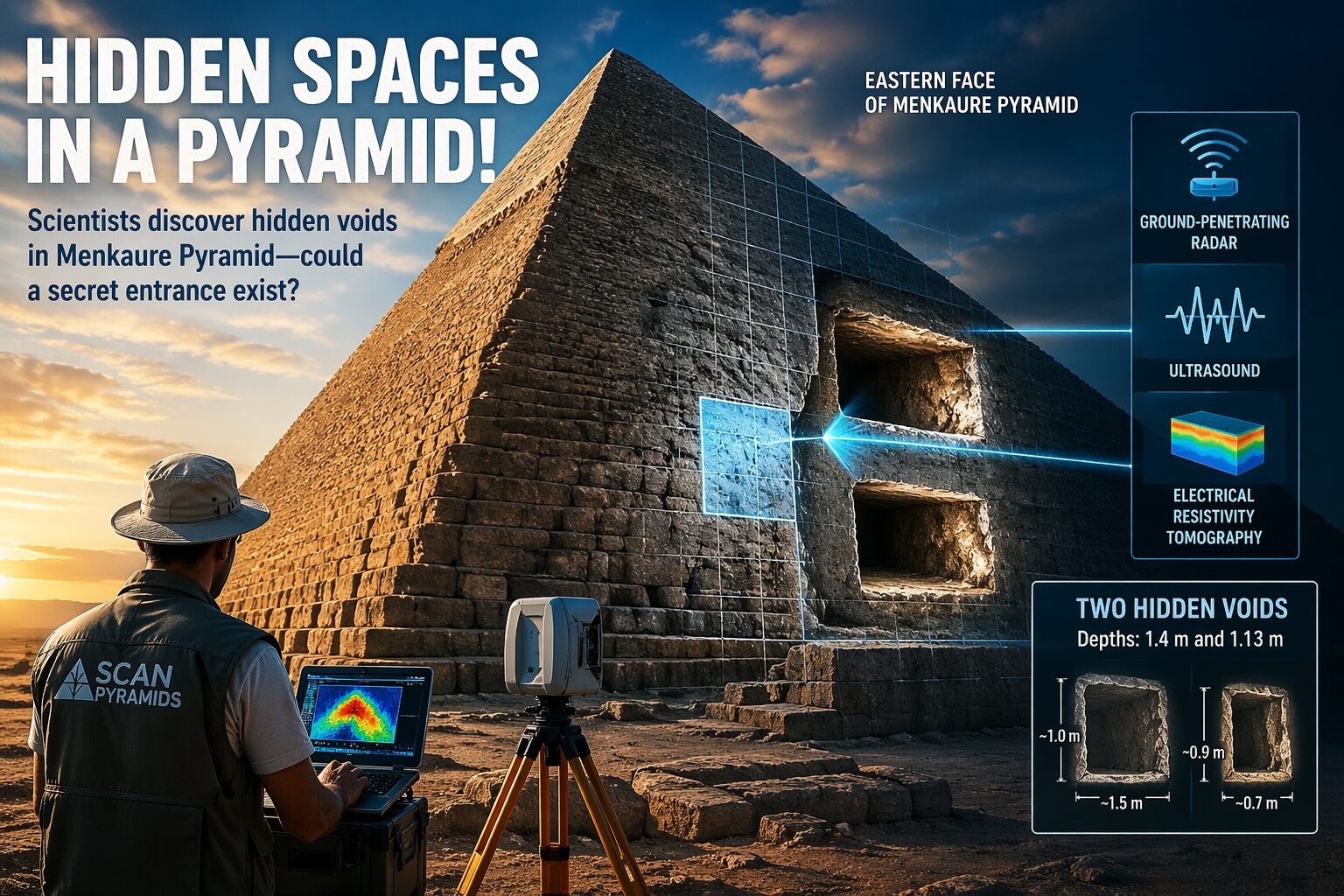
Scientists discovered hidden voids inside Egypt’s Menkaure Pyramid using advanced scanning—could they reveal a secret entrance?
🤔 Curiosity
What if one of the world’s most famous pyramids is still hiding a secret… right behind its smooth stone walls?
For thousands of years, the pyramids of Giza have stood silent in the desert. But now, scientists may have uncovered a clue that suggests we still don’t know all their secrets.
🔍 Key Highlights
- Scientists found two hidden empty spaces (voids) inside a pyramid
- The discovery was made using advanced scanning tools—no digging needed
- The voids are located behind a mysteriously smooth wall section
- This could support the idea of a hidden entrance
- The discovery is part of the ScanPyramids mission
🏺 Main Story: A Mystery Inside the Stones
Deep inside the ancient Menkaure Pyramid—the smallest of the three famous pyramids at Giza—scientists have discovered something unusual.
Behind a smooth, polished section of stone on the pyramid’s eastern side, they detected two hidden air-filled spaces.
But here’s what makes this discovery exciting…
That smooth stone patch is not normal.
Most of the pyramid’s surface is rough and weathered, but this section looks carefully finished—similar to the main entrance on the north side. That made scientists wonder:
👉 Could this be hiding another doorway?
🔬 How Did Scientists Find It?
Instead of breaking open the pyramid (which would damage it), researchers used non-invasive technology, meaning they could “see inside” without touching it.
Here’s what they used:
- Radar waves to detect structures inside
- Ultrasound signals to measure hidden shapes
- Electrical scanning to spot differences in materials
By combining all these methods (a technique called image fusion), they created a detailed picture of what lies behind the wall.
📦 What Did They Find?
Two hidden voids:
- One about 1 meter tall and 1.5 meters wide
- Another smaller one nearby
- Both located just over 1 meter behind the outer wall
These are not random cracks—they are clear, structured empty spaces.
And that’s where the mystery deepens…
👉 Why would ancient builders leave empty spaces here?
👉 Could they lead somewhere?
🧠 Science Terms Explained
- Void: An empty space inside a solid structure
- Ground-Penetrating Radar (GPR): A tool that uses radio waves to see underground or inside objects
- Ultrasound: Sound waves used to detect hidden shapes and structures
- Non-invasive: A method that studies something without damaging it
🌍 Why This Discovery Matters
This isn’t just about finding empty spaces—it could change how we understand ancient civilizations.
🏺 History
If a hidden entrance is confirmed, it may lead to unknown chambers or passages that reveal how pyramids were built—or even why.
🧪 Technology
These discoveries show how modern science can explore ancient structures without destroying them.
🌍 Human Curiosity
Even after 4,000+ years, the pyramids are still teaching us something new. That means:
👉 There may be many more secrets waiting to be discovered.
❓ Mini FAQ
Q1: What is the Menkaure Pyramid?
It is the smallest of the three main pyramids at Giza, built for Pharaoh Menkaure.
Q2: What are the hidden voids?
They are empty spaces found inside the pyramid walls.
Q3: Did scientists open the pyramid to find them?
No! They used special scanning technology to look inside safely.
Q4: Could this really be a secret entrance?
It’s possible—but scientists need more evidence to confirm it.
Q5: Why didn’t we find this earlier?
Because the technology needed to detect these hidden spaces didn’t exist until recently.
🌟 Big Takeaway
The pyramids may look ancient and fully explored—but they’re still full of mysteries.
And now, thanks to modern science, we’re getting closer than ever to unlocking them.
👉 Who knows what might be hiding behind the next stone?

The Kids Science Magazine Editorial Team brings together nearly a decade of hands-on experience in electronics engineering, IoT systems, and embedded technology — combined with a deep passion for making complex science genuinely exciting for young minds. Our writers have worked across core electronics testing and real-world technology development, giving every science mystery article a foundation in actual engineering thinking rather than surface-level storytelling. We believe every child deserves access to mind-blowing science — explained clearly, honestly, and in a way that makes them lean forward and ask “but wait, WHY?” Every mystery published on this site is thoroughly researched, fact-checked against credible scientific sources, and written to spark curiosity in kids aged 8–14 across the USA, UK, Canada, Australia & Others across the Globe. New mystery every Friday — because science never runs out of surprises.