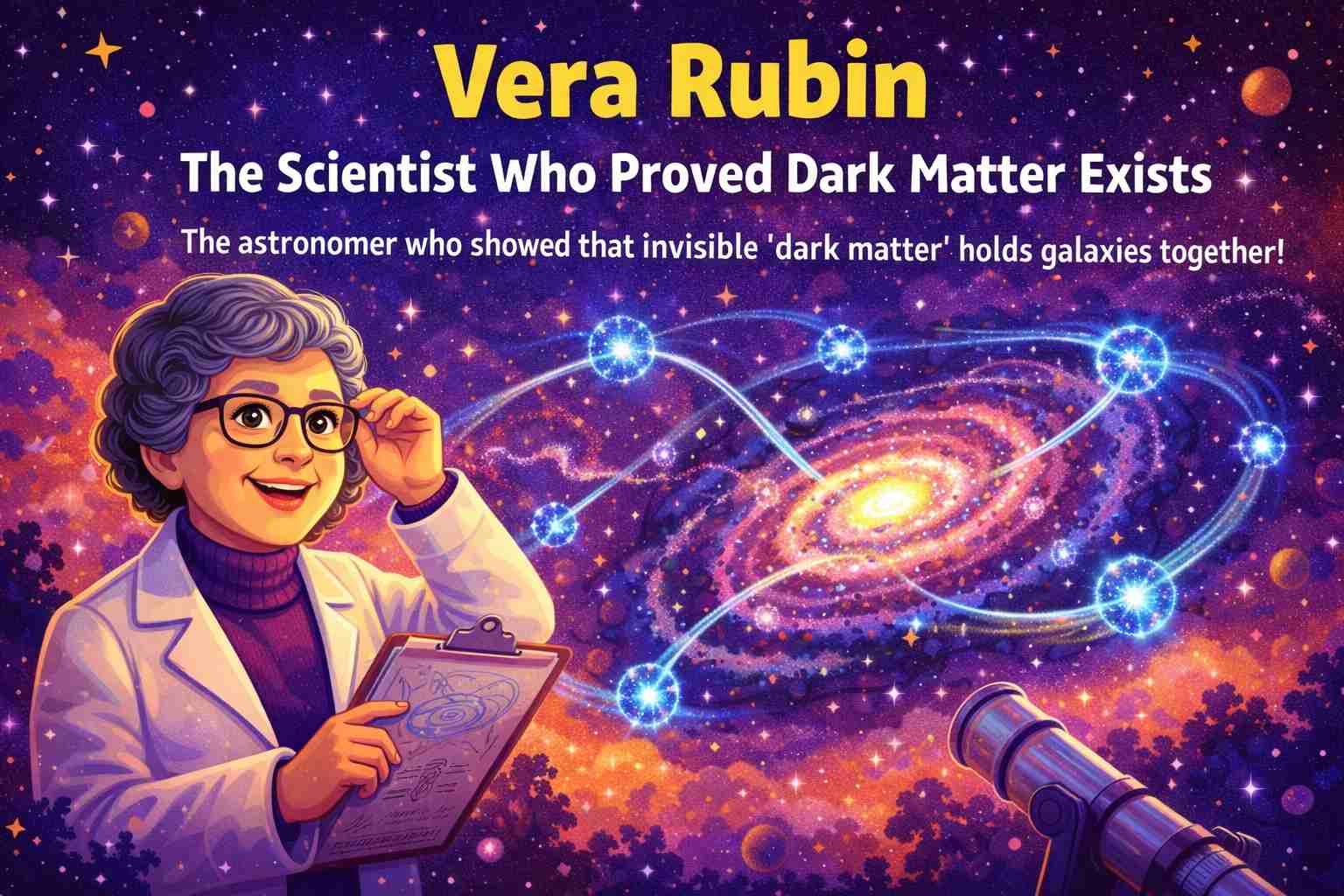
Discover the inspiring story of Vera Rubin, the astronomer who proved dark matter exists and showed that invisible matter holds galaxies together. A fun, easy science story for kids with facts, quizzes, and inspiration.
Introduction: The Invisible Mystery of the Universe 👀🌌
Look up at the night sky. You see stars, planets, and glowing galaxies. But what if I told you that most of the universe is invisible? 😲
A brilliant scientist named Vera Rubin discovered that something we cannot see—called dark matter—is quietly holding galaxies together like invisible glue. Her discovery changed astronomy forever and taught the world that not everything important can be seen with our eyes.
🌱 Early Life: A Girl Who Loved the Stars
Vera Rubin was born in 1928 in the United States. As a child, she loved watching the stars move across the night sky from her bedroom window. 🌟
She asked big questions:
- Why do stars move the way they do?
- How do galaxies stay together?
At a time when many people believed girls shouldn’t become scientists, Vera didn’t listen. She studied astronomy anyway—even when some universities tried to stop her.
Her curiosity was stronger than any rule. 💪✨
🚪 Breaking Barriers in Science
When Vera wanted to study astronomy, some schools said “no” simply because she was a woman. She wasn’t even allowed to use certain telescopes at first! 😔
But Vera didn’t give up. She kept studying, kept asking questions, and kept proving her ideas with careful observations and math.
Her determination helped open doors—not just for herself, but for many women scientists who came after her. 👩🔬💙
🌌 The Big Discovery: Galaxies Are Spinning Too Fast!
Vera studied how galaxies rotate—how stars move around the center of a galaxy.
Here’s what she expected:
👉 Stars farther from the center should move more slowly, just like planets far from the Sun.
But that’s not what she found! 😮
Instead:
- Stars at the edges of galaxies were moving just as fast as stars near the center.
- According to known physics, galaxies should have flown apart!
So Vera asked a bold question:
What’s holding galaxies together?
🌑 The Invisible Answer: Dark Matter
Vera discovered that galaxies contain a huge amount of invisible matter—matter that does not glow, shine, or reflect light.
This mysterious substance was named dark matter.
✨ Dark matter:
- Cannot be seen
- Does not give off light
- Makes up most of the universe
- Uses gravity to hold galaxies together
Thanks to Vera Rubin, scientists now know that everything we see is only a small part of what exists.
🌍 Why Dark Matter Matters
Vera Rubin’s discovery helped scientists:
- Understand how galaxies are formed 🌌
- Explain why the universe doesn’t fall apart ⚖️
- Explore what the universe is really made of 🧠
Today, dark matter is one of the biggest mysteries in science, and astronomers around the world are still studying it!
🤔 DO YOU KNOW? Fun Facts About Vera Rubin
- She studied hundreds of galaxies to prove her idea
- At first, many scientists didn’t believe her 😲
- She never won a Nobel Prize—but many say she deserved one 🏆
- An entire observatory is now named in her honor 🌌
- She encouraged young scientists—especially girls—to never give up
🎮 Interactive Fun Zone
🧠 Quick Quiz
1️⃣ What did Vera Rubin discover?
A) New planets
B) Dark matter
C) Comets
Answer: B
2️⃣ What does dark matter do?
A) Makes stars shine
B) Holds galaxies together
C) Causes explosions
Answer: B
3️⃣ Why is dark matter hard to study?
A) It is very far away
B) It is invisible
C) It moves too fast
Answer: B
🔍 Think Like Vera!
Imagine discovering something important that no one else can see.
What would you do?
- Keep collecting evidence 📊
- Trust your data 🧠
- Keep going even if others doubt you 💪
That’s exactly what Vera Rubin did.
🌈 Conclusion: Seeing the Unseen
Vera Rubin showed the world that the universe is full of hidden wonders. Her story teaches kids an important lesson:
🌟 Science isn’t just about what you see—it’s about what you can prove.
Thanks to her courage and curiosity, we now know that invisible dark matter holds the universe together.
So next time you look at the stars, remember:
Even what you can’t see may be doing something amazing. 🌌✨

The Kids Science Magazine Editorial Team brings together nearly a decade of hands-on experience in electronics engineering, IoT systems, and embedded technology — combined with a deep passion for making complex science genuinely exciting for young minds. Our writers have worked across core electronics testing and real-world technology development, giving every science mystery article a foundation in actual engineering thinking rather than surface-level storytelling. We believe every child deserves access to mind-blowing science — explained clearly, honestly, and in a way that makes them lean forward and ask “but wait, WHY?” Every mystery published on this site is thoroughly researched, fact-checked against credible scientific sources, and written to spark curiosity in kids aged 8–14 across the USA, UK, Canada, Australia & Others across the Globe. New mystery every Friday — because science never runs out of surprises.