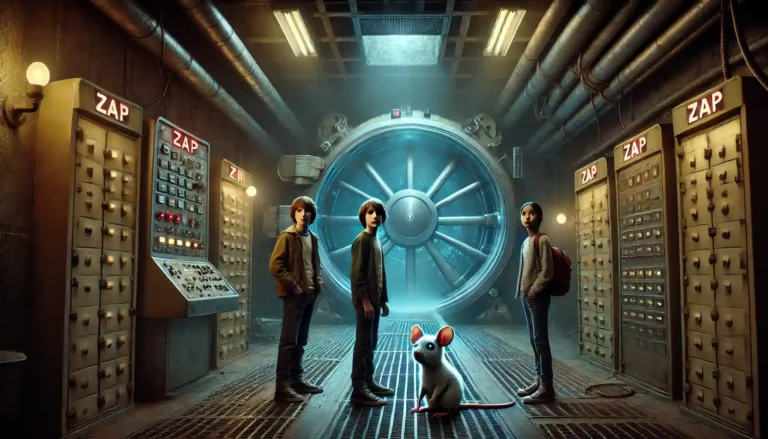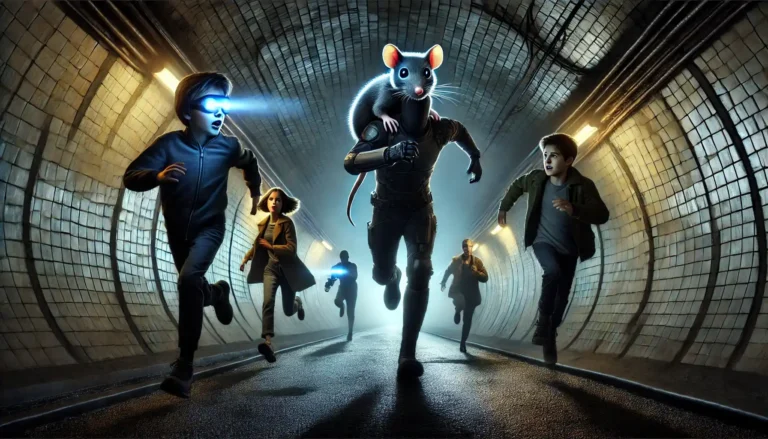
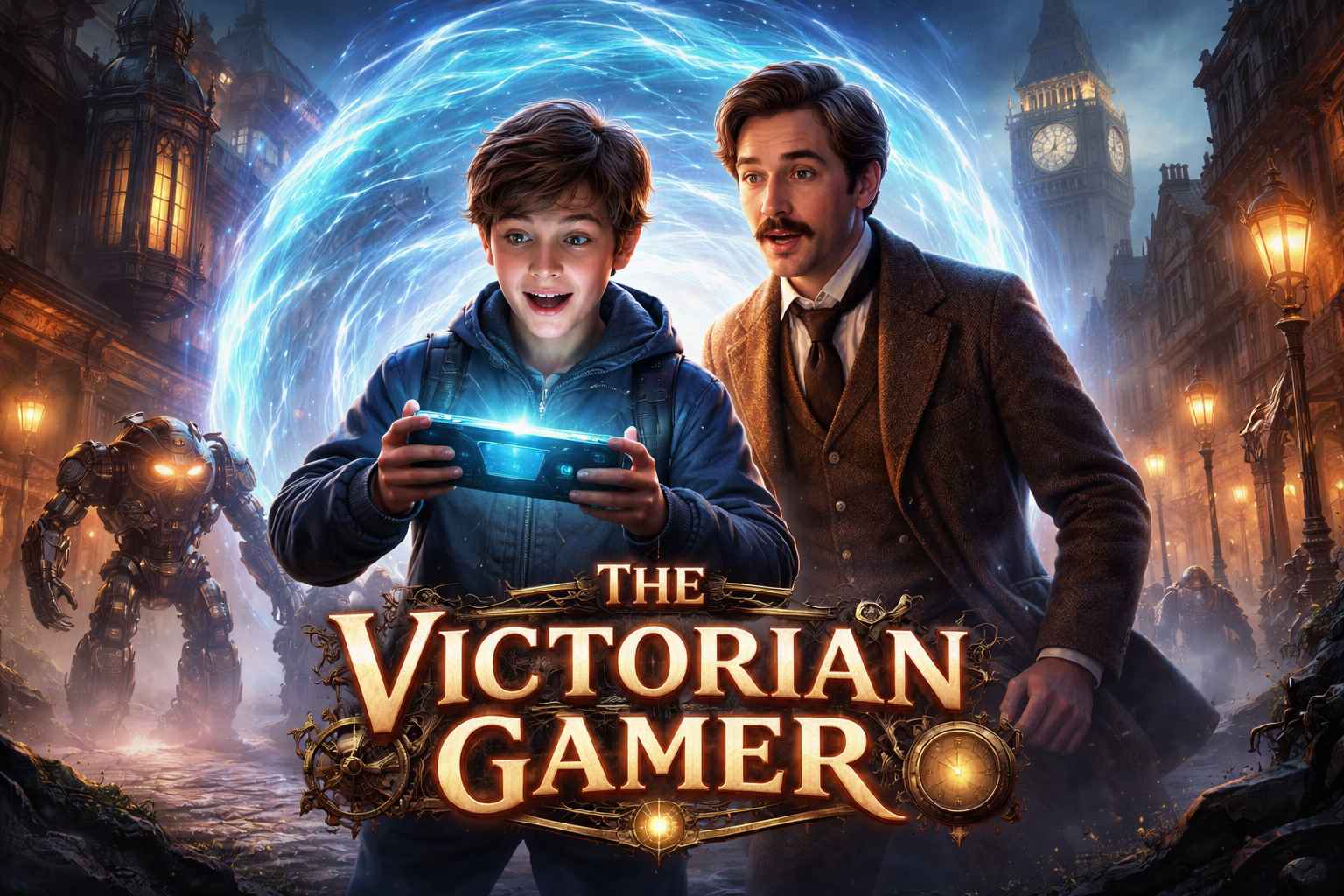
A kid from the year 2050 accidentally travels back to 1890 London with his handheld gaming console. He meets a young H.G. Wells and shows him the game, inspiring the author to write his famous science fiction stories.
STORY:
In the year 2050, twelve-year-old Arin Vale held the rarest thing in his world: a Chrono-Deck, a handheld gaming console so advanced it could simulate entire universes. The device ran on a tiny quantum core, a humming crystal that processed choices before Arin even made them—predicting outcomes, learning from mistakes, and adapting like a thinking brain.
Arin loved one game above all others: TimeRift Runner. The rules were simple—never break history, never reveal the future, and always return home before the clock ran out.
That was before the sky split open.
A blinding ripple of light tore through Arin’s room, the Chrono-Deck shrieked, and the numbers on its screen spun backward. Arin felt the floor vanish beneath him. When he landed, it was on wet cobblestones, under gas lamps hissing like watchful snakes.
A horse-drawn carriage thundered past.
A newspaper boy shouted, “Evening edition!”
And the date on a nearby shop window read: LONDON — 1890.
Arin’s heart slammed against his ribs.
“The game… it’s real,” he whispered.
Fog, Gears, and Danger
London in 1890 was alive—and dangerous. Steam engines roared. Shadows crawled. The air smelled of coal smoke and secrets. Arin pulled his jacket tight, clutching the Chrono-Deck as its screen flickered with a warning:
TEMPORAL BREACH DETECTED. STABILITY: 72%.
If stability hit zero, Arin wouldn’t just be stuck in the past—he’d be erased from time.
As he turned a corner, a group of rough-looking men blocked his path.
“Oi! What’s that glowing brick you’ve got?” one snarled.
Arin’s mind raced. He tapped the console, activating a simulation overlay—the same tool he used in games. Time slowed. Possible futures shimmered in blue light. Run left: failure. Fight: worse.
Talk.
“It’s… a calculator,” Arin said, steadying his voice. “For engineers.”
The men laughed, but a sudden whistle cut through the fog. A young man rushed toward them, coat flapping, eyes sharp with curiosity.
“Leave the boy be,” he said. “Unless you fancy explaining yourselves to the constable.”
The men scattered.
The stranger turned to Arin. “Are you quite all right?”
Arin nodded. “Thanks. I’m Arin.”
The young man smiled. “Herbert. I write stories.”
A Game That Shows Tomorrow
They ducked into a quiet workshop filled with ticking clocks and half-built machines. Herbert’s eyes never left the Chrono-Deck.
“That device,” he said slowly, “it hums as if it’s alive.”
Arin hesitated—but the stability meter dropped again. 65%.
He showed Herbert the game.
Cities floating in the sky. Machines that thought. Humans racing through time itself.
Herbert’s breath caught.
“Stories,” he whispered. “These aren’t games. They’re warnings. Possibilities.”
Arin explained, carefully, about probability, about how the console’s quantum core explored millions of outcomes at once—like rolling infinite dice in the blink of an eye.
“Time isn’t a line,” Arin said. “It’s more like a… web. Tug one thread too hard, and everything shakes.”
Herbert’s eyes shone. “Then the future must be written with care.”
The Clock Is Breaking
Suddenly, the Chrono-Deck screamed.
PARADOX FORMING. SOURCE: OBSERVATION LOOP.
Someone was watching.
Outside, a strange machine clanked through the fog—brass limbs, glowing lenses, gears spinning backward. It was a Temporal Auditor, an automated enforcer built to erase disruptions.
It had found Arin.
“Run!” Arin shouted.
They sprinted through alleyways as the machine fired pulses that froze time for seconds at a stretch. When the world paused, Arin could move—barely—thanks to the console shielding him.
At the River Thames, they were cornered.
Arin made a choice no game had prepared him for.
He handed Herbert the Chrono-Deck.
“You inspired the future,” Arin said. “Now help save it.”
Herbert understood instantly. He adjusted a setting—Narrative Probability Amplifier—turning imagination into a weapon. The console projected impossible futures all at once, overwhelming the Auditor with contradictions.
The machine seized, sparked, and collapsed into silent gears.
A Promise Across Time
The stability meter surged back to 100%. A portal bloomed behind Arin, glowing soft blue.
“I have to go,” Arin said.
Herbert nodded, eyes misty but fierce. “I will write. Not predictions—but questions. Stories that make people wonder where progress leads.”
Arin smiled. “That’s how you change the future without breaking it.”
With a final wave, Arin stepped into the light.
2050 — And Beyond
Arin woke in his room, the Chrono-Deck quiet in his hands. On the screen was a new achievement:
QUEST COMPLETE: THE VICTORIAN GAMER.
Later that day, Arin opened a digital library. New titles flickered into existence—stories about time machines, invisible men, worlds yet to come.
Outside his window, the future stretched wide and uncertain.
Arin powered on the Chrono-Deck.
Some games, he knew now, were just getting started.

The Kids Science Magazine Editorial Team brings together nearly a decade of hands-on experience in electronics engineering, IoT systems, and embedded technology — combined with a deep passion for making complex science genuinely exciting for young minds. Our writers have worked across core electronics testing and real-world technology development, giving every science mystery article a foundation in actual engineering thinking rather than surface-level storytelling. We believe every child deserves access to mind-blowing science — explained clearly, honestly, and in a way that makes them lean forward and ask “but wait, WHY?” Every mystery published on this site is thoroughly researched, fact-checked against credible scientific sources, and written to spark curiosity in kids aged 8–14 across the USA, UK, Canada, Australia & Others across the Globe. New mystery every Friday — because science never runs out of surprises.