Learn why magnets stick to metal through the science of magnetism. Easy explanation for kids with fun facts, quiz, and hands-on magnet experiments.
The Invisible Force of Magnetism!
Have you ever played with a magnet and watched it snap onto the fridge door?
Or seen paper clips jump up and cling together like magic? ✨
It may look mysterious, but magnets are using a powerful invisible force called magnetism.
Let’s uncover how magnets work and why they love some metals—but ignore others!
🌍 What Is Magnetism?
Magnetism is a force that acts without touching.
That means magnets can pull or push objects from a distance!
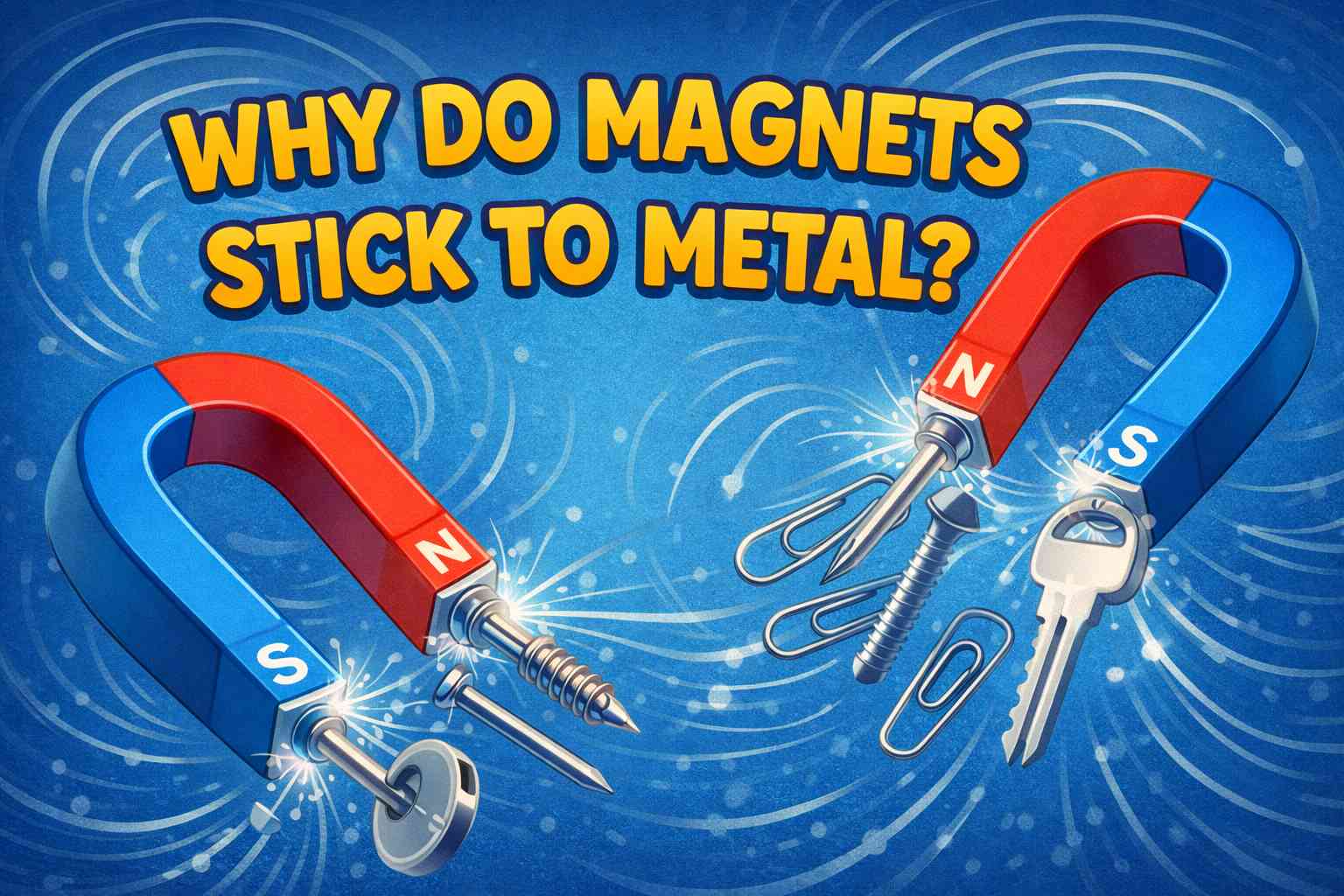
Magnets create something called a magnetic field—an invisible area around them where magnetic force works.
You can’t see this field, but you can see what it does!
🧲 Why Do Magnets Stick to Metal?
Here’s the big secret:
Magnets don’t stick to all metals.
They stick mainly to metals that contain iron, such as:
- Iron
- Steel (which has iron in it)
- Nickel
- Cobalt
⚙️ What’s special about iron?
Inside iron atoms are tiny regions called magnetic domains.
Normally, these domains point in different directions.
But when a magnet comes near:
- The magnet lines up the domains
- The domains pull together
- The metal sticks firmly to the magnet!
It’s like tiny soldiers snapping into formation 🪖🪖🪖
🚫 Why Don’t Magnets Stick to All Metals?
Magnets do not stick to:
- Aluminum
- Copper
- Gold
- Silver
These metals don’t have magnetic domains that line up easily.
So even though they’re metal, magnets mostly ignore them!
🧭 What About the Two Ends of a Magnet?
Every magnet has two poles:
- North Pole
- South Pole
Here’s how they behave:
- Opposite poles attract (North + South ❤️)
- Same poles repel (North + North ❌)
That’s why magnets sometimes snap together—and sometimes push away!
🌟 DO YOU KNOW?
- Earth itself is a giant magnet! 🌍🧲
- A compass works because its needle is a tiny magnet that follows Earth’s magnetic field.
- Some animals, like birds and turtles, use magnetism to navigate long distances!
🤯 FUN SCIENCE FACTS!
✨ Magnetism is caused by moving electric charges inside atoms.
✨ Strong magnets are used in MRI machines to help doctors see inside the human body.
✨ The strongest magnets on Earth are made in laboratories and can lift cars and trains!
🎯 QUIZ TIME! (Test Your Magnet Brain!)
1️⃣ Which metal sticks best to magnets?
a) Aluminum
b) Iron
c) Gold
Answer: b
2️⃣ What do opposite magnetic poles do?
a) Push away
b) Ignore each other
c) Attract
Answer: c
3️⃣ What invisible thing surrounds a magnet?
a) Shadow
b) Magnetic field
c) Wind
Answer: b
🧪 TRY THIS AT HOME!
Magnet Detective Experiment 🔍🧲
You will need:
- A magnet
- Small objects (coin, paper clip, spoon, nail, key)
Steps:
- Touch the magnet to each object.
- Make two piles: sticks and doesn’t stick.
- Check which ones contain iron.
You’re now a magnet scientist! 👩🔬👨🔬
🌠 Encouragement to Explore
Next time you see a magnet at work—on a fridge, toy, or compass—remember:
you’re seeing invisible forces shaping our world.
Try experimenting with magnets:
- Can you make a paper clip chain?
- Can a magnet work through paper or cloth?
Science isn’t always something you can see—but it’s always something you can explore! 🌈🔬

The Kids Science Magazine Editorial Team brings together nearly a decade of hands-on experience in electronics engineering, IoT systems, and embedded technology — combined with a deep passion for making complex science genuinely exciting for young minds. Our writers have worked across core electronics testing and real-world technology development, giving every science mystery article a foundation in actual engineering thinking rather than surface-level storytelling. We believe every child deserves access to mind-blowing science — explained clearly, honestly, and in a way that makes them lean forward and ask “but wait, WHY?” Every mystery published on this site is thoroughly researched, fact-checked against credible scientific sources, and written to spark curiosity in kids aged 8–14 across the USA, UK, Canada, Australia & Others across the Globe. New mystery every Friday — because science never runs out of surprises.