Scientists Unveil Stunning Secrets of a Star Factory Near a Giant Black Hole!
Deep in the heart of the Milky Way Galaxy, a cosmic wonder is taking place! Scientists have captured stunning new images of Sagittarius C, a mysterious and extreme region of space where thousands of new stars are being born. Thanks to NASA’s James Webb Space Telescope, researchers have been able to explore this stellar nursery like never before!
What is Sagittarius C? 🌌✨
Sagittarius C is a giant cloud of gas and dust, located about 200 light-years away from the supermassive black hole at the center of our galaxy. Over millions of years, this cloud has collapsed in on itself, forming thousands of new stars. But despite its star-making power, something strange is happening—scientists have noticed that fewer stars are being born than expected. Why? That’s the big mystery!
A Magnetic Discovery 🧲💫
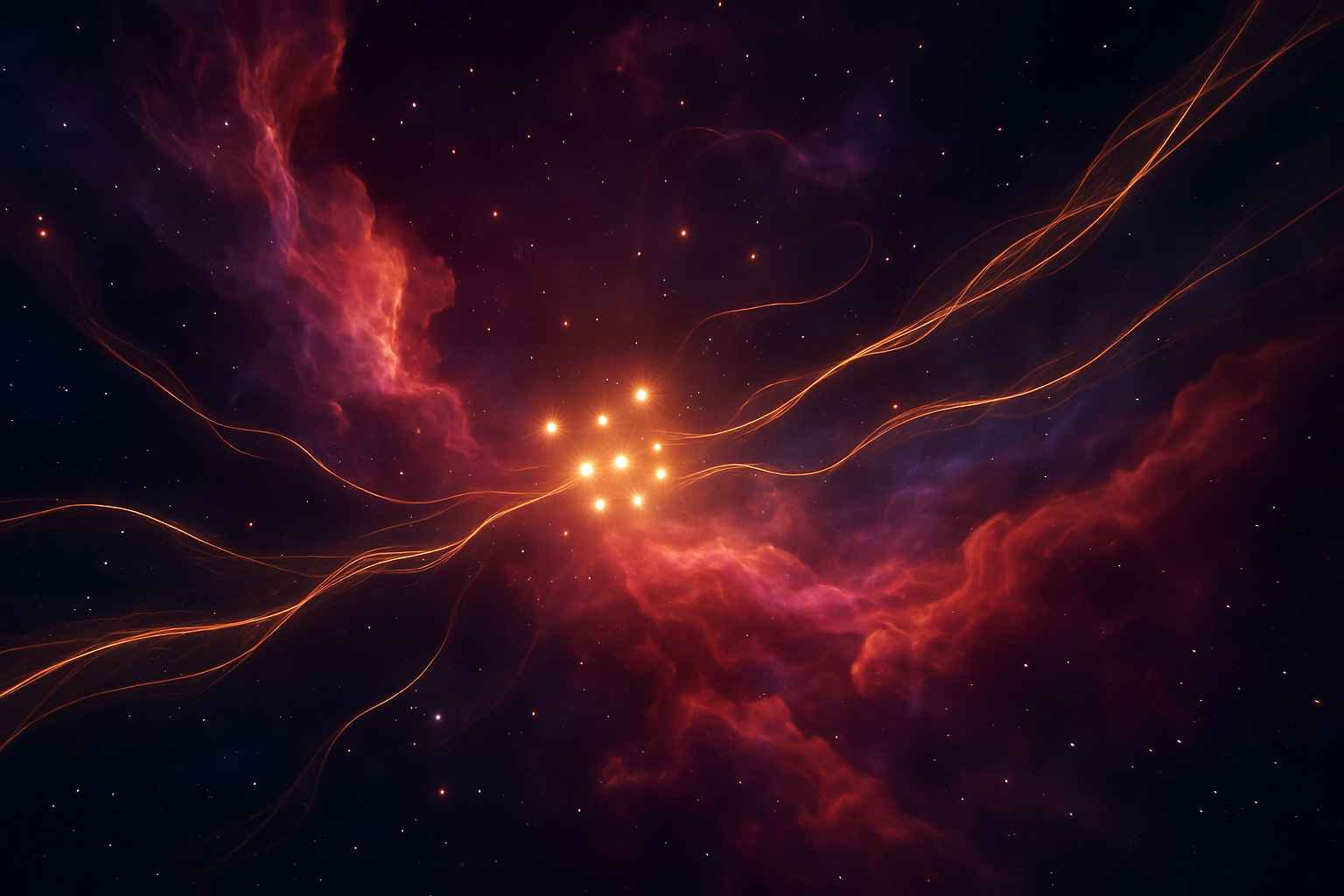
A team of scientists led by John Bally from the University of Colorado Boulder and Samuel Crowe from the University of Virginia has uncovered a fascinating clue. Using the James Webb Space Telescope, they discovered long, glowing filaments of hot hydrogen gas in Sagittarius C. These filaments look like spaghetti noodles and are actually shaped by powerful magnetic fields threading through the region!
These magnetic fields may be slowing down the process of star formation. Instead of gas clouds quickly collapsing into new stars, the strong magnetic forces hold them in place, making it harder for stars to form. This could explain why there are fewer young stars than scientists originally predicted.
What Makes Sagittarius C Special? 🌠🧐
Sagittarius C is located in what scientists call the Central Molecular Zone (CMZ)—one of the most extreme environments in our galaxy. This area is packed with dense clouds of hydrogen, helium, and organic molecules, creating the perfect conditions for star formation. However, because of its unique shape and intense magnetic fields, Sagittarius C looks very different from other star-forming regions, like the famous Orion Nebula.
How Do Stars Form? 🌟🛠️
Stars are born in molecular clouds, massive regions filled with gas and dust. Over time, gravity pulls these materials together until they become hot and dense enough to start nuclear fusion, the process that makes stars shine!
But new stars also push back against their surroundings. As they grow, they release powerful winds of radiation that can blow away nearby gas and dust. This means that once enough stars form in a region like Sagittarius C, they might actually stop more stars from forming!
What’s Next? 🚀🔭
Scientists believe Sagittarius C’s time as a stellar nursery might be coming to an end. The powerful radiation from its stars has already blown away much of the surrounding molecular cloud, and in a few hundred thousand years, this cosmic nursery could disappear completely!
By studying Sagittarius C, scientists hope to unlock more secrets about how stars form, how galaxies evolve, and how cosmic forces like magnetism shape the universe. With tools like the James Webb Space Telescope, we are getting closer than ever to solving some of the greatest mysteries of space!
So next time you look up at the night sky, remember that the Milky Way is still creating new stars, and places like Sagittarius C hold the secrets to the universe’s past, present, and future! 🌠😊
The Kids Science Magazine Editorial Team brings together nearly a decade of hands-on experience in electronics engineering, IoT systems, and embedded technology — combined with a deep passion for making complex science genuinely exciting for young minds. Our writers have worked across core electronics testing and real-world technology development, giving every science mystery article a foundation in actual engineering thinking rather than surface-level storytelling. We believe every child deserves access to mind-blowing science — explained clearly, honestly, and in a way that makes them lean forward and ask “but wait, WHY?” Every mystery published on this site is thoroughly researched, fact-checked against credible scientific sources, and written to spark curiosity in kids aged 8–14 across the USA, UK, Canada, Australia & Others across the Globe. New mystery every Friday — because science never runs out of surprises.