
The Moving Rocks of Death Valley: How Do Rocks Move on Their Own?
The Moving Rocks of Death Valley
In one of the hottest, most lifeless places on Earth, heavy rocks get up and slide across the desert floor — leaving trails behind them. Nobody has ever seen them move. So… what’s dragging them?
FOLLOW THE TRAIL🪨 Picture this…
You’re walking through the most scorching desert in North America. The ground is cracked, completely flat, and baked so hard it’s almost like concrete. There’s no wind strong enough to move a pebble. No animals big enough to push a rock. No rivers. No people for miles.
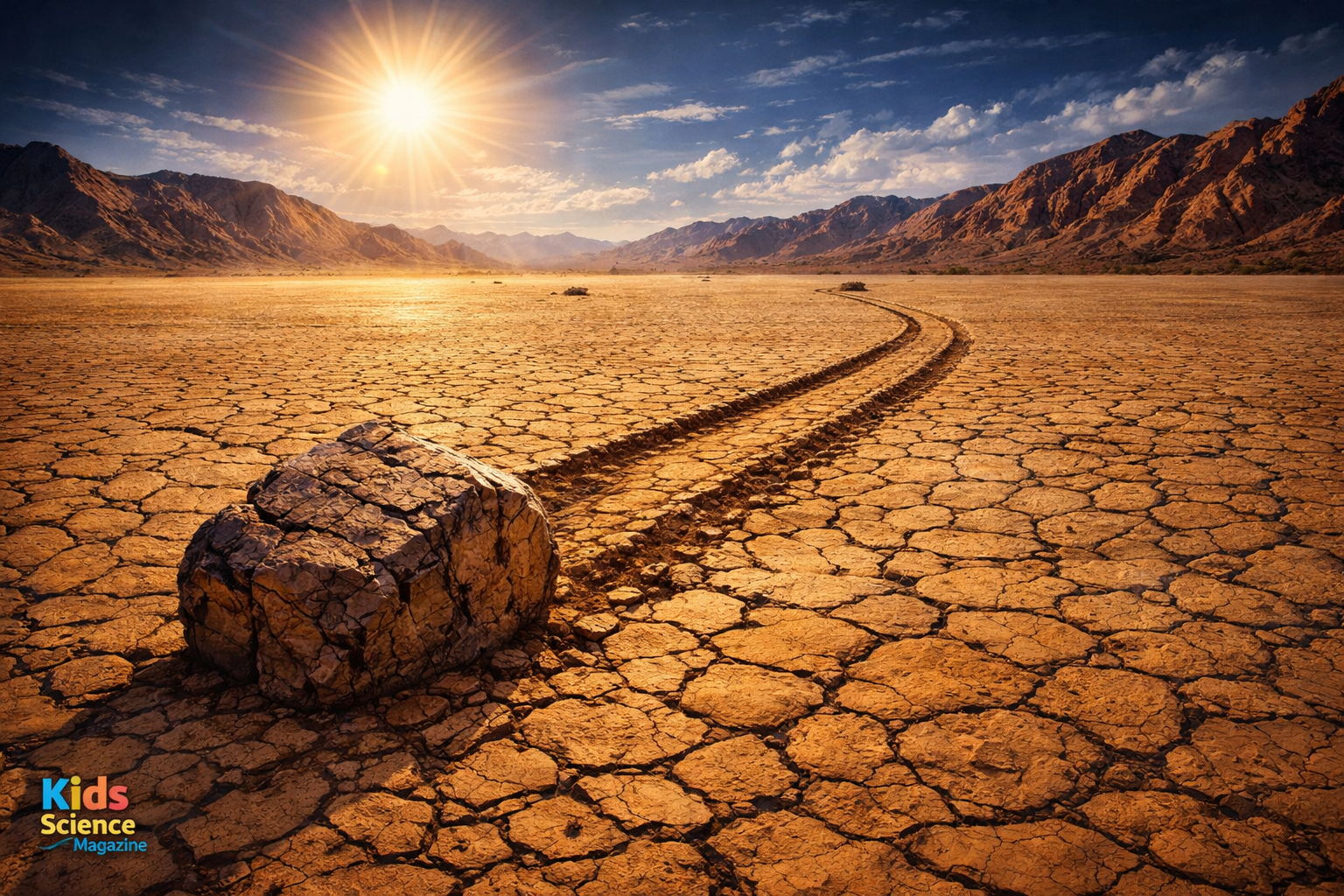
And then you see it. A rock the size of a football — maybe even bigger, the weight of a small child — sitting on the desert floor. Nothing weird about that. Except behind it stretches a long, perfectly carved groove in the mud. A track. Like the rock had been slowly dragged across the ground, carving its path as it went.
But nobody dragged it. Nothing touched it. And no one has ever once seen it move. Yet the trail is fresh — and the rock has clearly travelled dozens of metres.
Welcome to the Racetrack Playa — the most mysteriously mobile desert on Earth.
Where Is This Creepy Desert?
Death Valley, California — USA
Death Valley National Park sits on the border of California and Nevada. It holds the record for the hottest air temperature ever reliably recorded on Earth — a scorching 56.7°C (134°F) in 1913. The Racetrack Playa — where the rocks move — is a dry lake bed about 1,130 metres above sea level, roughly 45 km from the nearest paved road. It’s remote, brutal, and eerily silent.
A “playa” is a dried-up lake bed. During most of the year, the Racetrack Playa is completely dry — a vast, flat expanse of cracked grey mud stretching nearly 4.5 kilometres end to end. It’s almost perfectly level. Scientists checked: the north end is barely 4 centimetres higher than the south end across the entire length. That’s flatter than most kitchen floors.
And scattered all across this flat, impossible surface? Rocks. Dozens of them. With long trails gouged into the earth behind them, curving, turning — some even making U-turns — as if the rocks went for a little wander and came back.
Death Valley isn’t just hot — it’s the driest place in North America, receiving less than 5 centimetres of rain per year. The ground looks completely dead. But something is moving those rocks.
These Rocks Are Not Small
Before we go any further — let’s be clear about what kind of rocks we’re talking about. These aren’t pebbles blown by a breeze. Some of these things are seriously heavy.
Weight of the heaviest moving rock ever recorded
Maximum distance a rock has been tracked sliding
Years researchers spent puzzled before solving the mystery
Times anyone had seen them move — for nearly a century
Scientists have been visiting the Racetrack since the 1940s. They photographed the rocks. They measured the trails. They named individual rocks — there’s one famously called “Karen” — and tracked them across decades. Some rocks travelled side-by-side and left parallel tracks. One rock even made a full 360-degree loop.
The trails were clearly real. But in 70 years of visits, not a single scientist, hiker, or park ranger had ever actually witnessed a rock in motion. It was as if the desert only moved when no one was watching.
— From early geological survey records, Racetrack PlayaEven more baffling: rocks sitting right next to each other would move in completely different directions. If wind was pushing them, they’d all go the same way. But they didn’t. Something far stranger was happening.
Rocks with a flat bottom carved wider, smoother trails, while rocks with a pointed bottom carved narrower, wobblier trails — as if they were spinning slightly as they moved. Whatever was moving them was sensitive to each rock’s exact shape.
The Theories That Turned Out To Be Wrong
For decades, scientists came up with all kinds of explanations — and one by one, they failed. Let’s look at the ones that didn’t hold up:
💨 Extreme Wind Gusts
The most obvious guess: maybe insanely strong winds blow through the valley? Problem: to move a 320kg rock, you’d need wind speeds of over 800 km/h — faster than a commercial jet plane. No such wind has ever been recorded anywhere on Earth. And even if it existed, all rocks would move in the same direction. They don’t.
👽 Aliens or Pranksters
Some people suggested human pranksters were sneaking in at night and pushing rocks around. Problem: the Racetrack is 45km down a rough dirt road, in a national park, with no tyre tracks or human footprints ever found near the rock trails. And have you seen how heavy 320 kilograms actually is? Ruled out completely.
🧲 Magnetic Forces Under the Earth
Some people suggested powerful magnetic forces beneath the playa were pulling and tugging the rocks. Problem: rocks here are made of dolomite and syenite — neither is magnetic. Scientists tested for unusual magnetic activity under the Racetrack. Nothing. Dead end.
🌀 Dust Devils
Death Valley gets spinning whirlwinds called dust devils. Could they be spinning the rocks along? Problem: dust devils don’t carry enough force to move hundreds of kilograms, and they’d leave circular patterns — not long, straight, purposeful trails. Plus, dust devils are common everywhere in the desert. The moving rocks only happen here.
The Moment Scientists Finally Caught Them Moving
For nearly 70 years, this remained one of geology’s most stubborn mysteries. Then in 2013, researchers Richard Norris and James Norris planted GPS trackers inside rocks and set up weather stations and time-lapse cameras all around the Racetrack.
They waited. Months passed. Then in December 2013, something extraordinary happened.
THE ANSWER WAS ICE.
Not a monster. Not aliens. Not magnets. A thin, floating sheet of ice — sometimes barely 3 to 6 millimetres thick — was the secret behind one of Earth’s most baffling mysteries.
Yes, Death Valley is the hottest place in North America in summer. But in winter, temperatures at the Racetrack can plummet below freezing at night. The playa floods very slightly after rare winter rains. That water freezes overnight. And that is when the rocks start to move.
How Does Ice Move a Rock?
The process is slow, delicate, and frankly kind of magical. Here’s exactly what happens:
🌧️ A Rare Rain Falls
Death Valley gets very little rain — but occasionally, winter storms dump just enough water onto the Racetrack Playa to create a shallow pond a few centimetres deep across the dry lake bed.
🌙 Night Temperatures Drop Below Zero
As the desert night falls, temperatures crash. The shallow water begins to freeze — forming a thin sheet of ice, sometimes just 3–6mm thick. The rocks are now sitting in — or on the edge of — this ice sheet.
☀️ Morning Sun Begins to Melt the Ice
As the sun rises, the ice breaks apart into large floating panels — sometimes called “windowpane ice” — thin and nearly transparent, like shards of glass floating on a millimetre of water.
💨 Light Wind Pushes the Ice Panels
Even a gentle breeze — maybe 8–16 km/h — is enough to push the floating ice panels across the water. As they move, they push against rocks sitting in the water. The rock, on slippery wet mud, offers very little resistance.
🪨 The Rock Slides — Slowly, Silently
The ice pushes the rock across slippery mud at speeds of around 2–5 metres per minute — slow enough you might not notice if you were watching. The rock carves a groove into the soft mud beneath as it goes, leaving the trail we find later.
☀️ Everything Evaporates Without a Trace
Within hours, the desert sun evaporates every last drop of water and melts every shard of ice. The playa returns to its normal cracked, arid appearance. The rock sits quietly in its new position. The trail remains. And the desert looks like nothing ever happened.
In December 2013, the Norris team actually watched rocks moving for the first time in recorded history. The rocks moved in bursts of a few seconds to a few minutes, making gentle crackling sounds as the ice fractured around them. After nearly a century of mystery, the answer had been hiding in plain sight all along.
Why Does This Actually Matter?
🔬 It Shows Science Works
For 70 years, people guessed and speculated. Then scientists used GPS, cameras, and patient observation to get the actual answer. The truth was stranger and more beautiful than any wild guess — and it only revealed itself to people willing to wait, watch, and think carefully.
🌍 It Teaches Us About Other Planets
Moving rocks caused by freeze-thaw cycles might explain strange surface features on Mars and Pluto too — worlds where ice and wind interact in ways we’re still figuring out. Death Valley gives scientists a working model to study.
💧 It Reveals Hidden Water Activity
Death Valley seems completely waterless. The moving rocks mystery revealed that micro-events of water and ice happen there regularly enough to shape the landscape dramatically — completely invisible to human eyes. It makes scientists rethink which “dead” environments might actually have hidden water cycles.
🪨 Think About It, Rock Detective!
- If you had been a scientist in 1950 studying the rock trails, what experiment would you have tried first?
- The rocks moved at only 2–5 metres per minute. Why do you think slow movement is harder to detect than fast movement?
- Why do you think the mystery lasted nearly 70 years — even though the answer turned out to be ordinary ice and wind?
- If the same ice-and-wind process might happen on Mars, what would that tell us about water on Mars?
- Can you think of another mystery in nature that might have a surprisingly simple explanation hiding in plain sight?
Supernatural Force — Or Beautiful Science?
THE SCIENCE MYSTERY JURY SAYS…
The Moving Rocks of Death Valley are 100% real — and the explanation is 100% science. No ghosts, no magnets, no aliens. Just the extraordinary teamwork of winter rain, freezing nights, morning sunlight, and a gentle desert breeze — creating a perfect, brief, invisible machine that slides heavy rocks across slippery mud and then vanishes without a trace.
The universe is full of secrets like this — hiding not in darkness, but in the brief, magical intersection of ordinary things: water, ice, wind, mud, and time. The job of science — and of curious kids like you — is to keep watching until those secrets reveal themselves.
Keep asking questions. The desert is still listening.
Stay Curious. Keep Questioning.
The best scientists aren’t the ones with all the answers. They’re the ones who refuse to stop asking questions.
🔬 Explore All Science Mysteries →
M. K. Sinha is an electronics engineering and IoT systems professional with nearly a decade of hands-on experience in core electronics testing and embedded technology development. Having spent years working at the intersection of hardware engineering and real-world technology, he brings an engineer’s precision and a storyteller’s instinct to science writing — translating complex phenomena into ideas that make young readers genuinely stop and think. His work at Kids Science Magazine focuses on the science mysteries and everyday science phenomena that sit right at the edge of what we understand — the questions that keep researchers up at night and make curious kids lean forward and ask “but how?” He believes the best science education doesn’t happen in textbooks alone — it happens the moment a child realises the world around them is far stranger, more surprising, and more wonderful than anyone told them. New mystery published every Friday.
