Ancient sediment records show that K’gari’s famous lakes dried up 7,500 years ago during a rainy era, raising concerns about future climate risks.
🔎 Key Highlights
- K’gari is the largest sand island on Earth
- Its famous freshwater lakes are tens of thousands of years old
- About 7,500 years ago, some lakes suddenly dried up
- This happened during a wet climate period
- Scientists think changing wind patterns may be responsible
- Future climate shifts could put the lakes at risk again
What If a Lake Just… Vanished?
Imagine visiting a world-famous crystal-clear lake — and discovering it simply isn’t there.
No water.
No reflection.
Just dry sand.
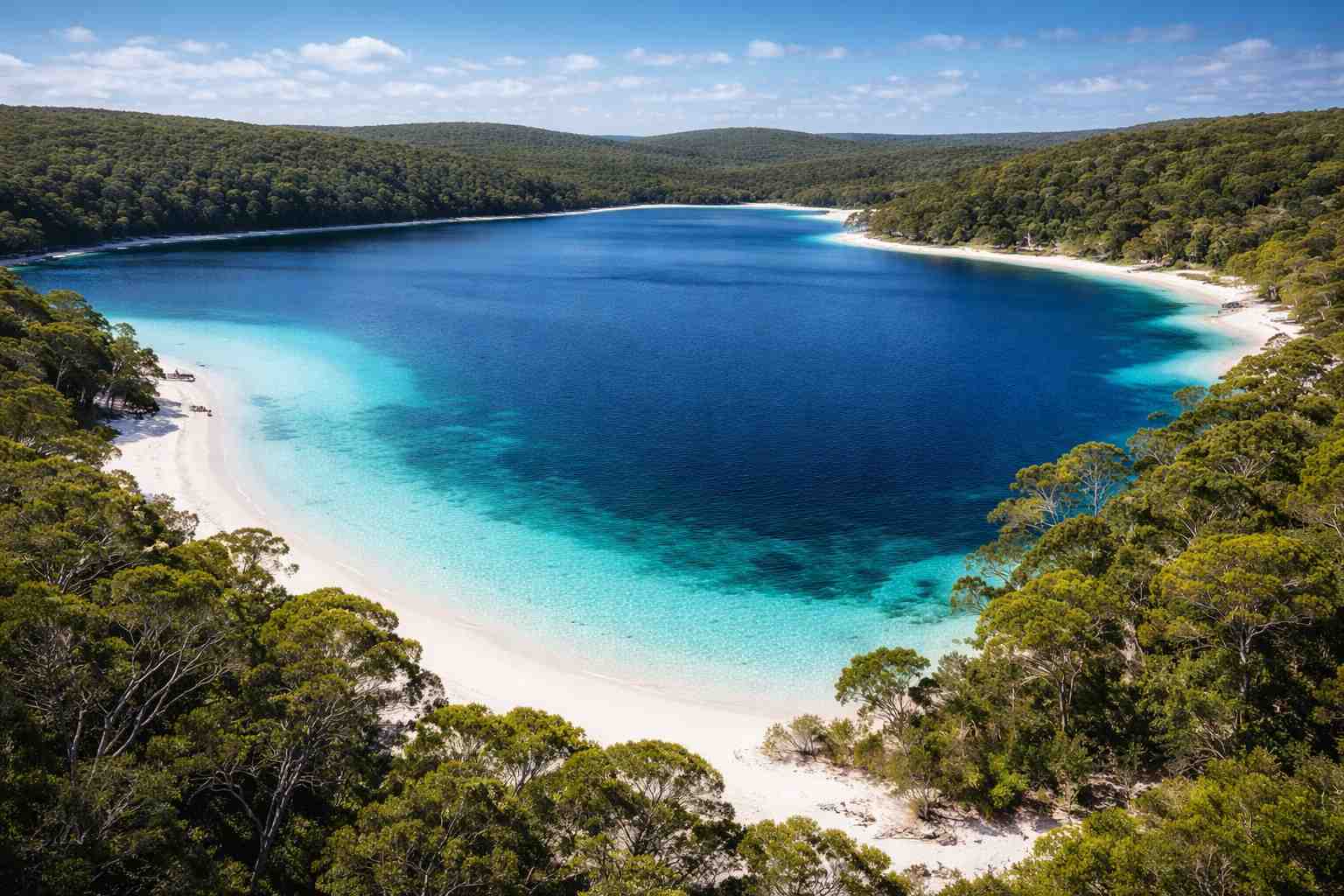
That’s exactly what happened thousands of years ago on K’gari, also known as Fraser Island — the largest sand island on Earth.
And here’s the strangest part:
It happened during a rainy era.
🌴 Meet K’gari — The Island Made of Sand
K’gari lies off the coast of Queensland, Australia. Unlike rocky islands, it’s built almost entirely from sand.
Yet somehow, it holds dozens of deep freshwater lakes — something that sounds almost impossible.
How Can a Sand Island Hold Water?
Most lakes sit in rocky basins.
But K’gari’s lakes are called perched lakes.
🧠 What Is a Perched Lake?
A perched lake forms when:
- Rainwater collects in a depression
- A layer of organic material and compacted sand underneath acts like a natural waterproof barrier
It’s like water sitting in a bowl made of leaves and fine soil.
These lakes have existed for 35,000 to 55,000 years.
Until something unexpected happened.
🕰️ The Rainy Era Mystery
Scientists from the University of Adelaide studied ancient lake mud to understand the past.
About 7,500 years ago, during a time known as the middle Holocene, rainfall across Australia was higher than today.
So the lakes should have been full.
But sediment records revealed something shocking:
Between 7,500 and 5,500 years ago, layers of lake mud were missing.
That means the lakes weren’t there.
They had dried up.
📖 Lakes Keep Diaries in Mud
Scientists study something called sediment cores — long tubes of mud taken from the bottom of lakes.
Think of it like slicing through a layered cake.
Each layer:
- Holds pollen from ancient plants
- Contains sand or organic material
- Records environmental changes
If a layer is missing?
That means something major happened.
In this case, it meant no water.
💨 The Wind May Have Changed Everything
If rainfall was high, why did the lakes dry out?
Researchers think the answer lies in wind patterns.
At the time, strong south-east trade winds may have redirected rain away from K’gari.
Nearby Minjerribah (North Stradbroke Island) still received rainfall.
But K’gari may have been left out.
Rain doesn’t just depend on how much falls from the sky — it also depends on where winds carry it.
🌎 Why This Matters Today
Australia’s climate is changing.
Scientists expect:
- Longer dry periods
- More intense rainfall events
- Shifting wind systems
The big question:
Could K’gari’s lakes disappear again?
If wind and rainfall patterns shift in just the wrong way, it’s possible.
🌺 More Than Just Water
To the Butchulla people, the Traditional Owners of K’gari, the lakes are known as “The Eyes of K’gari.”
They are sacred.
They hold stories, memory, and cultural meaning.
Protecting them isn’t just about science — it’s about respect, heritage, and responsibility.
🌟 Big Takeaway
Even natural wonders that seem permanent can change.
K’gari’s lakes survived ice ages and thousands of years of climate shifts.
But 7,500 years ago, they vanished — even in a rainy world.
The real mystery now is:
What will happen next?
🧠 Quick Quiz: Can You Solve the Mystery?
1. What makes K’gari unique?
A) It’s volcanic
B) It’s the largest sand island on Earth
C) It has saltwater lakes
D) It’s frozen year-round
2. What are perched lakes?
A) Lakes on mountains
B) Lakes fed by rivers
C) Rain-fed lakes sitting on organic layers
D) Underground lakes
3. When did the lakes dry up?
A) During the Ice Age
B) 100 years ago
C) 7,500 years ago
D) Last year
4. What clue showed the lakes were gone?
A) Fossil fish
B) Missing sediment layers
C) Satellite photos
D) Ice cores
5. What may have caused the drying?
A) Earthquakes
B) Meteor impacts
C) Changing wind patterns
D) Volcanoes
✅ Answers:
1-B, 2-C, 3-C, 4-B, 5-C
🤔 Think About This…
If rainfall alone doesn’t guarantee a lake will survive…
what other hidden climate forces might shape the places we think are permanent?
🌊 Mini FAQ: The Mystery of K’gari’s Missing Lakes
1️⃣ Where is K’gari?
K’gari is the world’s largest sand island, located off the coast of Queensland, Australia. It is famous for its crystal-clear freshwater perched lakes.
2️⃣ What happened 7,500 years ago?
Scientists found evidence that some of K’gari’s deepest lakes dried up for about 2,000 years — even though the climate was wetter than today.
3️⃣ How did researchers know the lakes disappeared?
They studied sediment cores — layers of mud at the bottom of lakes. Missing layers showed that water was not present during that time.
4️⃣ Why did the lakes dry up during a rainy period?
Researchers believe changing south-east trade winds may have redirected rainfall away from K’gari.
5️⃣ Could this happen again?
Possibly. Climate change may alter wind and rainfall patterns, which could affect the long-term stability of these unique lakes.