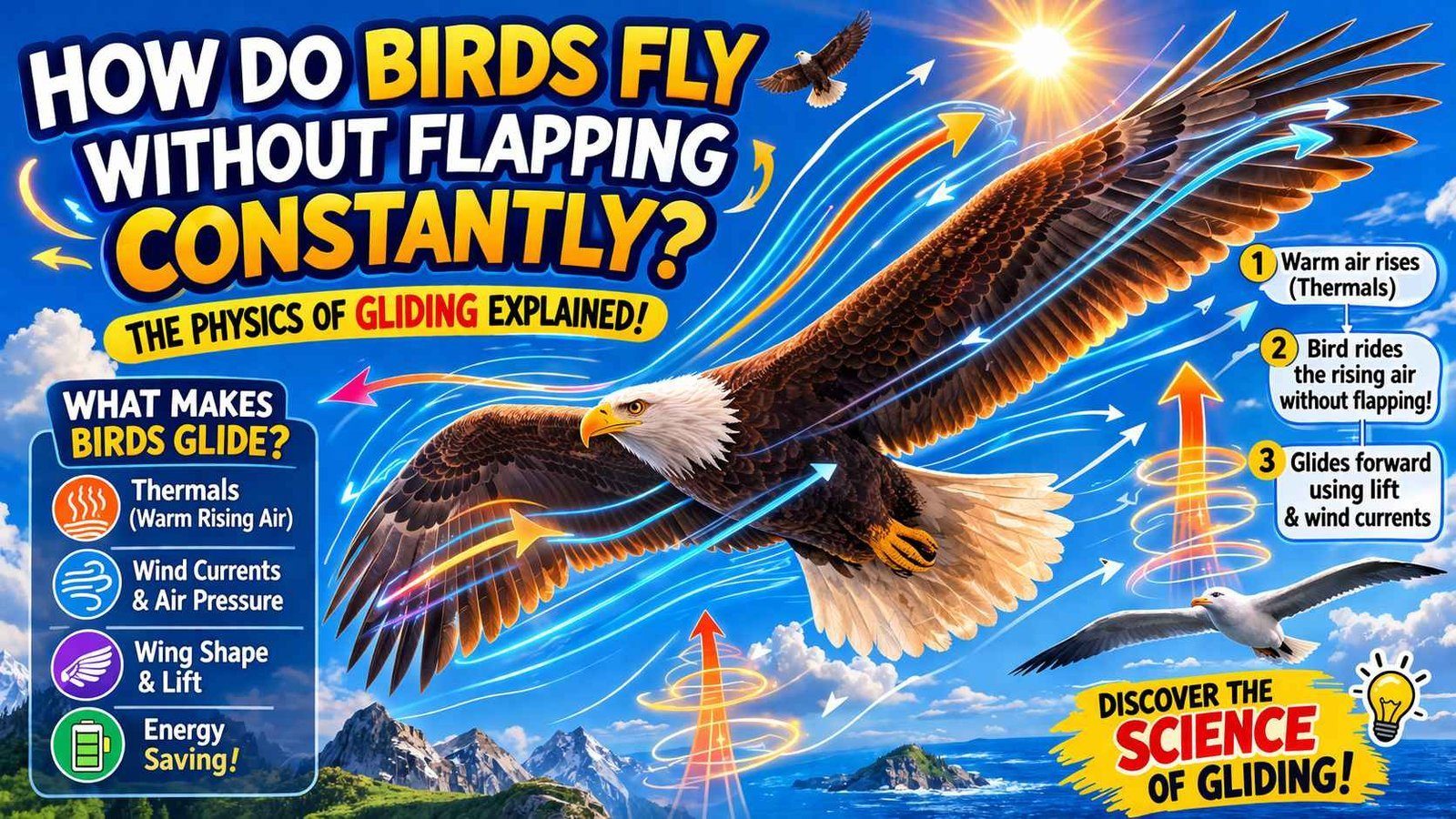
How Do Birds Fly Without Flapping? | Science of Gliding for Kids 🕊️
Uncover the science of lift, soaring thermals, and effortless bird flight through the physics of gliding.
Have you ever watched a bird soaring high in the sky—barely flapping its wings? 🌤️It looks like it’s just floating on air! 😲
So how do birds stay in the sky without constantly flapping?Let’s uncover the science behind this incredible flying trick!
🪽 First, How Do Birds Fly at All?
Birds fly using the same basic forces as airplanes:
• Lift – pushes them up• Gravity – pulls them down• Thrust – moves them forward• Drag – slows them down
When birds flap their wings, they create thrust and lift.But flapping all the time would take a lot of energy!
So birds have a smarter way… 👇
🌬️ What Is Gliding?
Gliding means flying without flapping wings.
Instead of using energy, birds:
• Stretch their wings wide• Use air movement to stay up
It’s like sliding through the sky! 🛫
🌡️ The Secret: Rising Air (Thermals)
Here’s the real magic: warm rising air, called thermals.
🔥 How thermals work:
• The Sun heats the ground ☀️• Warm air rises upward• Birds catch this rising air like an elevator
So instead of flapping, birds:👉 Ride the air currents upward👉 Then glide forward
Eagles, hawks, and vultures are experts at this! 🦅
🌊 Another Trick: Wind Currents
Some birds use wind over oceans or hills.
Example:
• Wind hits a mountain and moves upward• Birds glide along that rising wind
The albatross can glide for hours over the ocean without flapping! 🌊
🪽 Why Wings Matter
Bird wings are perfectly shaped for gliding:
• Long and wide wings = better lift• Curved shape helps air move faster on top• This creates pressure difference and keeps them in the air
Some birds are built for gliding more than others!
⚡ Saving Energy Like a Pro
Flapping takes energy—like running 🏃Gliding saves energy—like sliding downhill 🛝
Birds use a smart strategy:
1. Flap to gain height2. Glide to rest3. Repeat
This helps them fly long distances without getting tired!
🌟 DO YOU KNOW?
• The albatross can travel thousands of kilometers without much flapping!• Eagles can soar for hours using thermals.• Some birds sleep while gliding in the air! 😴
🤯 FUN SCIENCE FACTS!
✨ Gliding birds often fly in circles to stay inside rising air columns.✨ Bigger birds glide better because they can catch more air.✨ Humans copied this idea to build gliders and airplanes! ✈️
🎯 QUIZ TIME! (Test Your Flight Skills)
1. What is it called when birds fly without flapping their wings?Running | Gliding (Correct) | Jumping | Floating
2. What helps birds rise into the air without flapping?Cold air | Warm rising air (thermals) (Correct) | Rain clouds | Fog
3. Why do birds glide instead of flapping all the time?To look cool | To save energy (Correct) | To fly faster | To sleep
4. What force helps keep birds in the air?Heat | Lift (Correct) | Sound | Light
5. Which bird is famous for gliding long distances?Sparrow | Albatross (Correct) | Pigeon | Parrot
6. What shape of wings helps birds glide better?Short and round | Long and wide (Correct) | Tiny and thin | Square
7. What do birds often do to stay inside rising air?Fly straight | Fly in circles (Correct) | Stop moving | Dive down
8. What is drag?Force pushing up | Force pulling down | Air resistance slowing movement (Correct) | Heat from the sun
🧪 TRY THIS!
Paper Glider Experiment ✈️
You need:
• Paper
Steps:
1. Make a paper airplane2. Throw it gently3. Watch it glide
Try changing wing shapes—Which one glides farther? 🤔
🌈 Encouragement to Explore
Next time you see a bird soaring in the sky, look closely…Is it flapping or gliding?
You’re not just watching a bird—you’re watching physics in action! 🧠✨
Keep observing, keep asking, and keep exploring—because science is flying all around you! 🌍🕊️
✨ Did You Know?
📖 Science Word
Thermal
/THUR-muhl/An upward current of warm air caused by the uneven heating of Earth's surface by the Sun.
🔤 Word Scramble
Test Yourself!
Question 1 of 4
What is the primary upward force that keeps a bird airborne while gliding?
Quick Poll
Which soaring flyer would you most like to watch in action?
How fun was this article?