Learn how airplanes stay in the sky with an easy explanation of lift, thrust, and Bernoulli’s Principle. Fun science article for kids with facts, quiz, and experiment.The Amazing Science of Lift, Thrust & Bernoulli’s Principle.
Have you ever looked up at the sky and seen a huge airplane flying smoothly above the clouds? ☁️✈️
It might look like magic—but it’s actually science working perfectly together!
So how does a heavy metal airplane lift off the ground and stay in the air?
Let’s break this flying mystery into simple, fun ideas kids can understand.
🌬️ First, Meet the Four Forces of Flight
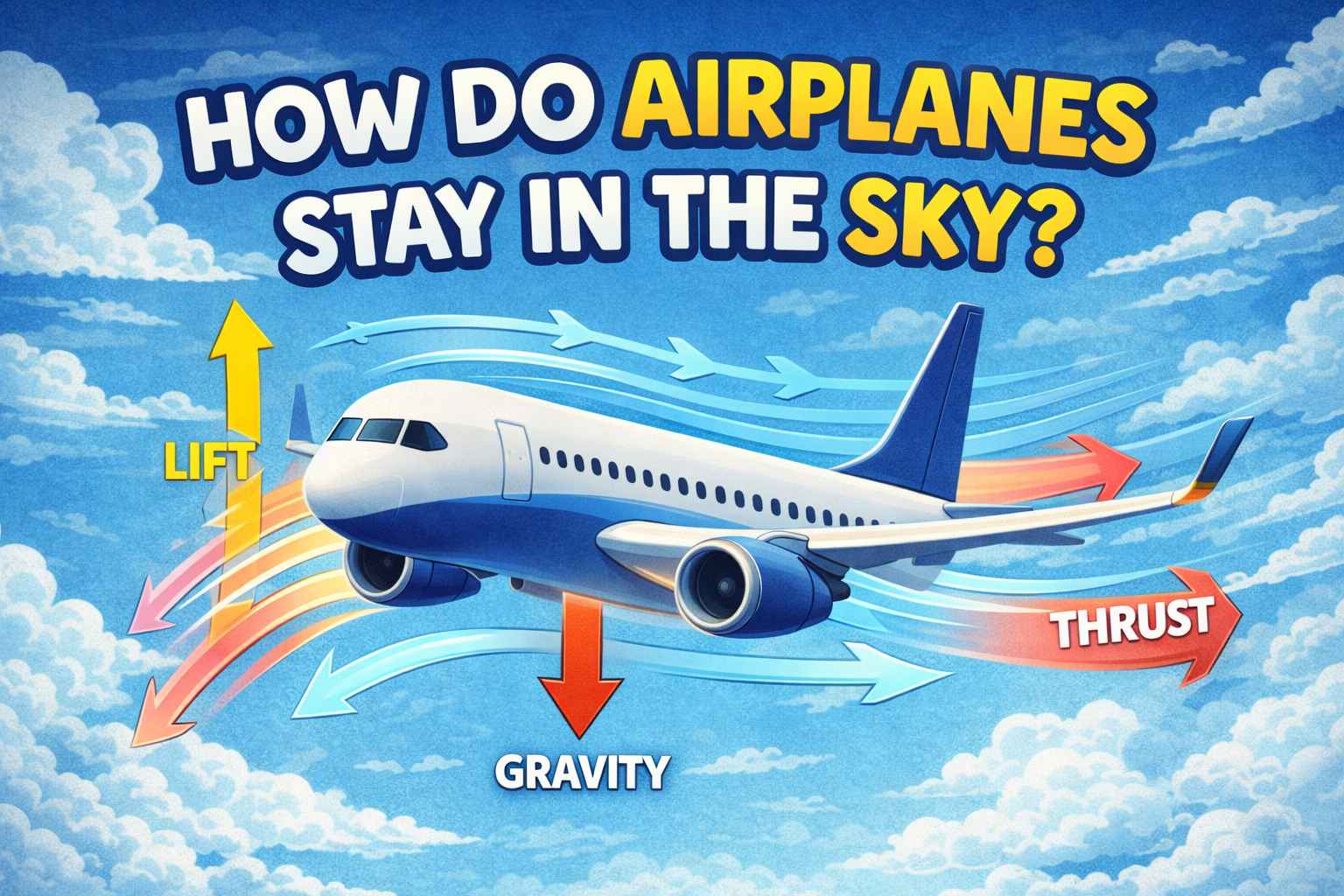
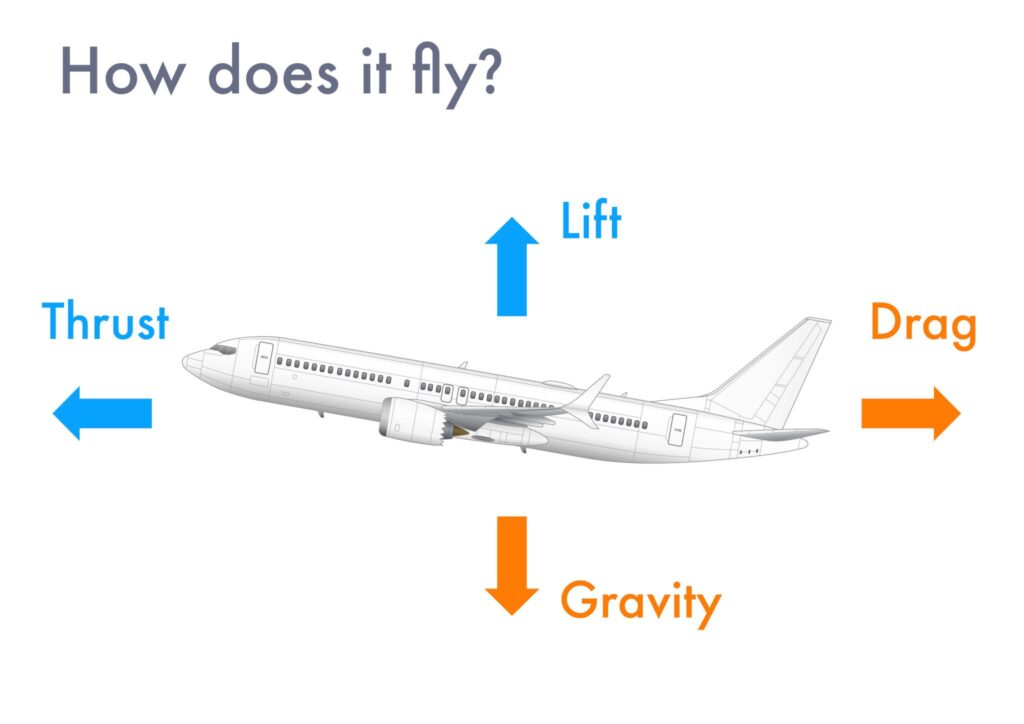
Every airplane in the sky is controlled by four invisible forces:
1️⃣ Lift – pushes the airplane up
2️⃣ Thrust – pushes the airplane forward
3️⃣ Drag – air resistance that slows it down
4️⃣ Gravity – pulls the airplane down
To fly, lift and thrust must be stronger than gravity and drag.
Let’s see how that happens!
🪽 What Is Lift? (The Wing’s Superpower!)
The most important part of an airplane is its wings.
Airplane wings are curved on top and flatter on the bottom.
Here’s the cool part:
- Air moves faster over the top of the wing
- Air moves slower under the wing
Fast-moving air has lower pressure, and slow-moving air has higher pressure.
This pressure difference pushes the wing upward.
That upward push is called lift! 🚀
This idea comes from Bernoulli’s Principle, which says:
When air moves faster, its pressure becomes lower.
🏃 Why Does an Airplane Need Speed?
An airplane needs fast air movement to create lift.
That’s why airplanes use engines.
✈️ Thrust = Forward Power
Engines push air backward, which pushes the airplane forward.
This forward push is called thrust.
As the airplane speeds up on the runway:
- More air flows over the wings
- Lift increases
- Eventually… whoosh! The plane takes off! 😄
🌍 What About Gravity and Drag?
- Gravity always pulls the airplane downward
- Drag is air pushing against the plane as it moves
Pilots and engineers design airplanes so:
- Wings make extra lift
- Engines make strong thrust
- Smooth shapes reduce drag
That balance keeps airplanes flying safely for hours!
🌟 DO YOU KNOW?
- Airplane wings are called airfoils.
- Even paper airplanes fly using lift (try it!) 📄✈️
- Birds use the same science—their wings also create lift! 🐦
- A fully loaded airplane can weigh as much as 400 elephants, yet still fly!
🤯 FUN SCIENCE FACTS!
✨ Airplanes don’t float—they are pushed up by air pressure.
✨ Helicopters use spinning blades instead of wings to make lift.
✨ The faster a plane flies, the more lift it can create.
✨ Astronauts don’t use wings in space—there’s no air for lift!
🎯 QUIZ TIME! (Test Your Flight Skills)
1️⃣ What force pushes an airplane upward?
a) Drag
b) Lift
c) Gravity
Answer: b
2️⃣ What makes air move faster over the wing?
a) Wing shape
b) Paint color
c) Gravity
Answer: a
3️⃣ What force moves the airplane forward?
a) Lift
b) Thrust
c) Drag
Answer: b
🧪 TRY THIS AT HOME!
Make Your Own Lift Experiment
You’ll need:
- A strip of paper
Steps:
- Hold the paper just below your mouth.
- Blow across the top of the paper.
What happens?
The paper lifts up! 😲
You just created Bernoulli’s Principle in action.
🌈 Encouragement to Explore
Next time you’re on a flight—or watching planes in the sky—remember:
you’re seeing air, speed, and science working together.
Try asking:
- Why are wings shaped that way?
- How do jets fly higher than clouds?
- Could humans ever flap wings like birds?
Keep asking questions…
because curiosity is what makes future pilots, engineers, and scientists take off! 🚀🧠




One Comment
Comments are closed.