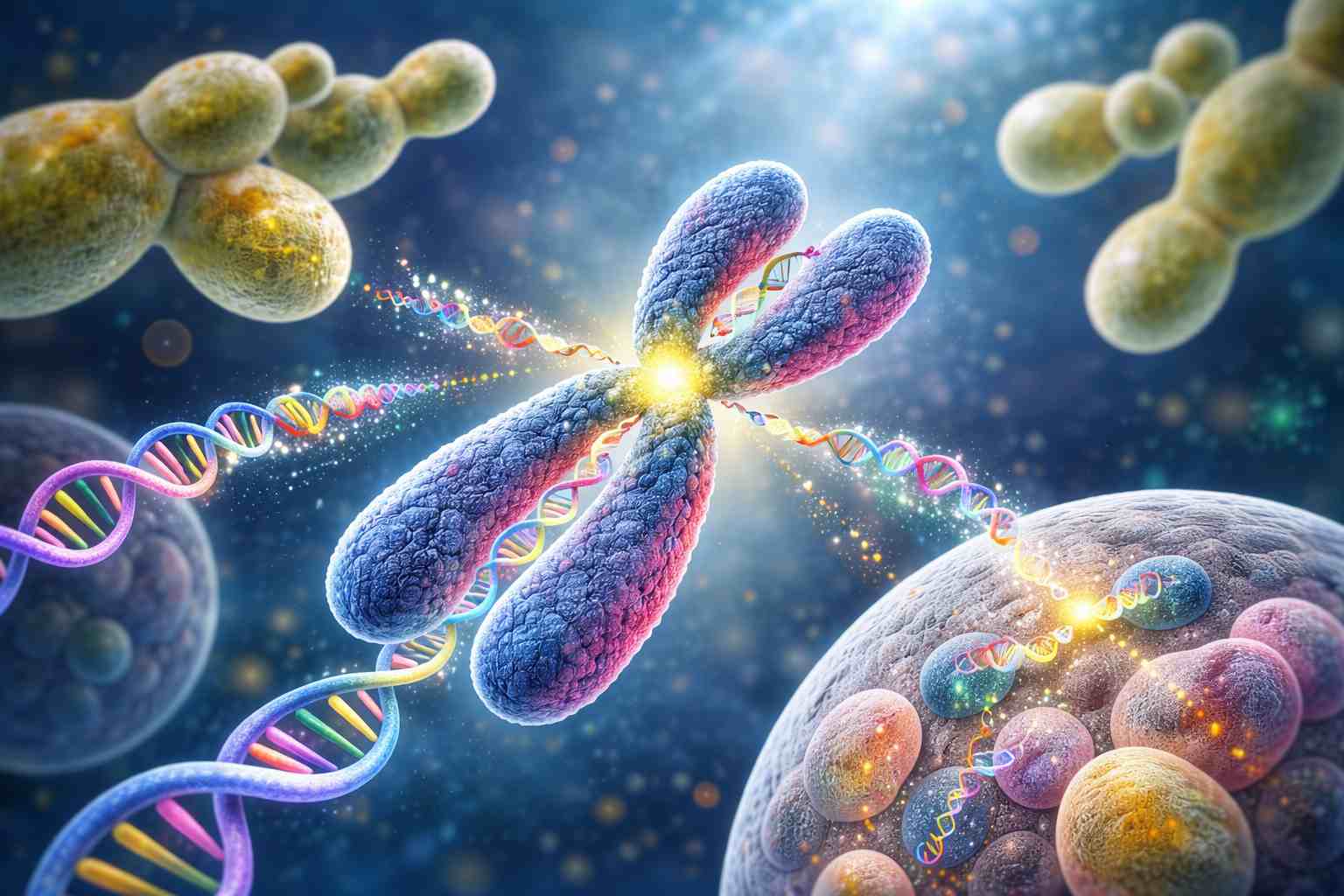
Scientists discovered how brewer’s yeast evolved its tiny centromeres, tracing them back to ancient jumping genes that became essential chromosome machinery.
🔎 Key Highlights
- Scientists discovered how yeast evolved extremely tiny centromeres
- Centromeres help chromosomes separate during cell division
- Researchers found evolutionary “halfway” centromeres in related yeast species
- The structures likely evolved from retrotransposons (jumping genes)
- DNA once considered “genetic junk” may actually build essential cell machinery
What Happens When a Cell Divides?
Every time a cell divides, it must copy and split its DNA perfectly.
Think of DNA like a giant instruction manual divided into chapters called chromosomes.
When a cell divides, each new cell needs exactly the same chapters.
But how does the cell make sure chromosomes separate correctly?
The answer lies in a tiny but powerful part of DNA called the centromere.
The Centromere: A Chromosome’s Control Point
A centromere is a special region on a chromosome where cellular machines attach.
These machines pull chromosomes apart during cell division.
Imagine it like a handle on a suitcase that lets workers grab and move it.
Without the centromere:
- chromosomes could break
- DNA could be lost
- cells could malfunction
Centromeres are essential for life in almost every organism.
But Yeast Does Something Very Strange
In most plants and animals, centromeres are large stretches of repetitive DNA.
But in Saccharomyces cerevisiae, they are incredibly small.
Scientists call them “point centromeres.”
They are:
- extremely tiny
- highly precise
- genetically simple
For decades, biologists wondered:
How could such tiny structures evolve?
A Discovery From Evolution’s “Halfway Point”
Researchers from the Max Planck Institute of Molecular Physiology studied related yeast species to look for clues.
And they found something amazing.
Some species had centromeres that looked like evolutionary middle stages.
These “proto-centromeres” helped scientists trace how yeast’s tiny centromeres developed over time.
It’s like discovering fossil footprints that show how dinosaurs evolved into birds.
The Surprising Source: Jumping Genes
The study revealed that the ancestors of yeast centromeres likely came from retrotransposons.
🧠 What Are Retrotransposons?
Retrotransposons are pieces of DNA that can copy themselves and move around the genome.
Because they behave a bit like genetic parasites, scientists once called them “junk DNA.”
But evolution sometimes turns junk into treasure.
In this case, ancient jumping genes appear to have been repurposed into essential chromosome machinery.
The Centromere Paradox
This discovery also helps solve something called the centromere paradox.
The paradox is that:
- the job of centromeres stays the same
- but the DNA sequence changes rapidly over evolution
Scientists didn’t know how such an important structure could evolve so quickly.
Now they have a clue:
Evolution may rebuild centromeres using mobile DNA elements.
Why This Discovery Matters
This research shows something important about how genomes evolve.
DNA once thought to be useless may actually help create new biological tools.
It also helps scientists understand:
- chromosome stability
- genetic evolution
- how cells avoid division errors
Those insights could someday help research on genetic diseases and cell biology.
🌟 Big Takeaway
Sometimes evolution doesn’t invent something new from scratch.
Instead, it recycles old genetic pieces.
In yeast, ancient jumping genes were transformed into one of the most important parts of the chromosome.
What once looked like genomic junk turned out to be essential for life itself.
🧠 Quick Quiz: Yeast Genetics Challenge!
1. What does a centromere do?
A) Stores energy
B) Controls chromosome separation
C) Creates new DNA
D) Protects the cell membrane
2. What organism was studied in this research?
A) Bacteria
B) Plants
C) Brewer’s yeast
D) Fish
3. What are retrotransposons?
A) DNA repair enzymes
B) Jumping genes that move in the genome
C) Cell membranes
D) Ribosomes
4. Why is yeast unusual?
A) It has extremely tiny centromeres
B) It has no DNA
C) It cannot divide
D) It has thousands of centromeres
5. What does the discovery show about DNA evolution?
A) Junk DNA is useless
B) DNA never changes
C) Evolution can reuse genetic elements
D) Chromosomes cannot evolve
✅ Answers
1-B
2-C
3-B
4-A
5-C
🤔 Think About This
If evolution can turn “junk DNA” into essential chromosome machinery…
What other hidden secrets might still be buried inside our genomes?