
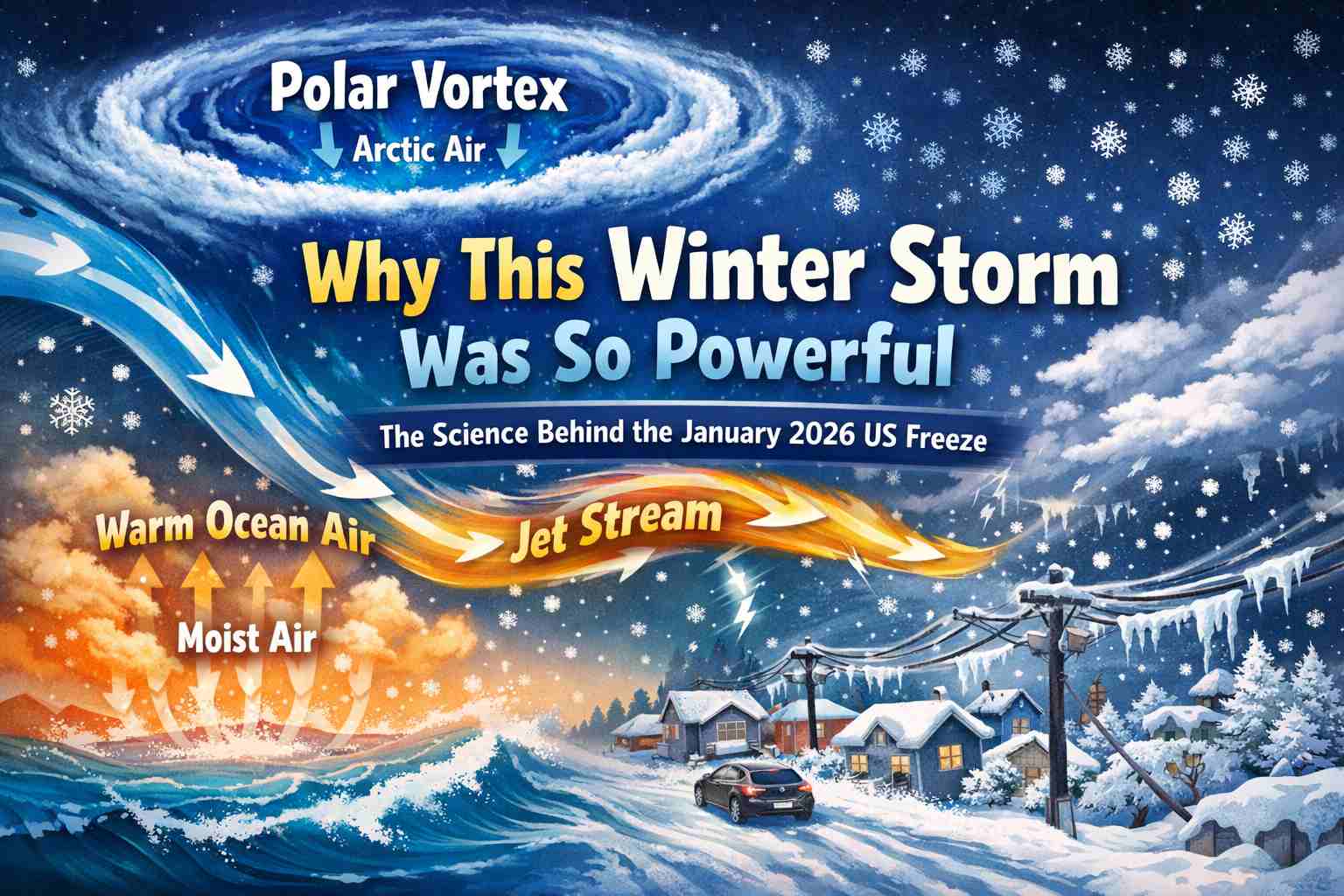
Why did the January 2026 winter storm hit the US so hard? Learn how the polar vortex, jet stream, and warm oceans combined to create extreme snow, ice, and cold—explained simply for kids.
🔍 Quick Highlights
- A sudden Arctic blast spread freezing cold across much of the U.S.
- Warm ocean water helped feed the storm with extra moisture.
- A wavy jet stream and a stretched polar vortex teamed up.
- The result: snow, ice, power outages, and record cold in many states.
🌎 What Happened Across the United States?
In late January 2026, a massive winter storm shocked millions of Americans. After a mostly mild start to winter, temperatures suddenly plunged, and a dangerous mix of snow, sleet, and freezing rain spread from the Southwest all the way to the Northeast.
Some places in the Midwest and Northeast were buried under more than a foot of snow. Southern states like Texas and Arkansas saw thick ice coating roads, trees, and power lines. Hundreds of thousands of homes lost electricity as ice snapped branches and pulled down wires.
Many people wondered:
“How did winter turn this extreme so fast?”
To find the answer, scientists looked far above our heads—miles up in the sky.
🧪 How Scientists Explain This Powerful Storm
Winter storms don’t form from just one thing. They need several ingredients to come together at the same time—kind of like a complicated recipe.
The key ingredients were:
- Bitter Arctic air
- Warm, moist air from the ocean
- A sharply bending jet stream
- A disturbed polar vortex
When all of these lined up, the storm exploded in strength.
🌀 The Jet Stream: Earth’s Weather Highway
High above Earth, about 3–5 miles up, flows a fast-moving river of air called the jet stream. It acts like a steering wheel for weather systems.
- When the jet stream flows smoothly, weather stays calmer.
- When it dips and bends, it can pull cold air far south.
In January 2026, the jet stream took a deep southward dive, allowing frigid Arctic air to spill into the U.S. This created a sharp temperature contrast between cold northern air and warmer southern air—perfect conditions for a major storm.
🧊 The Polar Vortex: The Cold Keeper That Escaped
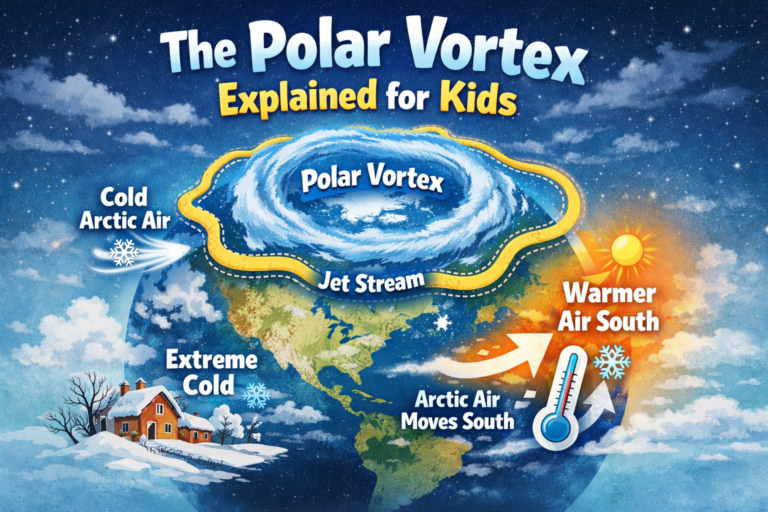
Even higher—about 20 miles above Earth, in a layer called the stratosphere—lives the polar vortex.
Normally, the polar vortex:
- Spins tightly around the North Pole
- Keeps the cold air locked in the Arctic
But this time, the polar vortex stretched and weakened. When that happened, it sent powerful energy downward that made the jet stream even wavier.
Think of it like this:
The polar vortex bounced energy back down, supercharging the jet stream’s bends, which pushed cold air deeper into the U.S.
🌊 Warm Oceans: Fuel for a Winter Storm?!
Here’s the surprising part: warm water helped make this cold storm stronger.
The Gulf of Mexico was unusually warm for January. Warm water means:
- More evaporation
- More water vapor in the air
- More moisture for storms
When cold air met this warm, moist air:
- Snowfall increased
- Ice storms became more intense
- Freezing rain fell instead of snow in some places
Moisture is like fuel for storms—and this storm had plenty of it.
😲 Why This Storm Surprised So Many People
Many Americans felt caught off guard because:
- Early winter was milder than usual
- People expected fewer extreme cold events
- Climate change is often linked only to warming
But warming doesn’t mean winter disappears.
Scientists explain that:
- Earth is warming overall
- Snowfall days may decrease
- But the strongest storms can still be very intense
In fact, a warmer atmosphere can hold more moisture, which can make extreme storms even more powerful when cold air does arrive.
❄️ Snow, Sleet, or Freezing Rain—Why the Mix?
Small temperature differences in the atmosphere decide what falls from the sky:
- All cold air → Snow
- Cold + warm layer above → Sleet
- Warm air above, freezing air near ground → Freezing rain
That’s why some states got fluffy snow, while others were coated in dangerous ice.
🧠 What Scientists Are Still Studying
Weather scientists are working to better understand:
- How climate change affects the polar vortex
- Why some winter storms become extreme
- How to improve long-range storm forecasts
Agencies like National Oceanic and Atmospheric Administration and the National Weather Service use satellites, weather balloons, and computer models to track storms and issue warnings that save lives.
🌟 The Big Takeaway for Kids
This January 2026 winter storm wasn’t random—it was the result of powerful forces working together high above Earth and across the oceans.
✔ Cold air
✔ Warm water
✔ A bending jet stream
✔ A disrupted polar vortex
When science pieces fit together like this, weather can turn extreme—even in a warming world.
And that’s why studying weather isn’t just cool…
It’s important.
❄️ Winter Storm Science Quiz: Can You Explain the January 2026 US Freeze?
Test what you learned about the polar vortex, jet stream, and powerful winter storms!
1. What made the January 2026 US winter storm especially powerful?
The storm intensified when bitter Arctic air met warm, moisture-filled air from the south.
2. What is the jet stream?
The jet stream steers weather systems and plays a key role in storm movement.
3. Where does the polar vortex usually stay?
The polar vortex normally spins around the Arctic, keeping cold air locked in.
4. Why did this winter storm surprise many Americans?
A warmer start to winter made the sudden freeze feel unexpected.
5. How did the warm Gulf of Mexico help fuel the storm?
Warm ocean water increases evaporation, which feeds storms with moisture.
6. Which type of winter precipitation is most dangerous for power lines?
Freezing rain coats wires with heavy ice, often causing power outages.
7. In which layer of the atmosphere does most weather occur?
All everyday weather, including storms, happens in the troposphere.
8. What happens when the polar vortex weakens?
A weaker polar vortex allows cold air to escape into lower latitudes.
9. Can severe winter storms still happen even as Earth warms?
Climate warming does not eliminate winter storms, especially extreme ones.
10. Which two forces worked together to intensify this storm?
The interaction between the jet stream and polar vortex made the storm stronger.

The Kids Science Magazine Editorial Team brings together nearly a decade of hands-on experience in electronics engineering, IoT systems, and embedded technology — combined with a deep passion for making complex science genuinely exciting for young minds. Our writers have worked across core electronics testing and real-world technology development, giving every science mystery article a foundation in actual engineering thinking rather than surface-level storytelling. We believe every child deserves access to mind-blowing science — explained clearly, honestly, and in a way that makes them lean forward and ask “but wait, WHY?” Every mystery published on this site is thoroughly researched, fact-checked against credible scientific sources, and written to spark curiosity in kids aged 8–14 across the USA, UK, Canada, Australia & Others across the Globe. New mystery every Friday — because science never runs out of surprises.




One Comment
Comments are closed.