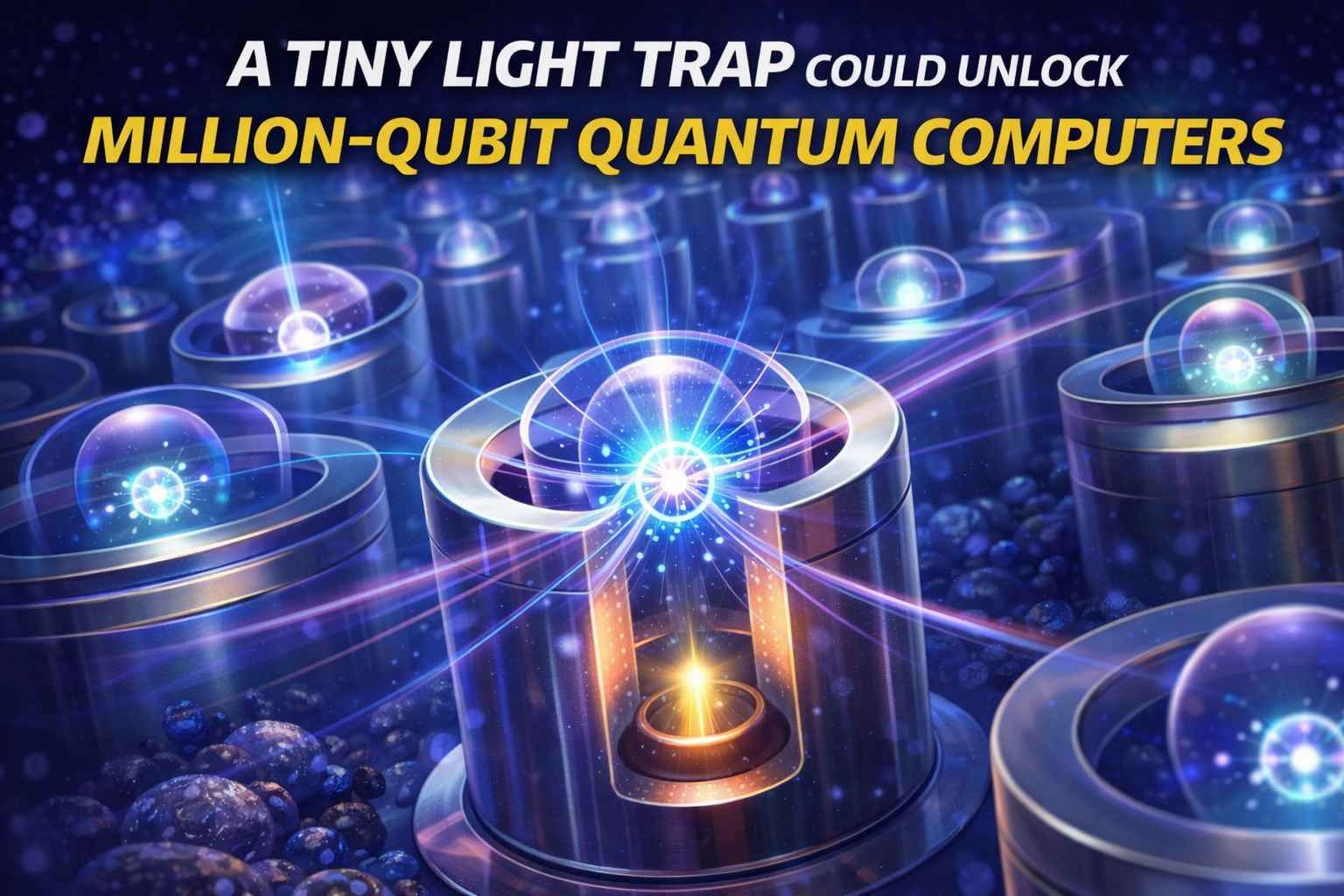
A new light-based breakthrough from Stanford could allow quantum computers to scale to millions of qubits by efficiently reading information from individual atoms.
How Scientists Learned to Catch Light From a Single Atom
🔍 Key Highlights (Quick Look)
- Scientists built tiny light traps that catch light from individual atoms
- Each atom stores a qubit, the basic unit of a quantum computer
- The new design lets scientists read many qubits at the same time
- Working systems already have hundreds of qubits
- This could lead to million-qubit quantum supercomputers
A Big Problem… Solved With a Very Small Idea ✨
Quantum computers promise to solve problems so hard that today’s computers would need thousands of years to finish them. But there’s been one giant problem holding them back:
👉 How do you read information from millions of qubits quickly?
Now, scientists at Stanford University think they’ve found the answer—with something called a tiny light trap.
And it all starts with light from a single atom.
First, What Is a Qubit? 🧠
Regular computers use bits, which are either:
- 0️⃣ or
- 1️⃣
Quantum computers use qubits, which are much stranger.
A qubit:
- Can be 0
- Can be 1
- Or can be both at the same time (yes, really!)
This special ability lets quantum computers explore many possible answers all at once.
But to use a qubit, scientists must read its information—and that’s been very hard.
Why Reading Qubits Is So Tricky 😵💫
In this system:
- Each qubit is stored inside a single atom
- When scientists want information, the atom releases a tiny flash of light
- That light carries the answer
The problem?
- Atoms release light slowly
- And they send it in all directions, like a broken flashlight
Trying to collect that light from millions of atoms is like trying to hear one whisper in a football stadium.
Enter the Optical Cavity: A Light Catcher 🔦
Scientists solved this using something called an optical cavity.
Think of it like this:
An optical cavity is like a mini hall of mirrors for light.
- Light bounces back and forth
- It gets guided in one direction
- Scientists can catch it much more easily
Optical cavities have existed for years—but atoms are tiny and nearly invisible, making them hard to work with.
The Breakthrough: Microlenses 🔍
The Stanford team redesigned the cavity in a clever way.
Instead of relying on many mirror bounces, they added microlenses—tiny lenses that focus light directly onto a single atom.
🎯 Result:
- Light interacts more strongly with the atom
- Information comes out faster and clearer
- Each atom gets its own personal light trap
This was the missing piece.
From 40 Qubits to Hundreds—and Beyond 🚀
In the study (published in Nature), the team showed:
- A working system with 40 optical cavities
- A larger prototype with more than 500 cavities
That’s hundreds of qubits being read at the same time.
Scientists believe this design could eventually scale to:
👉 Millions of qubits
That’s the number needed to beat the world’s fastest supercomputers.
Why Quantum Computers Are So Powerful ⚡
Professor Jon Simon explained it with a great analogy.
🖥️ A regular computer:
- Tries answers one by one
🎧 A quantum computer:
- Works like noise-canceling headphones
- It boosts correct answers
- And quiets the wrong ones
That’s why quantum computers could revolutionize:
- Drug discovery 💊
- New materials 🧪
- Code breaking 🔐
- Climate modeling 🌍
Quantum Computers That Talk to Each Other 🌐
In the future, scientists think quantum computers won’t work alone.
Instead:
- Many quantum computers will be connected together
- Light will carry information between them
- Huge quantum data centers could be built
These tiny light traps could be the connectors that make this possible.
More Than Just Computers 👀
This light-control technology could also help:
- Medical imaging 🧬
- Biosensors 🩺
- Microscopes 🔬
- Even powerful space telescopes 🌌
Learning to control light at the smallest scale may change how we see the universe.
🌟 Big Takeaway
Sometimes, the biggest technological leaps come from the smallest inventions.
By learning how to trap a single particle of light, scientists may have unlocked the path to:
💡 million-qubit quantum computers
💡 new scientific discoveries
💡 a faster future of computing
🧠 Quick Quiz: Quantum Check!
1. What does a qubit store information in?
A) Electricity
B) A single atom
C) A wire
D) A battery
2. Why is light important in reading qubits?
A) It cools atoms
B) It powers computers
C) It carries quantum information
D) It makes heat
3. What is an optical cavity?
A) A storage box
B) A type of atom
C) A light-trapping structure
D) A computer chip
4. How many cavities have scientists already tested?
A) 10
B) 40 and 500+
C) 1,000
D) 1 million
5. Why are millions of qubits needed?
A) To store pictures
B) To replace phones
C) To outperform supercomputers
D) To save energy
✅ Answers:
1-B, 2-C, 3-C, 4-B, 5-C
🤔 Think About This…
If computers can someday use the rules of the quantum world, what problems would you want them to solve?

The Kids Science Magazine Editorial Team brings together nearly a decade of hands-on experience in electronics engineering, IoT systems, and embedded technology — combined with a deep passion for making complex science genuinely exciting for young minds. Our writers have worked across core electronics testing and real-world technology development, giving every science mystery article a foundation in actual engineering thinking rather than surface-level storytelling. We believe every child deserves access to mind-blowing science — explained clearly, honestly, and in a way that makes them lean forward and ask “but wait, WHY?” Every mystery published on this site is thoroughly researched, fact-checked against credible scientific sources, and written to spark curiosity in kids aged 8–14 across the USA, UK, Canada, Australia & Others across the Globe. New mystery every Friday — because science never runs out of surprises.