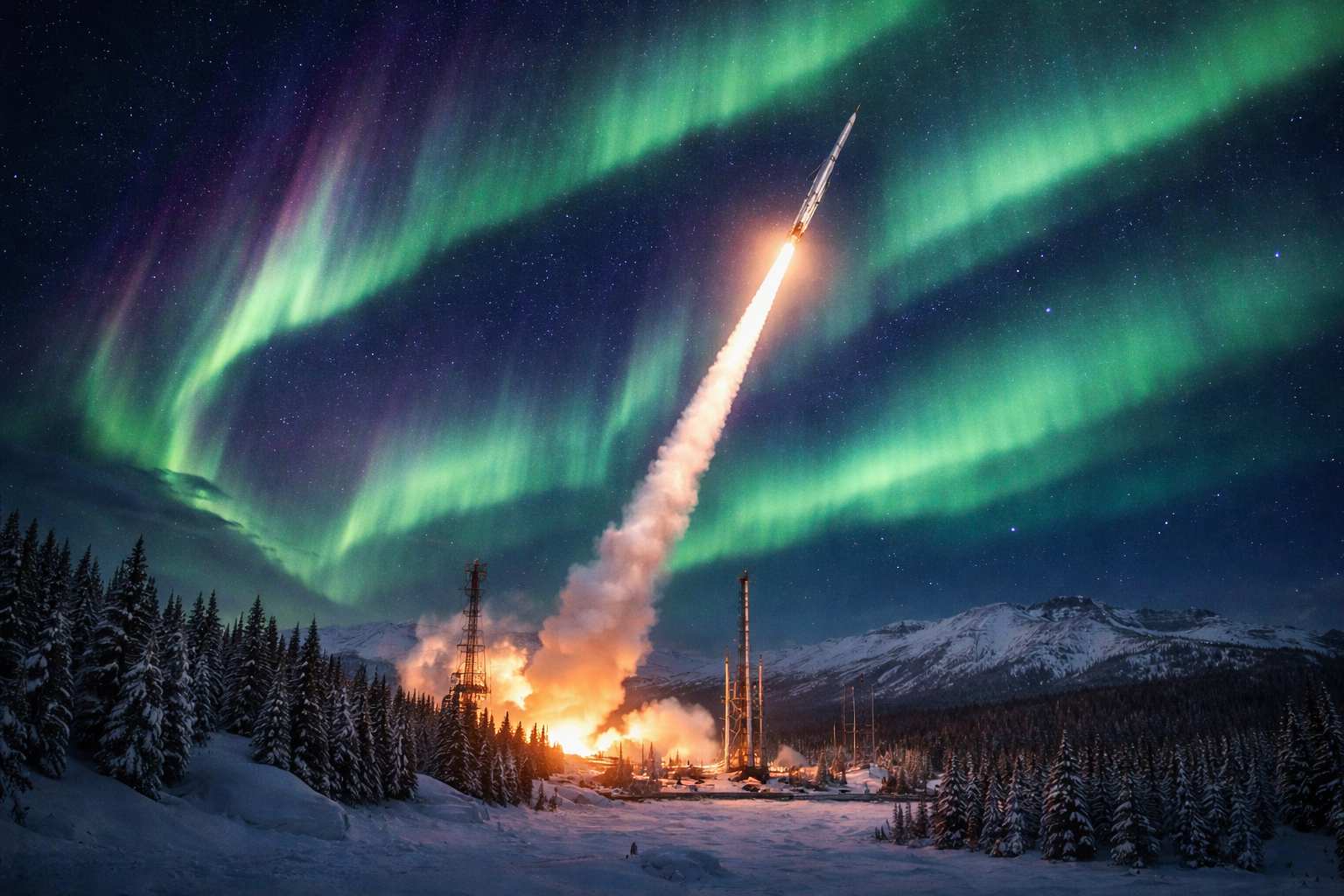
NASA launched three rockets into the northern lights over Alaska to map hidden electrical currents and mysterious black auroras.
🔍 Key Highlights
- NASA launched three sounding rockets into the northern lights over Alaska
- One mission studied mysterious “black auroras”
- Two rockets (GNEISS mission) created a 3D scan of auroral electricity
- Scientists are mapping how the aurora’s electrical circuit works
- The results could improve our understanding of space weather
What Happens If You Fly Straight Into the Northern Lights? 🤯
The northern lights look magical from the ground — glowing curtains of green, pink, and purple dancing across the sky.
But what if you could fly directly through them?
That’s exactly what NASA did.
Scientists from NASA Goddard Space Flight Center launched three research rockets into the aurora over Alaska to uncover how these glowing lights are powered.
And the results? Electrifying.
First, What Are the Northern Lights? 🌌
The northern lights — also called the aurora borealis — happen when:
- Charged particles from the Sun stream toward Earth ☀️
- Earth’s magnetic field guides them toward the poles 🧲
- They crash into gases in the upper atmosphere
- The gases glow — like a giant neon sign in the sky
It’s a bit like electricity flowing through a lightbulb.
But here’s the big question:
If electricity is flowing down into the atmosphere…
how does it flow back out?
Because every electrical system needs a complete circuit.
The Big Mystery: Where Does the Electricity Go? ⚡
Electricity doesn’t just stop.
In a simple circuit:
- Current flows down a wire
- Powers a light
- Returns to the source
The aurora works the same way.
Electrons stream down from space, light up the sky —
then they must return to space somehow.
But scientists didn’t fully understand how that return path works.
That’s what these rockets were built to study.
Mission 1: Investigating “Black Auroras” 🕳️
One rocket mission focused on strange dark patches inside glowing auroras.
These are called black auroras.
They look like:
- Empty holes
- Dark shapes moving through bright light
Scientists think these might be places where electrical currents reverse direction.
Finding out how these dark patches behave helps scientists understand the full electrical circuit of the aurora.
Mission 2: The GNEISS 3D Scan 🛰️
The second mission, called GNEISS (pronounced “nice”), launched two rockets only 30 seconds apart from Poker Flat Research Range.
These rockets flew into the same aurora but along slightly different paths.
Each rocket:
- Released four small instruments (subpayloads)
- Sent radio signals through the glowing plasma
- Measured how those signals changed
It worked like a CT scan at a hospital.
Just as doctors use X-rays to map your body in 3D, scientists used radio signals to map the aurora’s electric currents in 3D.
This is the most detailed electrical scan of the aurora ever attempted.
Why Does This Matter? 🌍
Auroral currents don’t just create pretty lights.
They also:
- Heat Earth’s upper atmosphere
- Stir up powerful winds
- Create turbulence
- Affect satellites
This is part of something called space weather.
Space weather can:
- Disrupt GPS
- Affect communication systems
- Damage satellites
- Impact power grids
Understanding how auroral currents spread helps scientists better predict these effects.
Rockets vs. Satellites 🛰️🚀
Satellites orbit above the aurora.
But sounding rockets:
- Fly directly through it
- Take measurements inside the action
- Return high-resolution data
They only fly for minutes — but those minutes are packed with powerful science.
🌟 Big Takeaway
The northern lights are more than just beautiful sky art.
They are part of a massive electrical system connecting Earth to space.
By launching rockets straight into the aurora, NASA is uncovering how that cosmic circuit works — helping protect satellites, communication systems, and technology here on Earth.
Sometimes, to understand the sky…
you have to fly right into it.
🧠 Quick Quiz: Aurora Science Check!
1. What causes the northern lights?
A) Clouds reflecting city lights
B) Charged particles from the Sun hitting Earth’s atmosphere
C) Lightning storms
D) Ice crystals
2. Why did NASA launch rockets into the aurora?
A) To take selfies
B) To map electrical currents
C) To collect snow samples
D) To test engines
3. What are black auroras?
A) Dark patches inside glowing auroras
B) Storm clouds
C) Space dust
D) Moon shadows
4. Why does the aurora need a circuit?
A) To make noise
B) Electricity must return to space
C) To cool down
D) To spin
5. What can auroral currents affect?
A) Satellites
B) GPS
C) Communication systems
D) All of the above
✅ Answers:
1-B, 2-B, 3-A, 4-B, 5-D
🤔 Think About This…
If glowing lights in the sky are part of a giant electrical system, what other invisible space forces might be shaping our planet right now?
🌌 Mini FAQ: NASA Rockets & the Northern Lights
1️⃣ Why did NASA launch rockets into the northern lights?
Scientists wanted to measure the electrical currents flowing through the aurora to better understand how it works.
2️⃣ What is a sounding rocket?
A sounding rocket is a small research rocket that flies briefly into space, collects scientific data, and then falls back to Earth.
3️⃣ What are black auroras?
Black auroras are dark patches that appear inside glowing auroras. Scientists think they may show where electrical currents reverse direction.
4️⃣ Why do auroral currents matter?
They affect space weather, which can influence satellites, GPS systems, radio communication, and even power grids.
5️⃣ Where were the rockets launched from?
The rockets launched from Poker Flat Research Range near Fairbanks, Alaska.
Also
🌬️🔬 Scientists Finally Solve a 100-Year-Old Mystery in the Air We Breathe
🛸 The Face on Mars Mystery Explained for Kids | Trick of Light or Alien Secret?

The Kids Science Magazine Editorial Team brings together nearly a decade of hands-on experience in electronics engineering, IoT systems, and embedded technology — combined with a deep passion for making complex science genuinely exciting for young minds. Our writers have worked across core electronics testing and real-world technology development, giving every science mystery article a foundation in actual engineering thinking rather than surface-level storytelling. We believe every child deserves access to mind-blowing science — explained clearly, honestly, and in a way that makes them lean forward and ask “but wait, WHY?” Every mystery published on this site is thoroughly researched, fact-checked against credible scientific sources, and written to spark curiosity in kids aged 8–14 across the USA, UK, Canada, Australia & Others across the Globe. New mystery every Friday — because science never runs out of surprises.