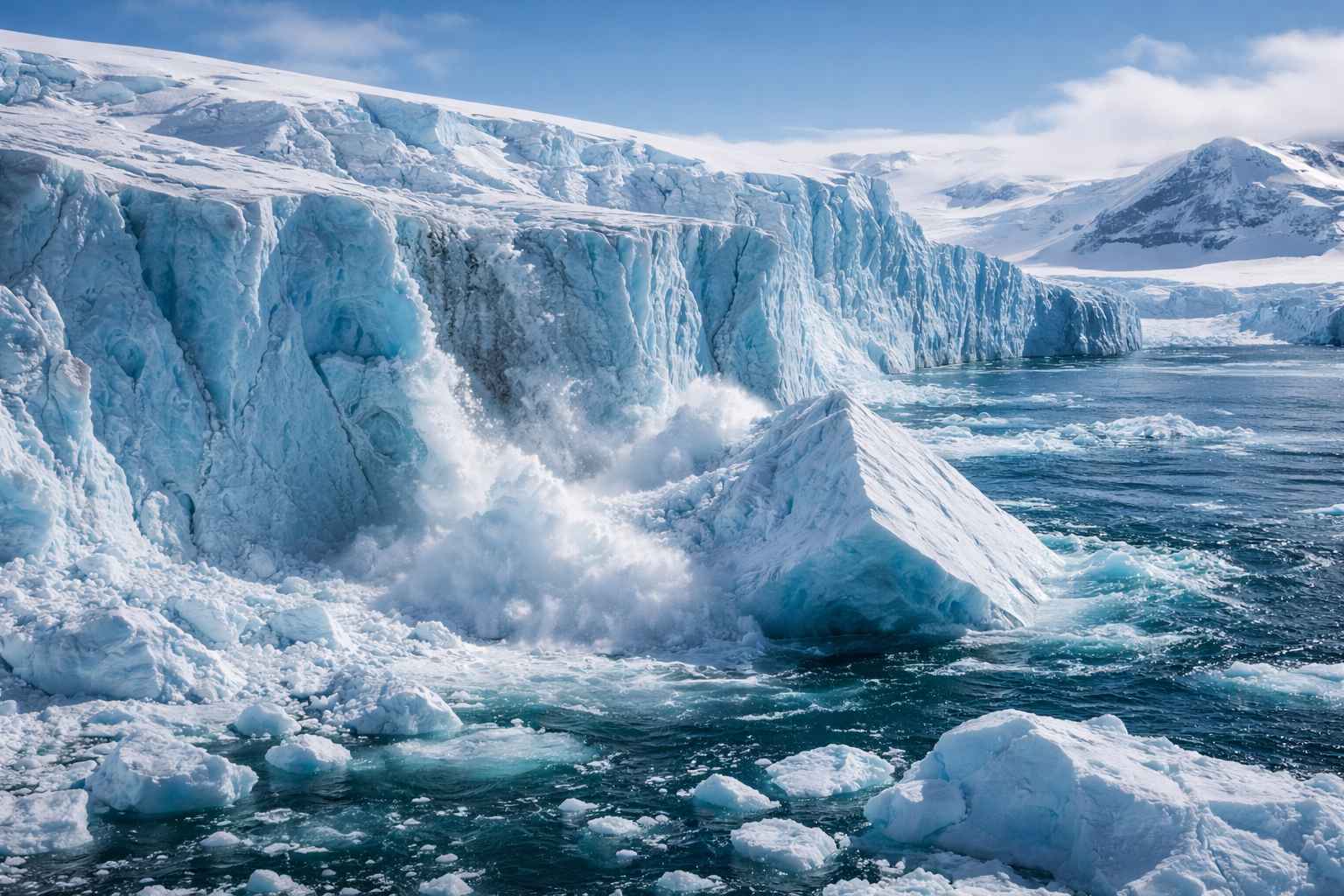
Hektoria Glacier in Antarctica retreated 8 kilometers in just two months after lifting off a flat seabed, raising new concerns about rapid sea level rise.
🔎 Key Highlights
- Hektoria Glacier retreated 8 kilometers in just 2 months
- Nearly half the glacier collapsed
- A flat underwater bedrock surface triggered the sudden breakup
- Satellites and seismic sensors captured the collapse in near real time
- Scientists warn larger glaciers could one day collapse just as fast
What If a Glacier Just… Let Go?
Imagine a giant wall of ice — taller than skyscrapers and miles wide — suddenly lifting off the ground and shattering into the sea.
That’s exactly what happened to Hektoria Glacier in 2023.
In just 60 days, the glacier pulled back eight kilometers — about the distance of 80 football fields lined up end to end.
Scientists say it’s the fastest glacier retreat ever recorded in modern times.
Where Is Hektoria Glacier?
Hektoria Glacier sits on the eastern side of the Antarctic Peninsula. Compared to Antarctica’s largest glaciers, it’s relatively small — about the size of a large city.
But what happened there has scientists paying close attention.
Because if this can happen to a small glacier… it could also happen to a much bigger one.
The Hidden Trigger Beneath the Ice 🧊⬇️
The key to the collapse wasn’t on top of the glacier.
It was underneath it.
Many Antarctic glaciers rest on the ocean floor. Scientists call these tidewater glaciers — glaciers that flow into the sea.
Under Hektoria Glacier was something called an ice plain.
What is an Ice Plain?
An ice plain is:
- A flat stretch of bedrock
- Located below sea level
- Smooth enough that ice can lift off easily
Think of it like this:
If a heavy object sits on rough ground, it stays put.
But if it sits on smooth ice, it can slide or lift much more easily.
As Hektoria thinned due to warming conditions, it reached a tipping point.
It suddenly lifted off the seabed and began floating.
The Grounding Line: A Glacier’s Anchor ⚓
The place where a glacier changes from sitting on the ground to floating in water is called the grounding line.
When Hektoria’s grounding line moved backward, large sections of ice lost their anchor all at once.
Once floating:
- Ocean water attacked the glacier from below
- Cracks formed at the base
- Surface fractures connected with bottom fractures
- A chain reaction of calving began
What is Calving?
Calving is when chunks of ice break off from a glacier and become icebergs.
But this wasn’t normal calving.
Nearly half the glacier broke apart in weeks.
Scientists Watched It Happen in Real Time 🛰️
Researchers from the University of Colorado Boulder pieced together the event using:
- High-frequency satellite images
- Remote sensing data
- Seismic instruments that detected glacier “earthquakes”
Seismic sensors confirmed something dramatic:
The glacier had been firmly grounded — and then suddenly lifted.
Some measurements showed the glacier retreating 2.5 kilometers in just two days.
That’s lightning-fast in glacier terms.
Why This Matters for Sea Level 🌊
Glaciers store massive amounts of frozen water.
When they collapse:
- Ice flows into the ocean
- Sea levels rise
Hektoria is small compared to giants like Thwaites Glacier.
But scientists say the same hidden ice plains exist under many Antarctic glaciers.
If larger glaciers collapse this way, global sea level rise could accelerate far beyond expectations.
🌍 Big Takeaway
Glaciers don’t always melt slowly.
Sometimes they reach a tipping point — and collapse in weeks.
Hektoria Glacier has shown scientists that Antarctica can change faster than anyone thought.
The big question now:
Which glacier could be next?
🧠 Quick Quiz: Glacier Science Check!
1. How far did Hektoria Glacier retreat in two months?
A) 800 meters
B) 8 kilometers
C) 80 kilometers
D) 2 kilometers
2. What is an ice plain?
A) A frozen lake
B) A flat underwater bedrock surface
C) A snowy mountain
D) A floating iceberg
3. What happens at the grounding line?
A) Ice turns into snow
B) Ice melts instantly
C) Glacier changes from grounded to floating
D) Ice becomes thicker
4. What is calving?
A) Ice melting
B) Ice freezing
C) Ice breaking off into icebergs
D) Snowfall
5. Why are scientists concerned?
A) Penguins may move
B) Larger glaciers could collapse quickly
C) Antarctica will disappear tomorrow
D) Ice will stop forming
✅ Answers:
1-B, 2-B, 3-C, 4-C, 5-B
🤔 Think About This…
If glaciers can collapse in weeks instead of centuries, how might that change predictions about future sea level rise?
Also Read
Even Antarctica’s Only Native Insect Is Swallowing Microplastics🧊🐜
Robot “Lassie” Discovers Hidden Icefish City Beneath Antarctic Ice!
🧊 Mini FAQ
❄️ Glacier Collapse FAQ
1️⃣ What happened to Hektoria Glacier?
Hektoria Glacier retreated about 8 kilometers in just two months after lifting off a flat seabed and rapidly breaking apart.
2️⃣ What caused the sudden collapse?
The glacier sat on a flat underwater ice plain. When it thinned enough, it suddenly floated, allowing cracks to form and spread quickly.
3️⃣ What is a grounding line?
The grounding line is the point where a glacier changes from resting on the seabed to floating on ocean water.
4️⃣ Why is this important?
If larger glaciers collapse this quickly, global sea levels could rise much faster than expected.
5️⃣ How did scientists measure the collapse?
They used satellite images and seismic sensors that detected glacier “earthquakes” during the breakup.