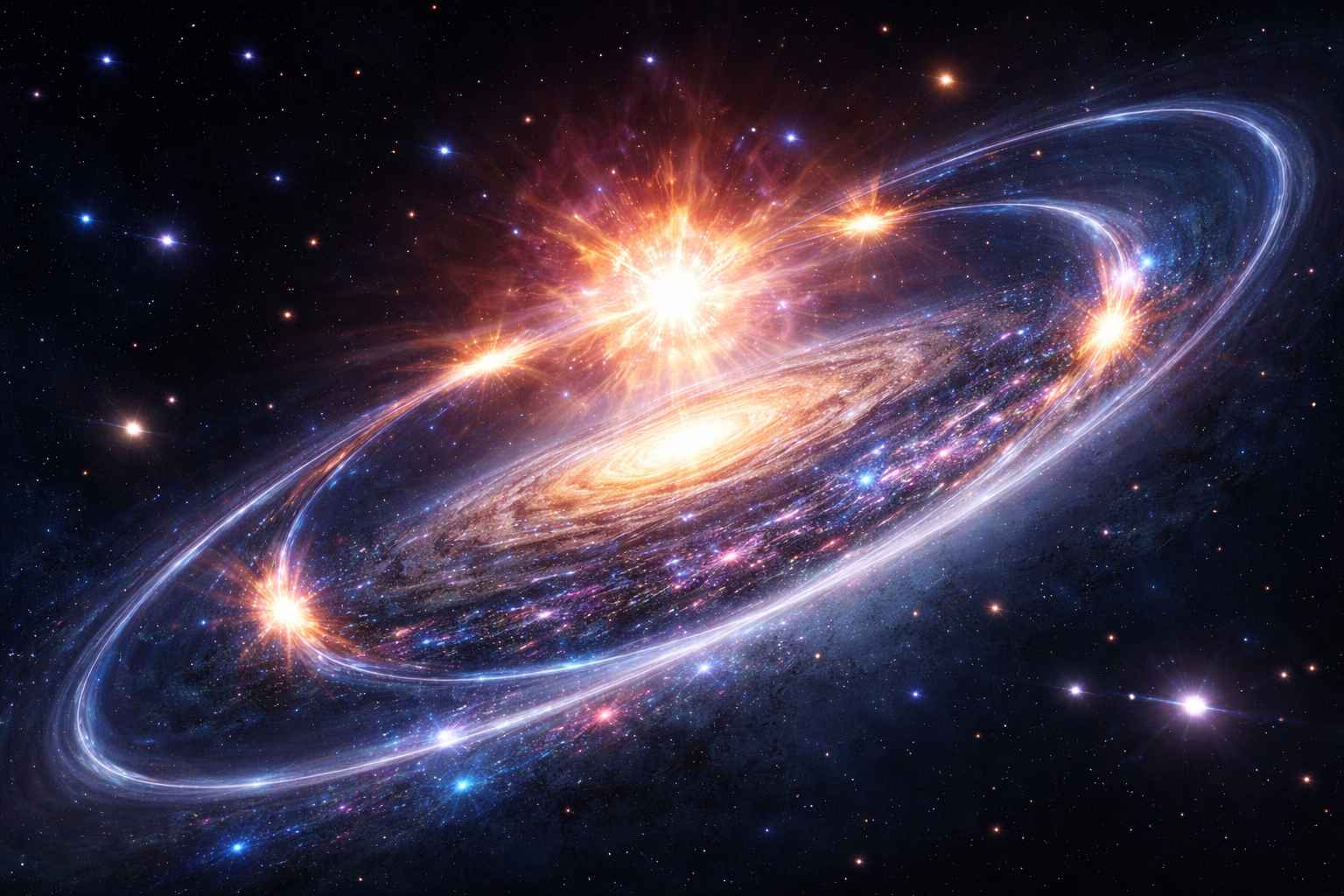
A rare lensed supernova from the early universe may help scientists measure cosmic expansion and understand dark energy.
Curiosity
What if one exploding star could help solve one of the biggest mysteries of the entire universe? 💥 Imagine light traveling for billions of years, only to be bent, split, and delayed—just so scientists on Earth can finally understand how fast the universe is growing!
Key Highlights
- A supernova over 10 billion years old has been discovered
- Its light was bent and split by gravity into multiple images
- Scientists can measure time delays in the light
- This could help solve the Hubble tension problem
- It may reveal clues about dark energy, the force expanding the universe
🌠 Main Story
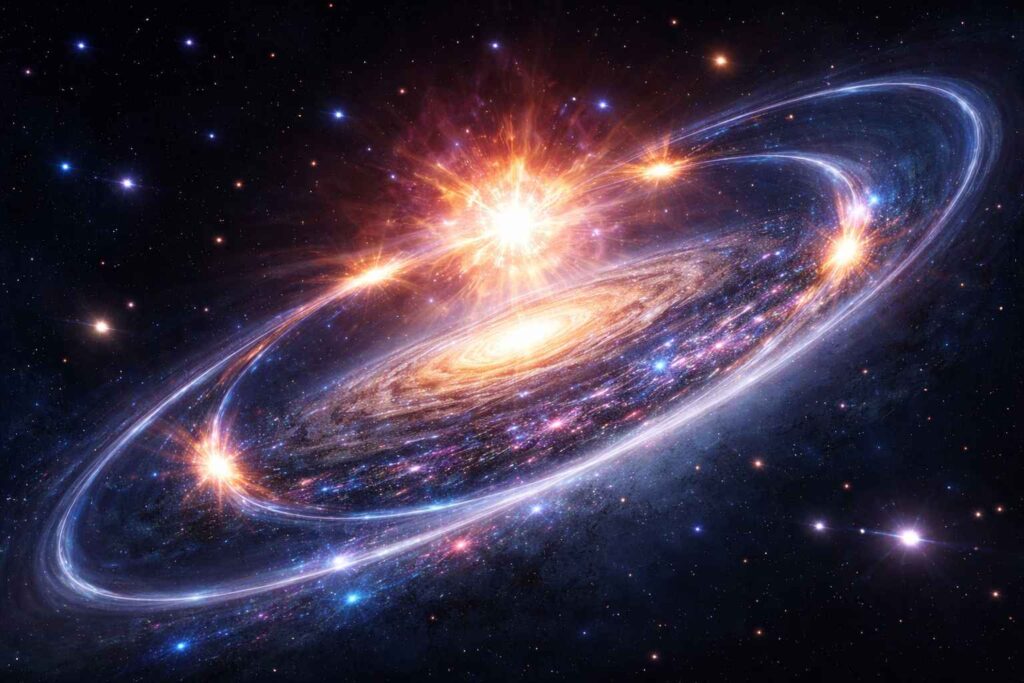
Far out in space, more than 10 billion light-years away, a massive star exploded in a brilliant event called a supernova. Normally, such distant explosions would be too faint to see—but this one had a cosmic advantage.
Between Earth and the exploding star sat a massive galaxy. Its gravity acted like a giant cosmic magnifying glass, bending and boosting the light from the explosion. This effect is called gravitational lensing.
But something even more fascinating happened.
Instead of seeing just one image of the supernova, astronomers saw multiple images of the same explosion! Why? Because the light didn’t travel in a straight line. It took different paths around the galaxy, and each path had a different length.
This means the light from the same explosion reached Earth at slightly different times.
So, scientists are essentially watching the same explosion replayed multiple times—each image showing a slightly different moment in the supernova’s life.
⏳ A Cosmic Time Trick
Because of these time delays, astronomers can measure how long each light path took. And here’s the exciting part:
👉 These time differences depend on how fast the universe is expanding.
By studying them carefully, scientists can calculate the Hubble constant, which tells us how quickly galaxies are moving away from each other.
🔬 Science Terms Explained
- Supernova: A huge explosion that happens when a star dies
- Gravitational Lensing: When gravity bends light, like a magnifying glass
- Dark Energy: A mysterious force pushing the universe to expand faster
- Hubble Constant: A number that tells how fast the universe is expanding
- Light-Year: The distance light travels in one year
🎯 Analogy or Visual Explanation
Imagine you’re walking home, but instead of one road, there are three different paths.
- One is short and direct
- One is longer and winding
- One goes around a big hill
Even if you start at the same time, you’ll arrive at different times depending on the path.
👉 Light from the supernova does the same thing!
Different paths = different arrival times = multiple images of the same event.
🌍 Why This Discovery Matters
Scientists currently have a big problem called the Hubble tension.
Different ways of measuring the universe’s expansion give different answers. That’s confusing—and it means something in our understanding of the universe might be missing!
This special supernova could act like a tie-breaker.
By measuring the exact time delays in its light, scientists can get a new, independent measurement of how fast the universe is expanding.
And that could finally help answer:
👉 What exactly is dark energy, and why is the universe speeding up?
🧠 Quick Quiz
1. What is a supernova?
A. A new planet
B. A star explosion ✅
C. A black hole
D. A comet
2. What bends the light from the supernova?
A. Wind
B. Magnetic fields
C. Gravity from a galaxy ✅
D. Dark matter
3. Why do we see multiple images of the supernova?
A. The telescope is broken
B. Light takes different paths ✅
C. There are many stars
D. Time stops
4. What does the Hubble constant measure?
A. Star brightness
B. Galaxy size
C. Universe expansion speed ✅
D. Light color
5. What mystery might this discovery help solve?
A. Life on Mars
B. Black holes
C. Dark energy and expansion rate ✅
D. Ocean tides
🌟 Big Takeaway
Sometimes, the universe itself becomes a laboratory.
By bending light and replaying an ancient explosion, space is helping scientists uncover one of its deepest secrets—how fast everything is expanding and why.
❓ Mini FAQ
Q1: Why is this supernova special?
Because its light is split into multiple images by gravity, letting scientists measure time delays.
Q2: What is dark energy?
It’s an unknown force that makes the universe expand faster and faster.
Q3: What is the Hubble tension?
It’s a disagreement between different ways of measuring the universe’s expansion speed.
Q4: How old is the light we see?
Over 10 billion years old—it started traveling long before Earth looked like it does today!
Q5: Why do scientists care about expansion?
Because it helps us understand the past, present, and future of the universe.