Meta Description / SEO Excerpt
Scientists discovered that Earth’s nights are getting brighter overall—but some regions are becoming darker due to energy saving and global changes.
Curiosity Hook (Opening Paragraph)
What if you looked at Earth from space at night… and saw it glowing brighter every year? 🌃
But here’s the twist—while some places are lighting up more than ever, others are suddenly going dark. Why is that happening?
Key Highlights
- Earth is getting brighter at night every year
- Some countries are lighting up due to urban growth
- Others are becoming darker because of energy-saving efforts
- Satellites reveal hidden patterns of human activity
- Light pollution affects nature, animals, and energy use
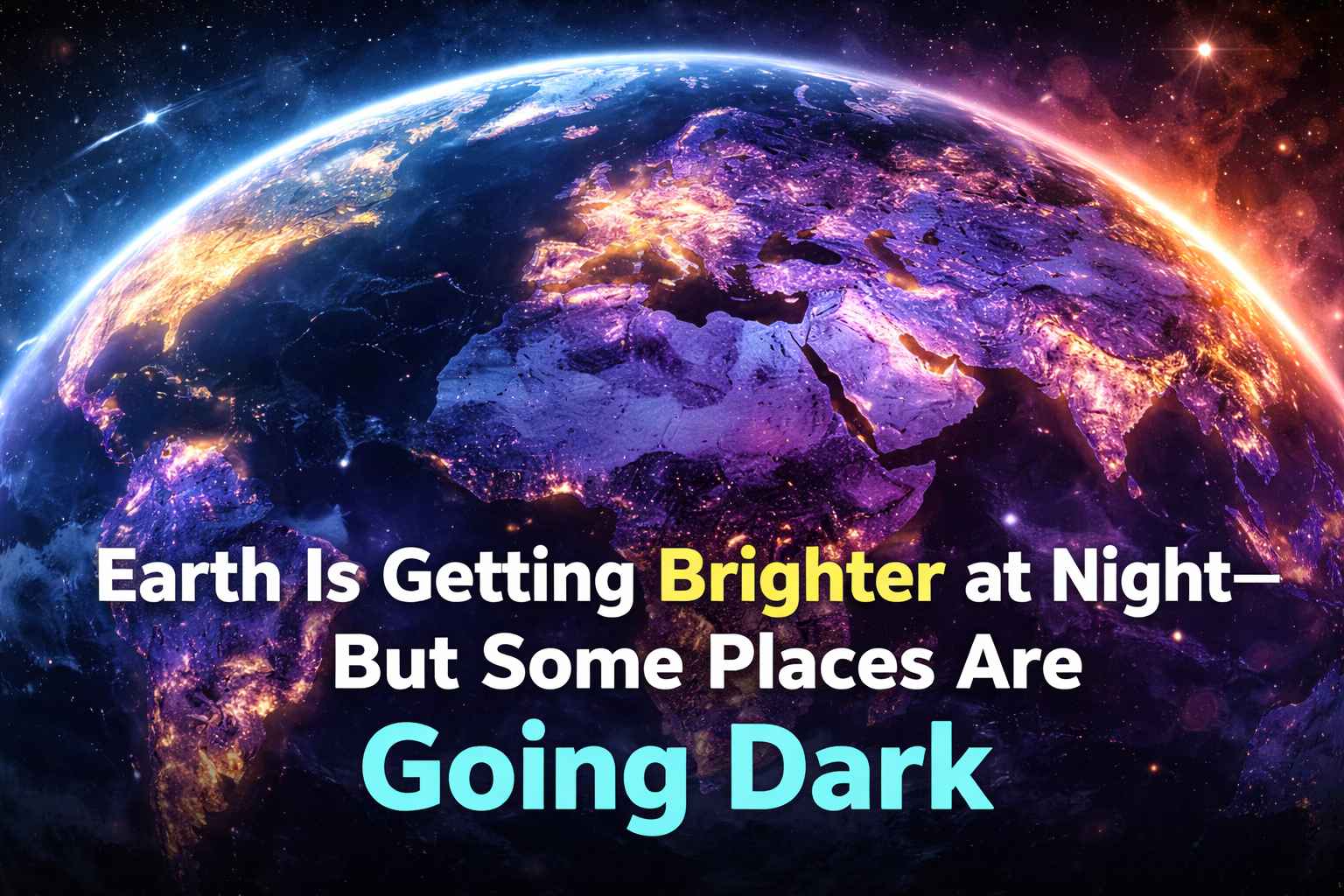
Feature Image Placeholder
(A glowing Earth at night showing bright cities and darker regions in contrast)
🌌 Main Story
If you could zoom out into space and look at Earth at night, you would see something incredible—a glowing planet filled with lights.
But scientists recently discovered something surprising:
👉 Earth is getting brighter at night every year… but not everywhere.
💡 A Planet That’s Lighting Up
Using powerful satellites, scientists studied Earth’s night lights over many years.
They found:
- Nighttime brightness is increasing by about 2% every year
- Big countries like China and India are becoming much brighter
Why?
👉 Because of:
- More cities
- More buildings
- More streetlights
As populations grow, so does the amount of light we use at night.
🌑 But Why Are Some Places Getting Darker?
Here’s where it gets interesting.
Not all places are getting brighter. Some are actually going darker.
For example:
- Some European countries are turning off streetlights at night
- Cities are using energy-saving LED lights
- Some regions experienced darkness due to conflicts or power loss
👉 Even entire countries can suddenly dim!
🛰️ How Do Scientists See Earth at Night?
Special satellites orbiting Earth take pictures every night.
They can:
- Detect tiny light sources
- Track changes over time
- Show how human activity changes
Each image reveals:
👉 Where people live
👉 Where cities grow
👉 Where lights disappear
🔍 A Hidden Pattern
When scientists looked closely, they found something surprising:
👉 Global trends can hide local changes
That means:
- One area might get brighter
- Another nearby might get darker
But when combined, it looks like a small overall change.
🔬 Science Terms Explained
- Light Pollution: Too much artificial light that brightens the night sky
- Satellite: A machine orbiting Earth that collects data
- Urbanization: Growth of cities and human settlements
- LED Lights: Energy-saving lights used in modern cities
- Energy Conservation: Using less electricity to save resources
🎯 Analogy or Visual Explanation
Imagine your city at night 🏙️
- Some houses turn on more lights
- Others switch lights off to save energy
👉 From far away, it looks like the brightness is changing—but not evenly
That’s exactly what’s happening on Earth!
🌍 Why This Discovery Matters
This isn’t just about lights—it affects our planet in big ways:
- 🌱 Animals get confused by artificial light
- 💤 Humans may lose natural sleep cycles
- ⚡ It impacts energy use and climate
Understanding this helps scientists:
👉 Reduce light pollution
👉 Save energy
👉 Protect ecosystems
🧠 Quick Quiz
1. What is happening to Earth at night?
A. Getting darker
B. Staying the same
C. Getting brighter overall ✅
D. Disappearing
2. Why are some places brighter?
A. Rain
B. Urban growth ✅
C. Snow
D. Wind
3. Why are some places darker?
A. Energy saving and reduced lighting ✅
B. Sunlight
C. Gravity
D. Clouds
4. What do satellites do?
A. Cook food
B. Measure light from space ✅
C. Make electricity
D. Create stars
5. What is light pollution?
A. Dirty water
B. Too much artificial light ✅
C. Loud sound
D. Air pollution
🌟 Big Takeaway
Earth at night is constantly changing.
Some places shine brighter, while others go dark—telling a powerful story about how humans live, grow, and adapt.
❓ Mini FAQ
Q1: Why is Earth getting brighter at night?
Because of growing cities and increased use of lights.
Q2: Why are some places getting darker?
Due to energy-saving efforts, better lighting, or major events.
Q3: How do scientists track this?
Using satellites that capture Earth at night.
Q4: What is light pollution?
Too much artificial light that disrupts nature.
Q5: Why does this matter?
It affects energy use, animals, and the environment.
The Moving Rocks of Death Valley: How Do Rocks Move on Their Own?

Gilkut is the hands-on science brand behind the Saturday Science Experiments column at Kids Science Magazine — and the place where real science gets messy, explosive, colourful, and brilliantly fun. Every experiment published under the Gilkut name is designed to be done with everyday household items, explained step by step in plain language, and chosen specifically because it produces that one magical moment: when something unexpected happens right in front of your eyes and you suddenly understand exactly why. Gilkut’s science experiments have been shared across Facebook, Pinterest, and X, building a community of young scientists, curious parents, and enthusiastic teachers who believe the best science classroom is your own kitchen. Whether it’s making a volcano, bending light, growing crystals, or building a working circuit with items from a junk drawer — Gilkut exists to prove that science isn’t just something you read about. It’s something you do.