
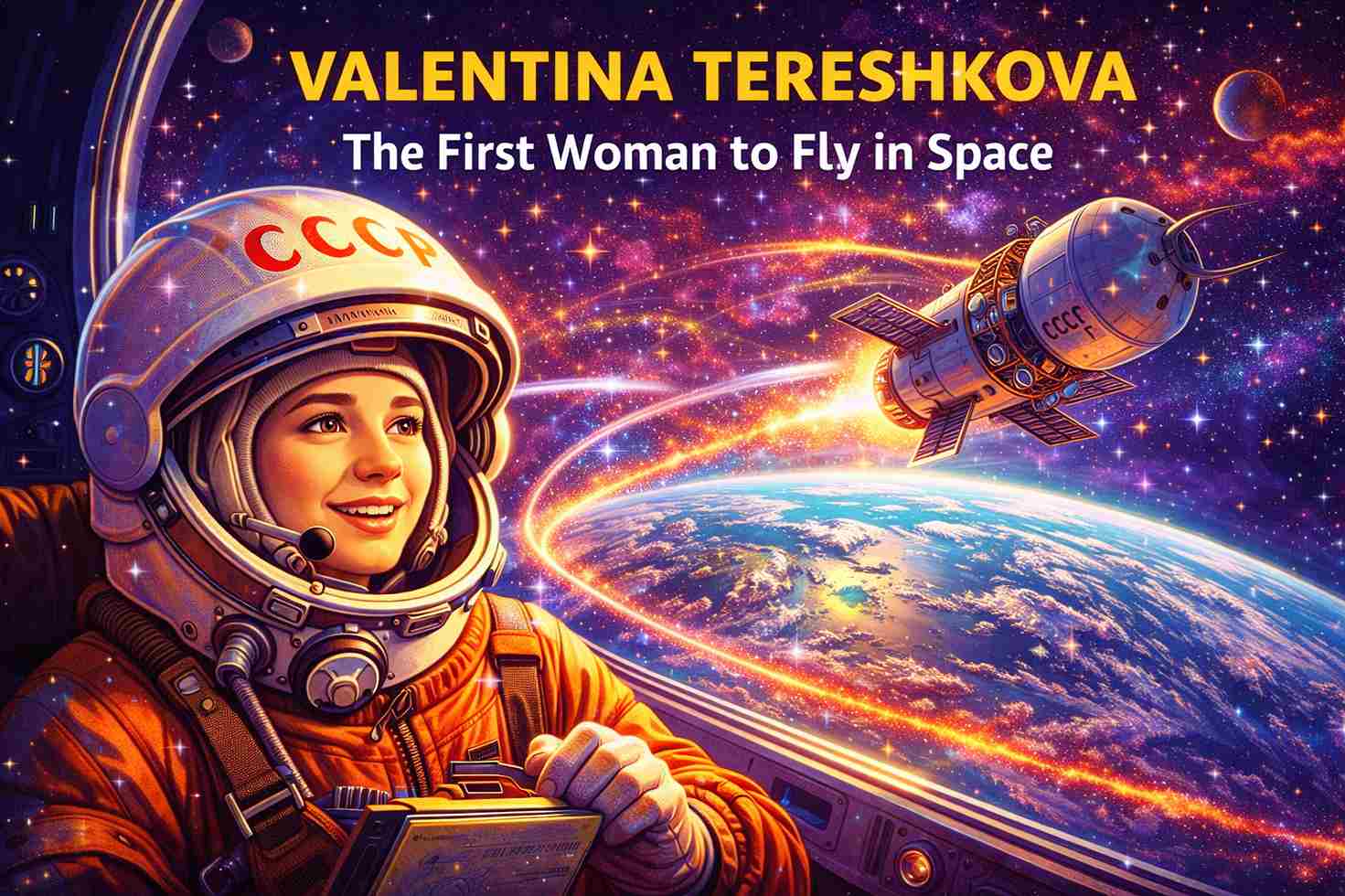
Discover the inspiring story of Valentina Tereshkova, the first woman to travel to space. A fun, kid-friendly science article about her historic Vostok 6 mission and space adventure.
The Woman Who Opened the Door to Space for Everyone
Long before many astronauts traveled to space, one brave woman showed the world that girls could reach the stars too. Her name was Valentina Tereshkova, and she became the first woman ever to fly into space.
In 1963, she blasted off aboard a spacecraft called Vostok 6 and orbited Earth 48 times! Her journey proved that women could be astronauts just like men—and it inspired millions of girls to dream big.
🌱 Early Life: A Girl With Courage and Determination
Valentina Tereshkova was born in 1937 in Russia. Her childhood was not easy. Her father was a tractor driver and soldier who died during World War II, and her mother worked in a factory to support the family.
Valentina left school early to help her family and began working in a textile factory. But she never stopped learning. She studied at night and developed a passion for skydiving.
Jumping from airplanes thousands of feet above the ground gave her a feeling of freedom and excitement. She completed more than 100 parachute jumps—a skill that would later change her life forever.
🚀 The Road to Becoming an Astronaut
In the early 1960s, the Soviet space program wanted to send a woman into space. They looked for someone brave, disciplined, and experienced in parachuting.
Out of hundreds of candidates, Valentina was chosen.
She trained like a real space pioneer. Her preparation included:
- Intense physical training
- Learning spacecraft controls
- Practicing survival skills
- Experiencing zero gravity simulations
Her determination impressed everyone. Soon she was ready for the most important mission of her life.
🌍 The Historic Flight of Vostok 6
On June 16, 1963, Valentina Tereshkova climbed into the spacecraft Vostok 6 and launched into space.
As the rocket roared into the sky, she spoke a famous message over the radio:
“Hey sky, take off your hat! I’m coming!”
During the mission:
- She orbited Earth 48 times
- Spent almost three days in space
- Took photographs of Earth and the atmosphere
- Conducted scientific observations
From space, she saw our planet as a beautiful blue sphere floating in darkness. It was a moment that changed her life—and history.
🌟 A Symbol of Courage and Inspiration
Valentina Tereshkova returned safely to Earth as a global hero. Her achievement proved something powerful:
✨ Women can explore space just like men.
Her mission opened the door for many future female astronauts, including scientists and space explorers around the world.
Today, she remains a symbol of bravery, determination, and the power of dreaming big.
🤔 DO YOU KNOW? Fun Facts About Valentina Tereshkova
- She was the youngest woman to travel to space at age 26.
- She orbited Earth more times than all American astronauts combined at that time.
- Her call sign during the mission was “Chaika,” which means “Seagull.”
- She was the only woman to fly a solo space mission.
- Even today, she is celebrated as one of the greatest pioneers of space exploration.
🎮 Interactive Fun Zone
🧠 Quick Space Quiz
1️⃣ Who was the first woman in space?
A) Sally Ride
B) Valentina Tereshkova
C) Mae Jemison
Answer: B
2️⃣ What spacecraft did she fly in?
A) Apollo 11
B) Soyuz
C) Vostok 6
Answer: C
3️⃣ How many times did she orbit Earth?
A) 10
B) 24
C) 48
Answer: C
🔍 Think Like an Astronaut
Imagine you are traveling to space.
What would you want to see first?
- 🌍 Earth from space
- 🌙 The Moon
- 🌌 Stars and galaxies
Every astronaut once started as a curious kid—just like you!
🌈 Conclusion: Reaching for the Stars
Valentina Tereshkova showed the world that courage and determination can break barriers. Her journey into space inspired millions of girls and boys to believe that the sky is not the limit—it’s just the beginning.
So the next time you look up at the night sky, remember the woman who proved that anyone brave enough can reach the stars. 🌟🚀
Also read
🌬️🔬 Scientists Finally Solve a 100-Year-Old Mystery in the Air We Breathe
Vera Rubin: The Scientist Who Proved Dark Matter Exists 🌠🔭