
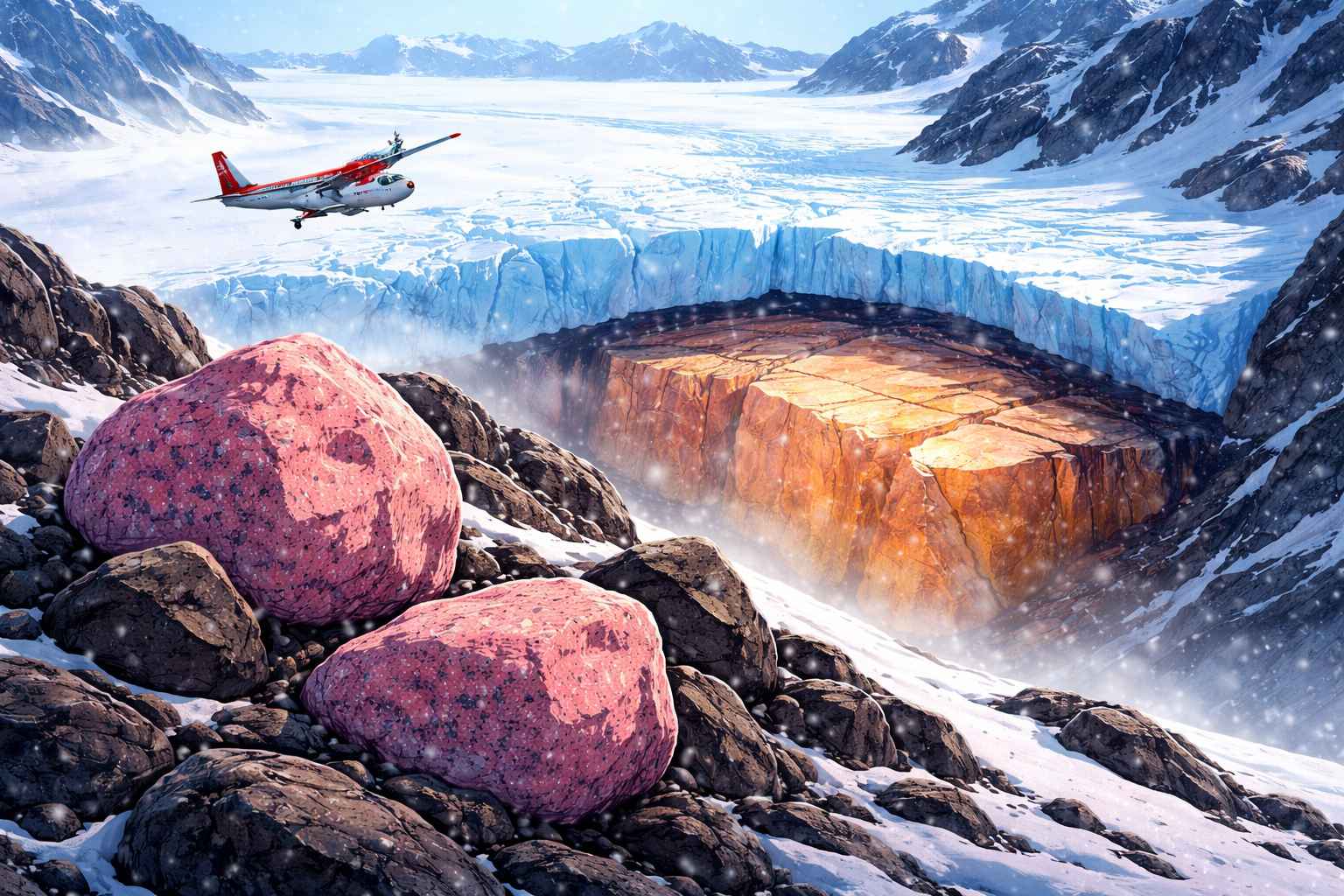
Strange pink rocks in Antarctica led scientists to discover a massive hidden granite formation beneath the ice, revealing clues about glaciers and sea level rise.
Curiosity
What if a few strange pink rocks sitting on icy mountains could uncover a giant hidden deep beneath Antarctica? 🧊 It sounds like a mystery story—but that’s exactly how scientists solved a decades-old puzzle buried under ice!
Key Highlights
- Bright pink rocks led to a huge hidden granite mass under ice
- The buried structure is nearly 100 km wide and 7 km thick
- Rocks are about 175 million years old (Jurassic period)
- Scientists used gravity measurements from aircraft
- Discovery helps explain glacier movement and sea level rise
Feature Image Placeholder
(Bright pink granite rocks sitting on dark Antarctic mountains with ice glaciers in the background)
🧭 Main Story
High in the icy Hudson Mountains of Antarctica, scientists noticed something unusual—bright pink granite rocks sitting on top of dark volcanic peaks.
That didn’t make sense.
Granite and volcanic rock form in completely different ways. So how did these pink rocks get there?
For years, this remained a mystery.
🔍 Clue #1: The Age of the Rocks
Scientists carefully studied tiny mineral crystals inside the rocks. Using a method called radioactive dating, they discovered something amazing:
👉 These rocks formed about 175 million years ago, during the time of dinosaurs—the Jurassic period!
But that still didn’t explain how they ended up on top of mountains in Antarctica.
✈️ Clue #2: A Hidden Signal Beneath the Ice
Next, scientists used special aircraft flying over the icy region. These planes measured tiny changes in Earth’s gravity.
Why does that matter?
Because different types of rock have different weights—and they slightly change gravity.
The results revealed something shocking:
👉 A massive granite structure hidden deep beneath the ice, under the Pine Island Glacier
This buried “giant” is:
- Nearly 100 kilometers wide
- About 7 kilometers thick
That’s almost half the size of Wales!
🧊 Solving the Mystery
Now everything clicked.
Long ago, Antarctica’s ice sheet was much thicker than today. As it moved, it acted like a giant conveyor belt:
👉 It scraped rocks from deep underground
👉 Carried them across the land
👉 And even pushed them uphill onto mountains
That’s how the pink granite ended up in such a strange place!
🔬 Science Terms Explained
- Granite: A hard rock formed deep underground from cooled magma
- Glacier: A slow-moving river of ice
- Radioactive Dating: A way to find the age of rocks using tiny particles
- Gravity Survey: Measuring small changes in gravity to detect hidden structures
- Ice Sheet: A massive layer of ice covering land
🎯 Analogy or Visual Explanation
Imagine a giant bulldozer made of ice 🚜
- It digs into the ground
- Picks up rocks
- Pushes them far away
- And even drops them on hills
👉 That’s what glaciers can do over thousands of years!
🌍 Why This Discovery Matters
This discovery is not just about rocks—it helps us understand Earth’s future.
The Pine Island Glacier is one of the fastest-melting glaciers in Antarctica.
By learning:
- What lies under the ice
- How glaciers moved in the past
Scientists can better predict:
👉 How quickly ice will melt
👉 How much sea levels may rise
This is important for cities and people living near coasts all over the world.
🧠 Quick Quiz
1. What made the rocks unusual?
A. They were glowing
B. They were pink granite on volcanic mountains ✅
C. They were frozen
D. They were soft
2. How old are the rocks?
A. 1 million years
B. 10 million years
C. 175 million years ✅
D. 1 billion years
3. What helped scientists find the hidden granite?
A. Satellites
B. Gravity measurements from aircraft ✅
C. Microscopes
D. Submarines
4. What moved the rocks to the mountains?
A. Wind
B. Earthquakes
C. Glaciers ✅
D. Volcanoes
5. Why is this discovery important?
A. It helps predict sea level rise ✅
B. It shows new animals
C. It finds gold
D. It explains weather
🌟 Big Takeaway
Sometimes, small clues—like a few pink rocks—can reveal massive hidden secrets beneath our planet. By studying them, scientists are unlocking how Earth’s icy regions work—and what might happen in the future.
❓ Mini FAQ
Q1: Why were the rocks pink?
Because they are made of granite, which often contains pink minerals like feldspar.
Q2: What is hidden under the glacier?
A huge granite mass buried deep beneath the ice.
Q3: How did scientists find it?
Using gravity measurements from aircraft and studying rock samples.
Q4: Why does this matter today?
It helps predict how glaciers will melt and affect sea levels.
Q5: Can glaciers really move rocks uphill?
Yes! When ice is thick and powerful, it can push rocks in surprising directions.
🧊 Antarctic Glacier Collapses in Weeks After Sudden Lift From Seafloor
The Mystery of Blood Falls: The Secret of Antarctica’s Crimson Waters
Robot “Lassie” Discovers Hidden Icefish City Beneath Antarctic Ice!
Even Antarctica’s Only Native Insect Is Swallowing Microplastics🧊🐜

The Kids Science Magazine Editorial Team brings together nearly a decade of hands-on experience in electronics engineering, IoT systems, and embedded technology — combined with a deep passion for making complex science genuinely exciting for young minds. Our writers have worked across core electronics testing and real-world technology development, giving every science mystery article a foundation in actual engineering thinking rather than surface-level storytelling. We believe every child deserves access to mind-blowing science — explained clearly, honestly, and in a way that makes them lean forward and ask “but wait, WHY?” Every mystery published on this site is thoroughly researched, fact-checked against credible scientific sources, and written to spark curiosity in kids aged 8–14 across the USA, UK, Canada, Australia & Others across the Globe. New mystery every Friday — because science never runs out of surprises.