🌱 Scientists discovered bizarre plants that survive without sunlight or sex. Learn how evolution bent the rules in this fascinating kids science story.
This Plant Survives Without Sunlight… or Even Plant “Romance”!**
Imagine a plant that never sees the Sun.
It doesn’t make its own food.
Some types don’t even need two parents to make seeds.
Sounds impossible, right?
But scientists have just revealed that some plants really do live this way — and they are rewriting what we thought it meant to be a plant!
🌍 Meet the World’s Strangest Plants
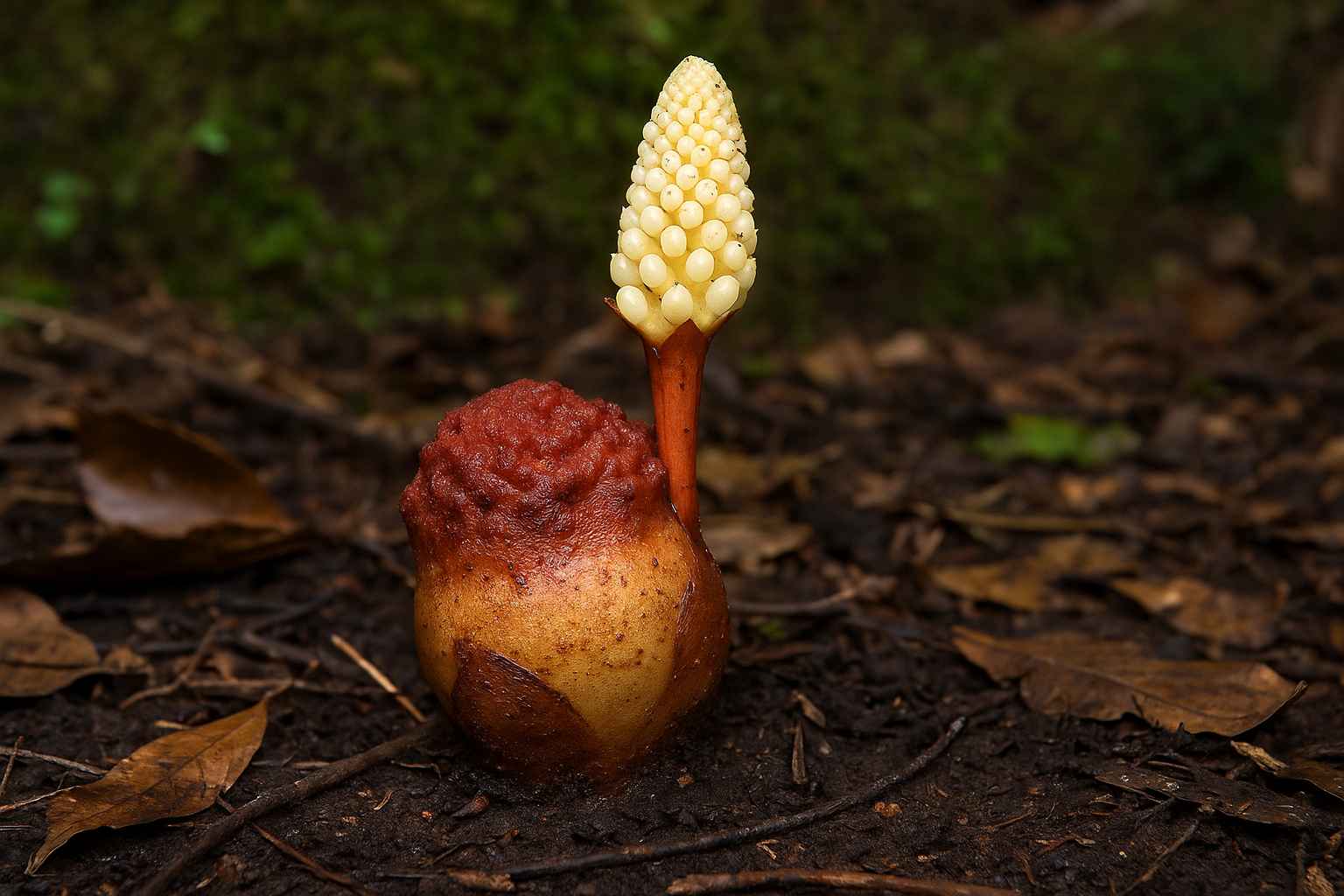
Deep in dark, wet forests in Japan, Taiwan, and nearby islands, scientists study a very unusual group of plants called Balanophora (bah-lan-oh-FOR-ah).
At first glance, these plants look more like:
- Mushrooms 🍄
- Alien knobs 👽
- Or strange forest lumps
They are:
- ❌ Not green
- ❌ Not powered by sunlight
- ❌ Often hidden underground
Yet… they are definitely plants.
☀️ No Sunlight? No Problem!
Most plants use sunlight to make food through photosynthesis. Their green parts act like tiny solar panels.
But Balanophora plants said:
“Nah… we’ll skip that.”
Instead of photosynthesis, they are parasitic plants. That means they:
- Attach to the roots of other plants
- Steal nutrients and energy directly from their hosts
- Stay underground most of the year
- Pop up only briefly to make seeds
Scientists wanted to know:
How can a plant survive after giving up something so important?
🔬 The Mystery of the Missing Solar Panels
Inside plant cells are tiny structures called plastids.
In green plants, plastids include chloroplasts — the “solar panels” that catch sunlight.
Researchers at Kobe University, led by botanist Dr. Kenji Suetsugu, studied the plastids of Balanophora plants.
What they found was shocking.
🧬 The plastid DNA was extremely tiny — much smaller than in normal plants!
At first, scientists thought:
“Maybe these plastids are almost useless.”
But when they looked closer…
⚙️ Tiny… But Still Essential!
Even though Balanophora plastids are shrunken, they are still working.
Scientists discovered that:
- The plant still sends important proteins into the plastids
- The plastids help with basic metabolism
- Without them, the plant could not survive
So even a plant that gave up sunlight still needs its ancient plant machinery to stay alive.
🌟 Big idea:
A plant can lose photosynthesis — but it can’t lose everything.
🌼 Plants That Don’t Need Two Parents?!
Here’s where the story gets even stranger.
Some Balanophora species don’t reproduce the usual plant way (with pollen and fertilization).
Instead, they use asexual reproduction.
That means:
- 🌱 One plant makes seeds all by itself
- ❌ No pollen needed
- ❌ No plant “partner” required
Scientists found that this ability:
- Appeared multiple times in different species
- Helped the plants survive in isolated forests
- Was useful when pollinators were rare
🦗 Unexpected Helpers in the Forest
When Balanophora does use sexual reproduction, the helpers are… surprising.
Scientists observed:
- 🦗 Camel crickets
- 🪳 Cockroaches
Yes — cockroaches!
These insects help spread pollen and seeds in the dark forest floor, showing that even strange plants have strange partners.
🗺️ Why This Helped the Plants Spread
Balanophora plants live in:
- Steep, humid forests
- Scattered islands
- Hard-to-reach places
Asexual reproduction helped them:
- Survive without mates
- Spread across island chains
- Persist even when populations were small
Evolution, it seems, found a clever shortcut.
🧠 What Scientists Learned From This
This research connects three big ideas:
- Evolution (how species change)
- Genetics (how DNA shrinks and adapts)
- Ecology (how plants survive in real forests)
Dr. Suetsugu says his work helps answer a deep question:
What does it really mean to be a plant?
Is it sunlight?
Is it green leaves?
Is it flowers?
Or is it something deeper — hidden inside the cells?
🌟 Fun Science Facts
🌱 Some plants live their entire lives underground
🧬 Plastids come from ancient bacteria billions of years ago
🌼 Asexual seeds can be clones of the parent plant
🌍 Forest parasites can survive for years without being seen
🌈 Big Takeaway
Nature doesn’t follow strict rules —
it experiments.
This strange plant shows that:
- Life can survive without sunlight
- Evolution can bend the rules
- Even the weirdest organisms teach us something important
Sometimes, the plants that look the strangest…
tell us the most about life itself.
🧠🌱 Kids Quiz: Can You Solve the Mystery of This Strange Plant?
1️⃣ What makes Balanophora plants very unusual?
A) They glow in the dark
B) They survive without sunlight
C) They eat insects
D) They grow on ice
✅ Correct Answer: B
2️⃣ How do these plants get food if they don’t use sunlight?
A) From rain
B) From soil minerals
C) By stealing nutrients from other plants
D) By eating insects
✅ Correct Answer: C
3️⃣ What tiny plant parts usually act like “solar panels” in green plants?
A) Roots
B) Flowers
C) Plastids
D) Seeds
✅ Correct Answer: C
4️⃣ What special trick helps some of these plants make seeds without a partner?
A) Fast growth
B) Cloning
C) Asexual reproduction
D) Wind power
✅ Correct Answer: C
5️⃣ Why is this discovery important to scientists?
A) It proves plants don’t need water
B) It shows evolution can bend the rules of life
C) It means all plants will lose leaves
D) It replaces farming
✅ Correct Answer: B

The Kids Science Magazine Editorial Team brings together nearly a decade of hands-on experience in electronics engineering, IoT systems, and embedded technology — combined with a deep passion for making complex science genuinely exciting for young minds. Our writers have worked across core electronics testing and real-world technology development, giving every science mystery article a foundation in actual engineering thinking rather than surface-level storytelling. We believe every child deserves access to mind-blowing science — explained clearly, honestly, and in a way that makes them lean forward and ask “but wait, WHY?” Every mystery published on this site is thoroughly researched, fact-checked against credible scientific sources, and written to spark curiosity in kids aged 8–14 across the USA, UK, Canada, Australia & Others across the Globe. New mystery every Friday — because science never runs out of surprises.