Genre: Science Fiction / Adventure
The red dust was everywhere. It coated the windows, it stained the white spacesuits, and Leo swore he could even taste it in his toothpaste.
Leo Miller, age 12, looked out the triple-paned window of Ares Colony One. Outside, it was a rusty, frozen wasteland. Inside, it was a world of gray metal, beeping computers, and recycled air that smelled like old gym socks.
“Earth to Leo,” a voice crackled.
Leo snapped out of his daydream. It was his dad, Dr. Miller, the colony’s chief engineer. “Stop staring at the rocks, kiddo. Dinner is ready. We’re having rehydrated nutrient paste. Again.”
Leo sighed. “I miss Grandma’s backyard in Oregon, Dad. I miss the smell of wet dirt. I miss… green.”
“I know, Leo,” his dad said softly, putting a hand on his shoulder. “But we’re making history here. We are the pioneers!”
Leo didn’t feel like a pioneer. He felt like a prisoner in a high-tech tin can.
That night, while the rest of the colony slept, Leo crept out of his bunk. He reached under his mattress and pulled out his most prized possession. It wasn’t a video game or a tablet. It was a crinkled paper packet he had smuggled on board right before launch.
“Giant Mammoth Sunflowers,” the packet read. “Guaranteed to grow 10 feet tall!”
Technically, bringing unauthorized biological material to Mars was a Class A violation. If Commander Higgins found out, Leo would be grounded until he was thirty. But Leo had a plan.
He tiptoed to the old, unused storage airlock in Sector 4. It was the only place in the colony that got direct sunlight through a skylight, but the heating was broken, making it freezing cold.
“Okay, guys,” Leo whispered to the seeds. “It’s showtime.”
He didn’t have Earth soil, so he had to improvise. For weeks, Leo had been collecting rock dust from the rover treads. He had washed the dust with distilled water to remove the toxic chemicals (perchlorates, his science book called them) and mixed it with compost he’d “borrowed” from the kitchen recyclers.
He planted three seeds in an old protein-powder tub. “Please grow,” he begged.
The Mutation
Two weeks passed. Nothing happened.
Leo was about to give up. He went to Sector 4 to throw the tub away, but when he opened the door, he froze.
A sound was filling the room. Hummmmmmmmm.
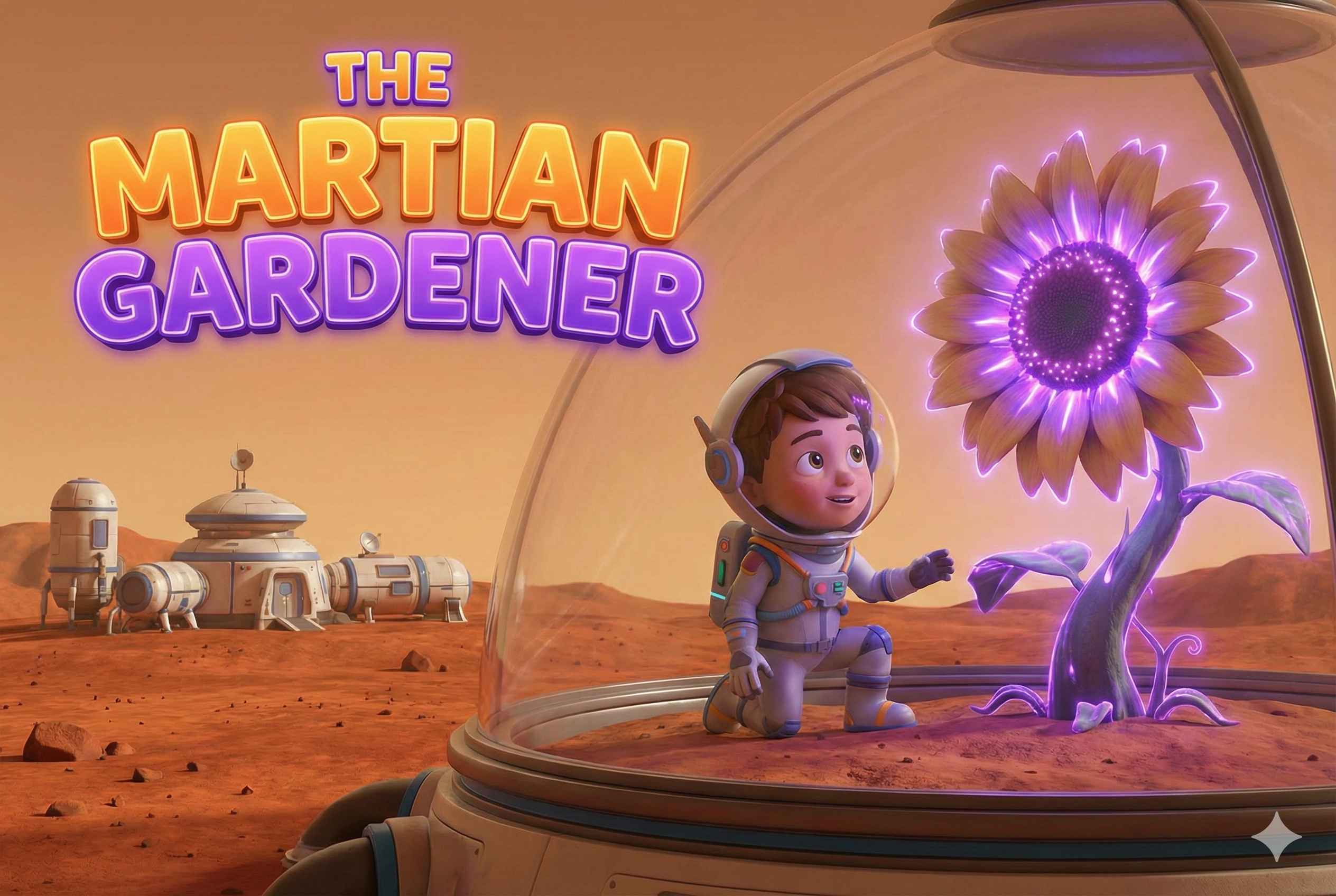
It sounded like a choir of bees humming in perfect harmony. Leo crept closer. In the tub, three sprouts had pushed through the red dirt. But they weren’t green. They were a deep, glowing purple. And they were vibrating.
“Whoa,” Leo breathed.
The low gravity on Mars was doing something strange to them. By the next morning, they were a foot tall. By the end of the week, they were five feet tall, pressing against the glass skylight, their purple leaves pulsing with light.
Leo named them Alpha, Beta, and Gamma. They were beautiful, but they were getting too big to hide.
The Storm
On Tuesday, the klaxons blared.
“WARNING. DUST STORM IMMINENT. SECTOR 4 INTEGRITY COMPROMISED.”
The entire station shook as a massive wall of red dust hammered the colony. The lights flickered and died, plunging the station into emergency red mode.
“Everyone to the Central Hub!” Commander Higgins shouted over the intercom. “The main oxygen scrubbers are clogged with dust! We are losing air pressure!”
Leo’s heart stopped. Sector 4. His garden.
While everyone ran toward the center of the station, Leo sprinted the other way. He had to save them.
He reached the door to Sector 4, but it was jammed. Through the small window, he saw a terrifying sight. A crack had formed in the outer skylight. The deadly Martian atmosphere was leaking in. The cold should have frozen the plants instantly. The lack of air should have killed them.
But Alpha, Beta, and Gamma weren’t dying.
They were glowing brighter than ever. As the carbon dioxide flooded the room, the purple sunflowers opened their massive heads. They weren’t just absorbing the bad air; they were eating it.
Thump-thump. Thump-thump.
The plants pulsed like giant hearts.
Suddenly, his dad and Commander Higgins grabbed Leo from behind. “Leo! What are you doing? We have to—”
Commander Higgins stopped. He looked through the window. “What… in the name of NASA… is that?”
“Check the air sensors!” Leo shouted. “Look at the oxygen levels in that room!”
Dr. Miller tapped his wrist computer. His eyes went wide. “Commander… the oxygen levels in Sector 4 are off the charts. It’s 300% purer than our recycled air. Those things are scrubbing the CO2 faster than the machines ever could!”
“The crack in the window!” Higgins pointed. “They’re sealing it!”
It was true. The thick, purple vines of the sunflowers were growing visibly fast, weaving together like a living net, plugging the crack in the glass and holding the storm back. The plants were fighting for their survival—and for Leo’s.
The New Mars
The storm lasted twelve hours. The machines failed, but the air in the colony stayed fresh, pumped in from the glowing jungle in Sector 4.
When the dust finally settled, the door was pried open. The sunflowers had withered, turning gray and brittle. They had used all their energy to save the ship.
Leo touched a dry leaf, tears stinging his eyes. “I’m sorry,” he whispered.
“Don’t be,” Commander Higgins said, stepping up beside him. He wasn’t angry. He looked amazed. He reached into the center of the dead flower head and plucked out a single seed.
It wasn’t black and white like an Earth seed. It was glowing soft purple.
“You didn’t just grow a flower, son,” the Commander said, handing the seed to Leo. “You forced evolution. You created the first plant that can survive on Mars.”
Leo looked at the glowing seed in his palm. He thought of his grandma’s garden in Oregon. It was beautiful, sure. But this? This was the future.
“Dad,” Leo smiled, wiping the dust off his face. “I think I’m going to need a bigger pot.”
Science Fact Check (for the Kids):
- Regolith: That’s the fancy name for the loose dust and rock covering Mars.
- Perchlorates: Real toxic chemicals found in Martian soil that would make it hard for Earth plants to grow unless we washed the soil first!
- Gravity: Mars has only 38% of Earth’s gravity, which might actually allow plants to grow much taller than they do on Earth!

The Kids Science Magazine Editorial Team brings together nearly a decade of hands-on experience in electronics engineering, IoT systems, and embedded technology — combined with a deep passion for making complex science genuinely exciting for young minds. Our writers have worked across core electronics testing and real-world technology development, giving every science mystery article a foundation in actual engineering thinking rather than surface-level storytelling. We believe every child deserves access to mind-blowing science — explained clearly, honestly, and in a way that makes them lean forward and ask “but wait, WHY?” Every mystery published on this site is thoroughly researched, fact-checked against credible scientific sources, and written to spark curiosity in kids aged 8–14 across the USA, UK, Canada, Australia & Others across the Globe. New mystery every Friday — because science never runs out of surprises.