Discover why the sky changes colors during sunset. Easy explanation of light scattering, wavelengths, and sunset colors for kids. Includes fun facts, quiz, and simple experiment.
The Amazing Science of Light Scattering!
Have you ever watched the sky turn pink, orange, purple, or even golden in the evening?
It feels like the whole sky is painting itself just for you! 🎨🌈
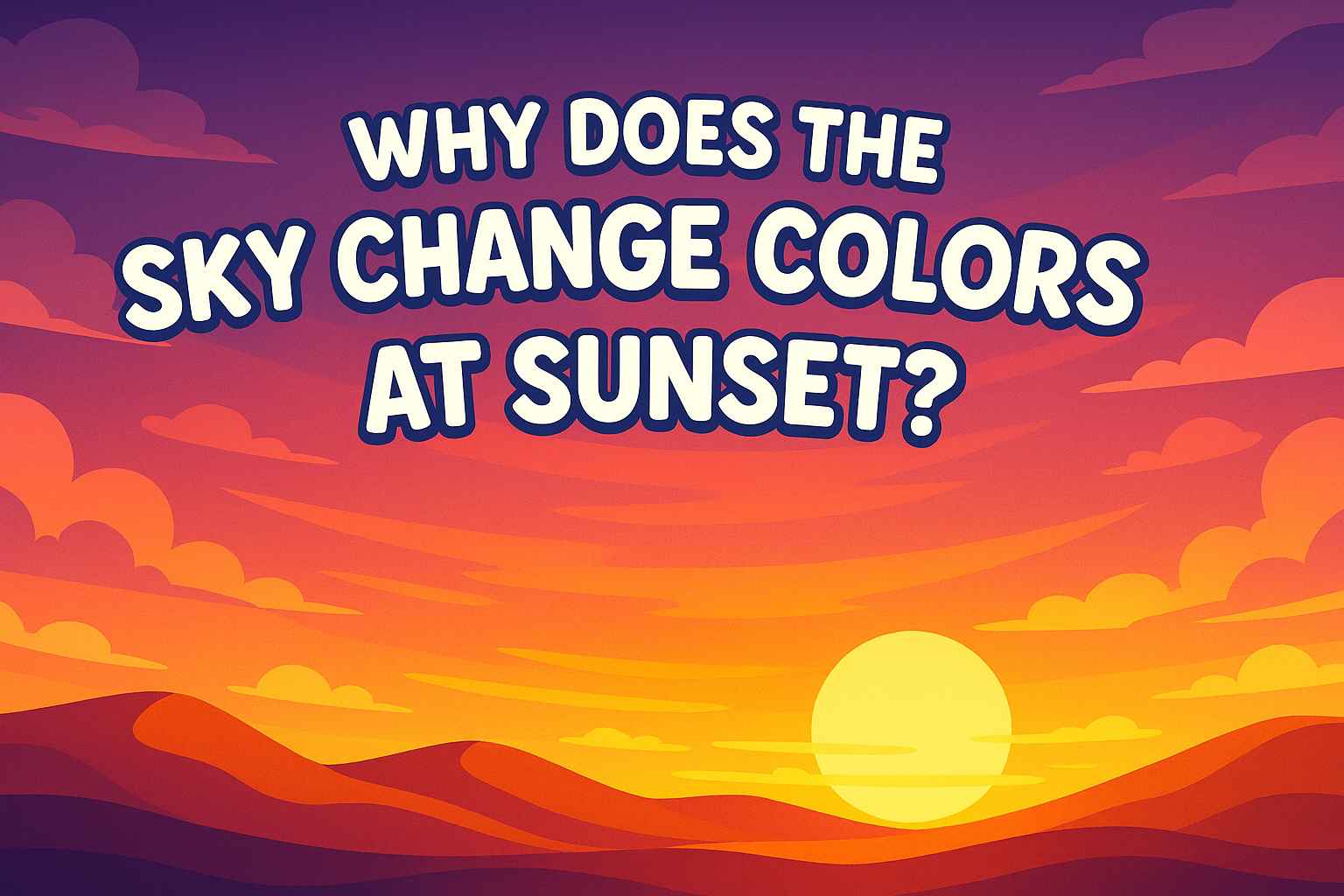
But why does the sky change colors at sunset?
Let’s explore the beautiful science behind this everyday magic!
☀️ Light Isn’t Just Yellow — It’s a Rainbow!
Sunlight may look white or yellow, but it is actually made of many colors mixed together — like red, orange, yellow, green, blue, and purple.
This rainbow of colors is called the visible spectrum.
Each color has a different wavelength:
- Blue & violet = short wavelengths
- Red & orange = long wavelengths
The sky’s color changes depend on how these wavelengths behave!
💨 What Is Light Scattering?
When sunlight enters Earth’s atmosphere, it bumps into:
- air molecules
- dust
- water vapor
- tiny particles
These bumps cause the light to scatter (spread around).
🌤️ During the day
The Sun is high in the sky.
Short wavelengths (blue) get scattered more easily, filling the whole sky with blue light — that’s why the sky looks blue!
🌅 What Happens at Sunset?
At sunset, the Sun moves lower on the horizon.
Now the sunlight has to travel a much longer path through the atmosphere to reach your eyes.
This long journey changes everything!
✨ Short colors disappear
Blue and violet light scatter away in all directions before reaching you.
🔥 Long colors survive
Red, orange, and yellow have longer wavelengths.
They don’t scatter as easily.
So these warm colors continue to travel toward your eyes.
And that’s why the sky glows with:
- Red 🔴
- Orange 🟠
- Pink 💗
- Purple 💜
- Gold ✨
Sunset colors are nature’s light show!
🌟 Why Do Sunsets Look Different on Different Days?
Not every sunset looks the same.
That’s because the atmosphere changes every day!
Sunsets become more colorful when:
- There’s dust in the air
- The weather is calm
- After a storm
- During pollution (not a good thing, but it does scatter colors!)
- After volcanic eruptions (they create amazing red sunsets!)
Clouds also act like mirrors, bouncing colorful light around the sky.
⭐ DO YOU KNOW?
- Sunsets on Mars are blue instead of red!
- Astronauts on the International Space Station see 16 sunsets every day because they orbit Earth so fast!
- Animals like birds and insects can see more colors in the sky than humans can.
🤯 FUN SCIENCE FACTS!
✨ The same scattering that makes sunsets colorful also makes sunrises beautiful!
✨ Blue light gets scattered 10 times more than red light.
✨ On very clean air days, sunsets look calmer. On dusty days, they look more dramatic.
🎯 QUIZ TIME! (Test Your Sunset Skills!)
1️⃣ Why does the sky look blue during the day?
a) Water in the air
b) Blue light scatters most
c) Sun turns blue
Answer: b
2️⃣ What colors reach your eyes at sunset?
a) Long wavelengths (red/orange)
b) Short wavelengths (blue/purple)
c) Black
Answer: a
3️⃣ Why do sunsets change every day?
a) The Sun changes shape
b) Atmosphere conditions change
c) The Moon controls it
Answer: b
🧪 TRY THIS!
Make Your Own Sunset in a Glass 🌅🥛
You need:
- A clear glass
- Water
- Milk
Steps:
- Fill the glass with water.
- Add a few drops of milk.
- Shine a flashlight through the glass.
- Look from the side or bottom.
You’ll see the water turning blueish at first, and orange/red when the light travels through more milk — just like a real sunset!
🌠 Encouragement to Explore
Tonight, step outside and watch the sky change colors.
Try naming the shades you see — peach, gold, lavender, coral, tangerine… 🍑✨
Every sunset is a reminder that science can be beautiful, and beauty can be scientific!
Keep looking up — there’s so much more to discover! 🌎💫

The Kids Science Magazine Editorial Team brings together nearly a decade of hands-on experience in electronics engineering, IoT systems, and embedded technology — combined with a deep passion for making complex science genuinely exciting for young minds. Our writers have worked across core electronics testing and real-world technology development, giving every science mystery article a foundation in actual engineering thinking rather than surface-level storytelling. We believe every child deserves access to mind-blowing science — explained clearly, honestly, and in a way that makes them lean forward and ask “but wait, WHY?” Every mystery published on this site is thoroughly researched, fact-checked against credible scientific sources, and written to spark curiosity in kids aged 8–14 across the USA, UK, Canada, Australia & Others across the Globe. New mystery every Friday — because science never runs out of surprises.