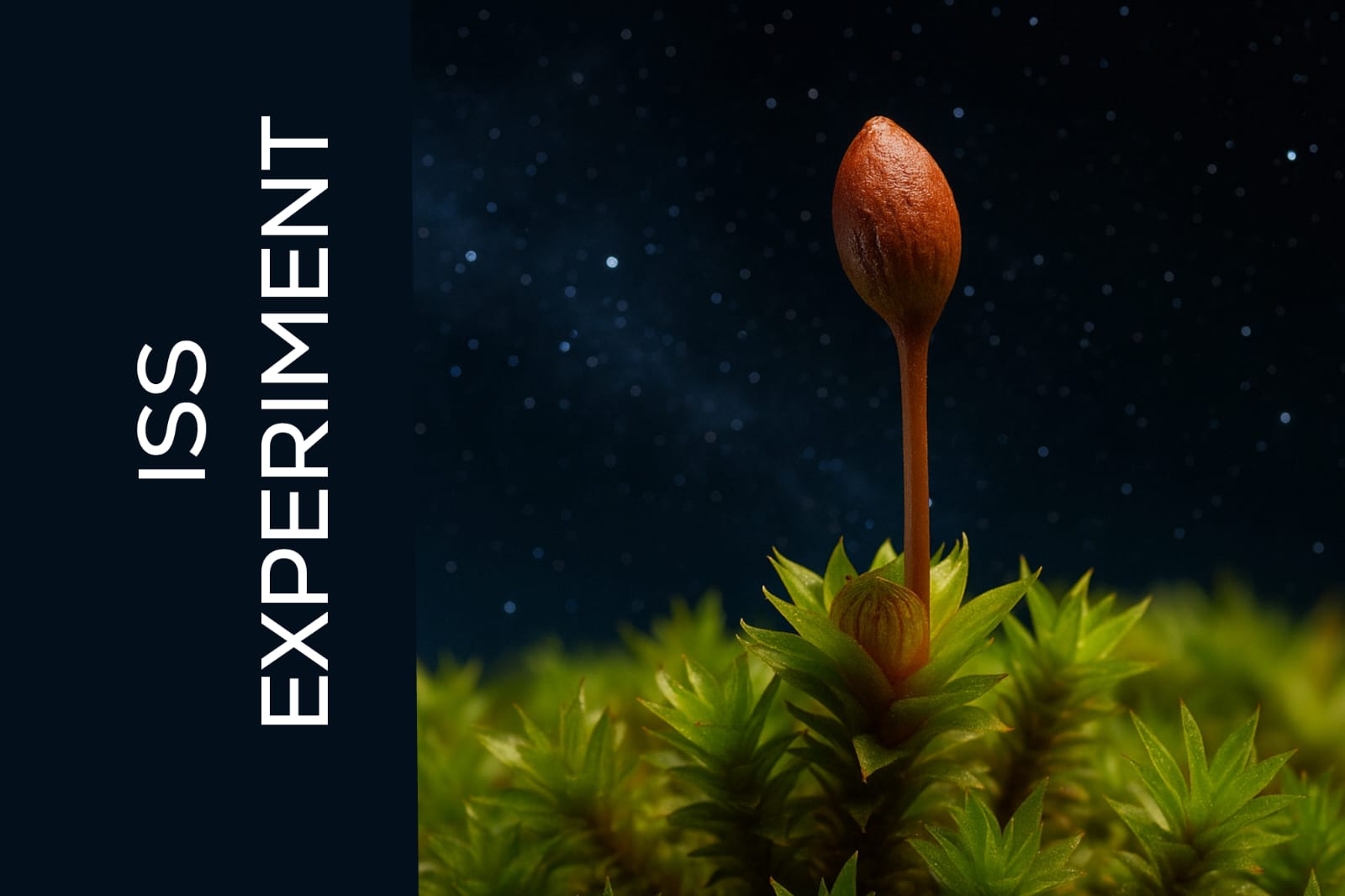
Scientists discovered that moss spores can survive nine months in the vacuum of space and still grow back on Earth! In this exciting kids’ science story, find out how these tiny plants endured harsh UV, freezing temperatures, and life outside the ISS.
A surprising discovery about one of Earth’s toughest plants
What’s the toughest living thing you can imagine?
A polar bear in Antarctica?
A camel in the desert?
A tardigrade floating in space?
Guess what — scientists have now found something even stranger:
Tiny moss spores that survived nine whole months outside the International Space Station… and kept growing when they came back to Earth!
This is the first time scientists have ever shown that an early land plant can survive the harsh, airless, freezing vacuum of outer space.
Let’s uncover this incredible story!
🚀 The Incredible Journey of the Space Moss
Mosses are tiny plants that grow in forests, on rocks, in the Arctic, in the desert — basically anywhere.
But scientists wondered:
“If moss can survive Earth’s toughest environments, can it survive space?”
To find out, researchers collected special structures called sporophytes, which look like tiny capsules on the moss plant. Inside each capsule are hundreds of spores — tiny cells that can grow into new moss plants.
These sporophytes were sent to the International Space Station (ISS) in 2022.
Astronauts mounted them on the outside of the station, exposing them to:
- ⚡ Extreme ultraviolet radiation
- ❄ Freezing cold temperatures
- 🔥 Sudden heat
- 🌀 Microgravity
- 🌌 The total vacuum of space
For 283 days — almost 9 months — they stayed there with no protection.
Scientists expected them to be completely dead.
But nature had a surprise.
🌌 More Than 80% Survived Space!
When the moss spores came back to Earth in early 2023, researchers were stunned:
✨ More than 80% were still alive.
✨ Many germinated into healthy new moss plants.
✨ Their chlorophyll levels were almost normal.
Only one pigment, chlorophyll a, dropped by 20% — but the spores still grew fine.
Lead researcher Tomomichi Fujita said:
“Most living organisms, including humans, cannot survive even briefly in space. But these moss spores retained their vitality after nine months. We were astonished.”
🛡 What Makes Moss Spores So Tough?
Scientists tested three forms of moss:
- 🌿 Young moss (protonemata) — didn’t survive UV or temperature extremes
- 🧬 Brood cells — survived some conditions but not others
- 🌱 Sporophytes (spores inside capsules) — survived almost everything
Why were spores the champions?
Because they are wrapped in a super-strong natural shell that:
- Blocks dangerous UV light
- Protects delicate inner cells
- Acts like nature’s tiny space suit
- May have helped ancient mosses survive 500 million years of harsh environments
It’s possible these protective coats helped early plants move from water to land during Earth’s ancient past.
🛰 A Space Experiment With Big Meaning
The moss spores were launched aboard Cygnus NG-17, lived outside the ISS, and returned on SpaceX CRS-16.
Back in the lab, scientists made another surprising discovery:
🧮 A mathematical model suggests spores might survive up to 15 years in similar space conditions!
This means life from Earth can last a long time beyond Earth — raising new scientific questions about astrobiology, the origins of life, and even the idea of life traveling between planets.
🌙 Could Moss Help Us Grow Food on the Moon or Mars?
Here’s the exciting part.
If moss spores can survive:
- Vacuum
- Radiation
- Extreme temperatures
…then moss might become one of the first plants we use to grow biological systems on other worlds.
Scientists think moss could help:
- Prepare extraterrestrial soil
- Produce oxygen
- Support early ecosystems
- Become part of off-world farming experiments
As Fujita says:
“I hope our moss research will be the starting point for building ecosystems in places like the Moon or Mars.”
🌟 Fun Science Facts: Space Moss Edition
- Mosses are among the oldest land plants on Earth.
- Some mosses can dry out completely and come back to life when watered.
- Moss spores are so tough they’ve survived Earth’s mass extinction events.
- Space is full of UV radiation — 1,000 times stronger than what moss gets on Earth.
- This study is the first to show an early land plant surviving so long in space.

The Kids Science Magazine Editorial Team brings together nearly a decade of hands-on experience in electronics engineering, IoT systems, and embedded technology — combined with a deep passion for making complex science genuinely exciting for young minds. Our writers have worked across core electronics testing and real-world technology development, giving every science mystery article a foundation in actual engineering thinking rather than surface-level storytelling. We believe every child deserves access to mind-blowing science — explained clearly, honestly, and in a way that makes them lean forward and ask “but wait, WHY?” Every mystery published on this site is thoroughly researched, fact-checked against credible scientific sources, and written to spark curiosity in kids aged 8–14 across the USA, UK, Canada, Australia & Others across the Globe. New mystery every Friday — because science never runs out of surprises.